A Better Roof Inspection Report Template
By Sunrise Roofers LLC · Nov 11, 2025 · 11-17 min read
A good roof inspection report template isn't just another piece of paperwork. It's a fundamental tool that builds trust with clients, cuts down on your liability, and standardizes how your team works. It makes sure every detail—from minor granule loss to major flashing failures—gets documented the same way, every time.
Why Your Report Template Is a Critical Business Tool
Stop thinking of your report as just a document and start seeing it as a core business asset. A scribbled, vague note on an invoice leaves far too much open to interpretation and looks amateur. On the other hand, a detailed report broken down into clear sections provides undeniable proof of your findings. That kind of clarity is priceless when dealing with insurance claims or real estate sales.
It’s the difference between a client second-guessing your work and seeing you as the definitive expert.
This level of professionalism is what separates you from the competition. The global market for roof inspection services was valued at around $5 billion in 2025 and is expected to hit $19.5 billion by 2033. What’s driving that growth? More people are finally understanding the value of preventative maintenance, and severe weather events are becoming more common. This makes your documentation more critical than ever.
Building Trust and Streamlining Operations
A solid template creates a repeatable, standardized process. Every inspector on your team follows the same checklist, looks at the same components, and records their findings uniformly. That consistency is how you build a reliable brand.
When a homeowner gets a report that’s easy to read, visually organized, and packed with clear photos, their confidence in your company skyrockets. This infographic really nails the core value a great report delivers.
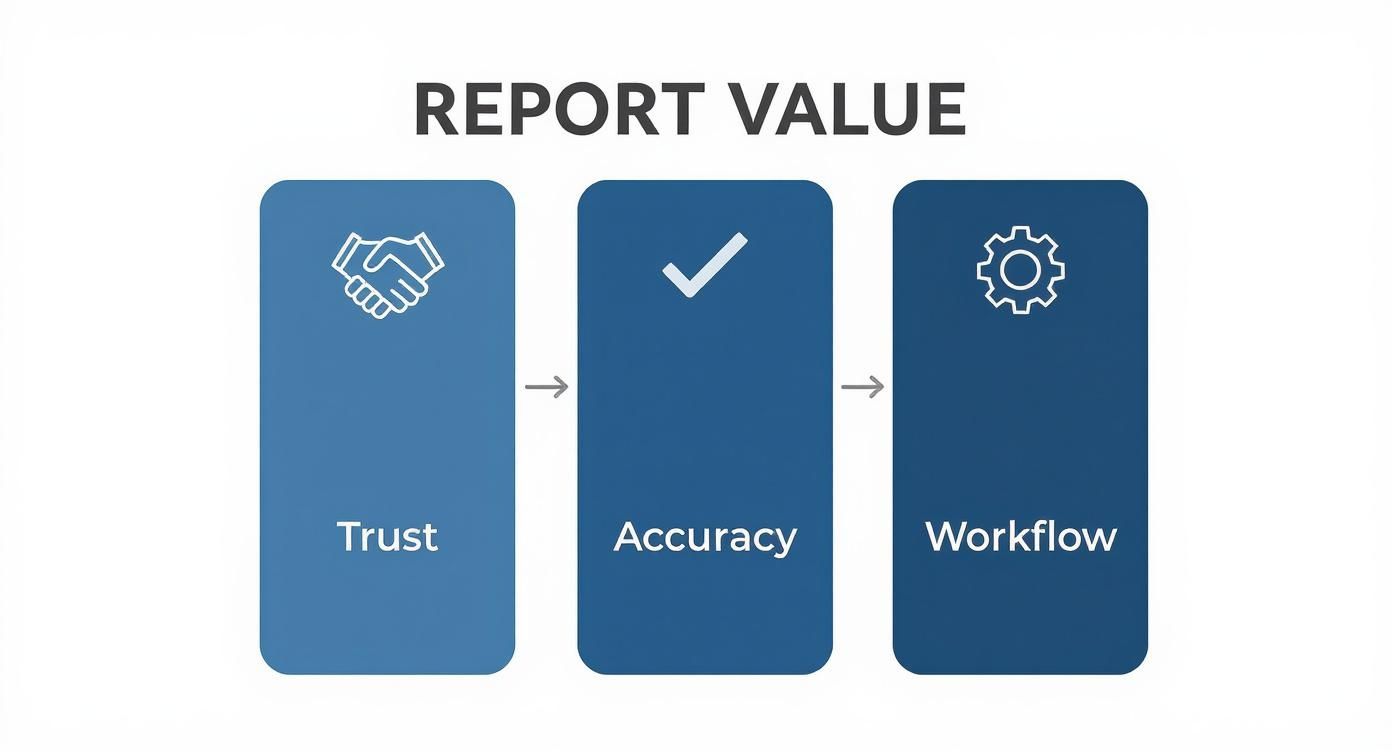
As you can see, those three pillars—trust, accuracy, and workflow—are all directly supported by a quality template.
A great report doesn't just list problems; it tells a clear story about the roof's condition. It’s your best tool for communication, risk management, and demonstrating a high level of expertise that sets you apart.
Ultimately, this document is your primary risk management tool. By meticulously documenting the roof's condition before you start work, you protect your business from future arguments about what damage was already there. It's a simple but incredibly powerful way to protect your reputation and your bottom line. For homeowners in Southern Arizona, understanding why you should choose a reliable local roofer is the first step toward getting this kind of quality and accountability.
The Anatomy of a High-Impact Roof Report
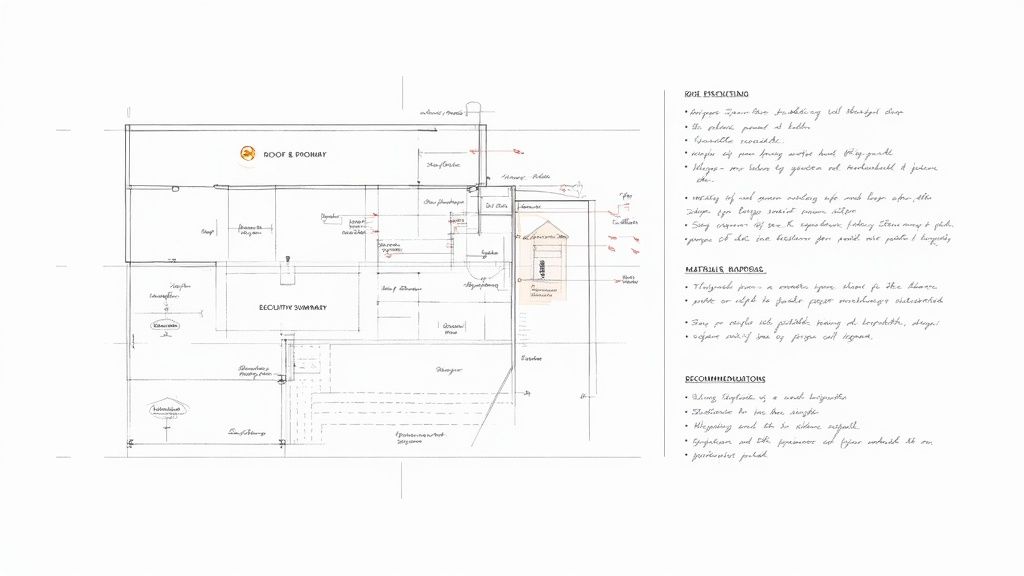 A good roof inspection report does more than just list problems; it tells the complete story of a roof's condition. Forget simple checklists. A high-impact report is structured so anyone—from a first-time homeowner to a seasoned insurance adjuster—can immediately grasp the findings and understand what needs to happen next.
It all starts with the basics: client details, property address, inspection date, and even the weather conditions on that day. But from there, a professional report dives much deeper, turning simple observations into a powerful communication tool.
The Non-Negotiable Core Sections
Every solid report is built around a few crucial sections. These are the chapters in the roof's story, giving structure to your findings and making them easy to follow. A vague, disorganized report just creates confusion. A well-structured one builds trust.
Here’s a look at what every professional roof report template should contain. These sections are non-negotiable for providing a clear, comprehensive picture of the roof's health.
Essential Sections of a Professional Roof Report Template
| Section Name | Purpose | Key Details to Include |
|---|---|---|
| Executive Summary | A high-level overview of the roof's condition. It's often the only part a busy client reads. | Overall condition (e.g., "Good," "Fair," "Poor"), major concerns, and a summary of key recommendations. |
| Detailed Findings by Area | To break down the inspection into manageable zones for clarity. | Document the condition of shingles, underlayment, and decking for each slope (e.g., North, South) with annotated photos. |
| Component-Specific Assessments | To assess individual systems like flashing, vents, and chimneys. | Note the integrity, installation quality, and signs of wear for each component. |
| Interior and Attic Inspection | To check for evidence of problems from the inside out. A roof inspection isn't complete without this. | Document signs of water intrusion, staining, poor ventilation, or structural issues visible from the attic. |
Putting this structure in place ensures all critical information is captured logically, making it easier for the client to understand and for you to justify your recommendations.
From Vague Notes to Actionable Insights
The real value is in the details. Vague notes create doubt, but specific, evidence-backed language builds confidence and justifies your proposed work. This is where your expertise shines.
Just look at the difference:
- Vague: "Some shingles are bad."
- Precise: "10-15 asphalt shingles on the west-facing slope exhibit significant granule loss and curling edges, consistent with advanced age and sun exposure."
A detailed report is your best defense against liability and your strongest sales tool. By providing clear, photographic evidence for every finding, you remove ambiguity and empower the client to make informed decisions.
This level of detail is more critical than ever. With nearly 99,000 roofing businesses in the U.S., homeowners have a lot of choices. Clear, professional reporting sets you apart. The industry is also seeing a big push for energy-efficient solutions, which means reports need to be more thorough to address these modern demands. You can read more about the growth of the roofing industry and its trends on prestigerootingllc.com.
Ultimately, a strong report makes your job easier. It creates a clear roadmap for repairs and gives the client a tangible document they can rely on. To see how this detailed approach translates into high-quality finished work, check out our gallery of completed roofing projects.
Using Technology to Upgrade Your Inspections
The days of just a ladder and a good eye are over. Modern tools are turning roof inspections from a simple visual check into a detailed, data-driven analysis. It’s a huge shift.
When you bring this kind of tech into your roof inspection report template, you’re giving clients and insurance adjusters a level of detail they can’t argue with. It shows you’re thorough and professional.
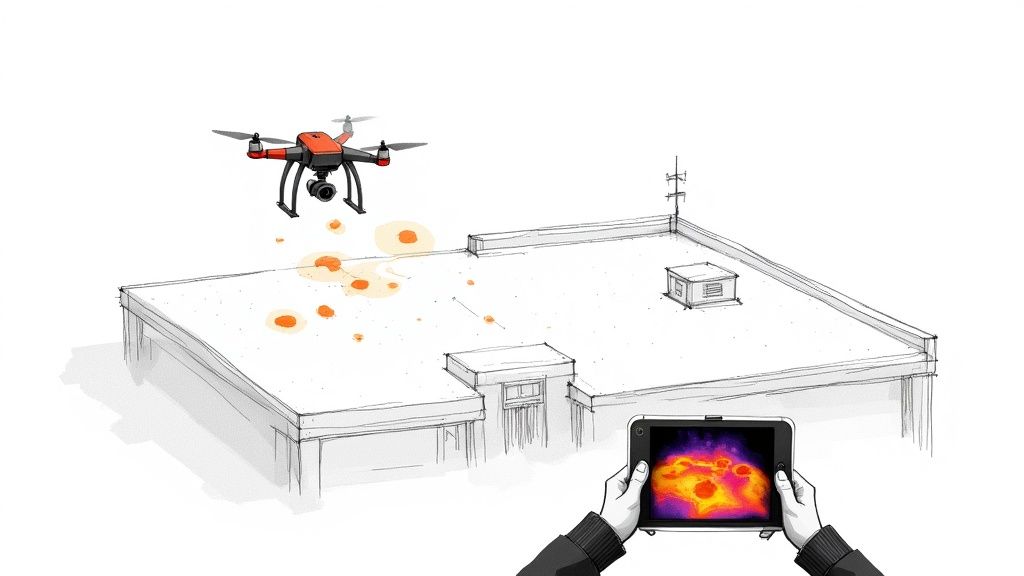
Drones, especially, have completely changed the game. They give you immediate, safe access to steep, complex, or sketchy roof surfaces without putting anyone at risk. Plus, the high-resolution cameras they carry capture crystal-clear images of every last shingle, tile, and seam.
Drones Deliver Deeper Insights
Picture this: you're inspecting a massive commercial flat roof. A traditional walk-through could take hours, tie up multiple crew members, and you might still miss something subtle. A drone survey, on the other hand, can cover that same area in a tiny fraction of the time, building a complete photographic record from every conceivable angle.
The data you get is just flat-out better. Drones can carry different kinds of sensors, and that’s where things get interesting.
- Thermal Cameras: These are your secret weapon for finding hidden moisture trapped under the roof's surface. A thermal map shows temperature differences that scream "water intrusion"—a problem that's often totally invisible to the naked eye.
- High-Resolution Video: Shooting in 4K gives you a dynamic view of the entire roof. Back at the office, you can review the flight path, pause, and zoom in on potential trouble spots you might have missed in the field.
- Orthomosaic Mapping: This is some next-level stuff. The software stitches together hundreds of individual photos to create one giant, high-resolution, and fully measurable map of the entire roof.
This isn’t some future trend; it’s happening now. The drone roof inspection market is expected to jump from $231.6 million in 2025 to $889.2 million by 2035. The safety and efficiency benefits are just too big to ignore. You can explore the full market analysis from Fact.MR to see the numbers for yourself.
Packing your report with high-quality drone imagery and thermal data provides undeniable proof of the roof's condition. It turns your findings from an opinion into a documented, data-backed assessment that leaves zero room for debate.
How to Weave Tech into Your Report
The trick is making all this high-tech data easy for your client to understand. Your report template needs dedicated sections for this kind of evidence.
Don't just write "moisture detected." That's lazy.
Instead, include a side-by-side comparison showing a standard photo right next to a thermal image, with the problem area clearly circled or highlighted. It’s powerful.
For example, you could have a section called "Thermal Imaging Analysis." Under it, you'd place an image with a caption like, "The darker area on the thermal map shows moisture saturation below the membrane near the northwest corner drain." This visual proof does the selling for you. By combining advanced data with a clean, well-structured report, you deliver a truly comprehensive professional roof inspection that makes your service stand out.
Writing Findings That Are Clear and Actionable
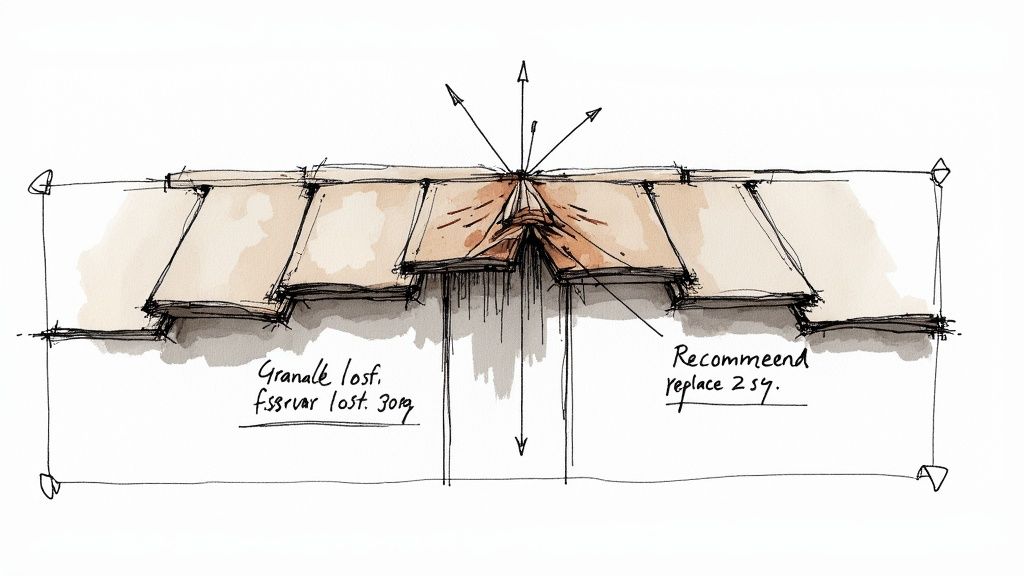
Once you're off the roof, the real work begins. A powerful report isn't just about checking boxes; it's about translating what you saw into clear, objective language that a homeowner, insurance adjuster, or realtor can immediately understand.
The goal is to eliminate confusion, not create it. We need to move away from vague, alarmist language and stick to professional, standardized terms. A client is far more likely to trust and act on a factual observation than a subjective opinion.
Use Objective Language and Standard Terminology
The words you choose carry a lot of weight. Using industry-standard terms shows you're a pro and ensures your findings are consistent and easily understood by other contractors or insurance adjusters who might see the report.
Think about it. "Shingles are bare" is an observation, but it’s sloppy. A much better description is "Significant granular loss observed on the south-facing slope." This terminology pinpoints the exact problem without exaggeration. This precision is critical, especially when detailing specific issues like those covered in our guide about why fixing broken roof tiles in Arizona is so vital.
Your report is an objective record of the roof's condition, not a high-pressure sales pitch. State the facts with precise, non-alarmist language and let the evidence speak for itself. This builds far more credibility than fear-based tactics ever will.
The Power of Annotated Photos
A picture might be worth a thousand words, but an annotated picture is worth half a report. High-quality, clearly labeled photos are non-negotiable. They are undeniable visual proof that leaves zero room for misinterpretation.
Don't just drop in a photo of a damaged vent. Take a moment to add simple annotations.
- Use arrows to point directly to cracks in the flashing sealant.
- Circle areas of hail impacts or significant granule loss.
- Add brief text overlays like "Deteriorated Pipe Boot Sealant."
This simple step transforms a generic photo into a powerful piece of evidence. It guides the reader's eye right to the problem, so they see exactly what you saw. This clarity saves you from endless follow-up questions and potential disputes.
From Vague to Valuable Descriptions
The difference between a helpful report and a useless one often boils down to the description. Vague statements create questions; precise descriptions provide answers. Let's look at how to turn weak notes into clear, actionable findings.
Report Description Comparison Good vs Bad Examples
This table shows the difference between scribbled, unclear notes and professional, fact-based descriptions. One creates confusion, the other builds trust.
| Issue | Vague Description (To Avoid) | Clear Description (To Use) |
|---|---|---|
| Flashing | The flashing looks bad. | Rusted step flashing is visible along the west-facing chimney stack, with a 1/4-inch gap between the flashing and the masonry. |
| Shingles | Some shingles are old and worn out. | Approximately 20-25 asphalt shingles on the north slope exhibit curling edges and widespread granule loss, indicating they are past their effective lifespan. |
| Gutters | Gutters are full of junk. | The gutter system is clogged with leaves and shingle granules, preventing proper drainage and causing water to overflow at the northeast corner. |
| Ventilation | Attic doesn't seem to breathe well. | The attic inspection revealed blocked soffit vents and inadequate exhaust ventilation, evidenced by moisture on the underside of the roof deck. |
By being specific—and quantitative where possible—you give the client the concrete information they need to understand the severity of the issue and make an informed decision. This is how you build a reputation for honesty and expertise.
Adapting Your Template for Different Scenarios
A generic roof inspection report template is a decent place to start, but the real pros know a one-size-fits-all approach just doesn't cut it. Every inspection has a different context, and if you don't adapt your report for the specific job, you risk delivering a document that completely misses your client's main concern.
Think of your base template as a flexible foundation, not a rigid script. You build on it depending on the property type and the reason someone called you in the first place. The details that matter on a residential shingle roof are worlds apart from what you need to document on a massive commercial flat roof.
Residential vs. Commercial Properties
The biggest pivot you’ll make is between residential and commercial inspections. Both demand a thorough eye, of course, but their components, priorities, and the language of the report are fundamentally different.
- Residential Focus: For homeowners, the report usually centers on shingles, tiles, underlayment, and flashing around chimneys and vents. They're worried about lifespan, leak prevention, and the condition of their gutters.
- Commercial Focus: A commercial report needs dedicated sections for things like parapet walls, HVAC curbs, big drainage systems like scuppers, and the membrane's integrity. The client here is usually a property manager focused on maintenance schedules and future capital expenses.
Showing up to a commercial job with a residential-focused template instantly makes you look unprepared and unprofessional. It signals you don't understand their world.
The most valuable report is one that speaks directly to the client's needs. A pre-purchase inspection should prioritize long-term costs, while an insurance claim report must zero in on evidence of acute, event-specific damage.
Tailoring the Report to the Client’s Goal
Beyond the building itself, the purpose of the inspection is your guiding star. The story your report tells has to align with what the client is trying to accomplish, whether that's buying a home, filing an insurance claim, or just planning routine maintenance.
A pre-purchase inspection, for instance, requires a totally different lens. Your focus sharpens on the roof's remaining lifespan, potential big-ticket costs looming on the horizon, and any defects that could kill the sale. For buyers in our area, understanding these specifics is crucial; you can see what they're looking for in this Tucson homebuyer roof inspection checklist.
On the flip side, a report for an insurance claim after a hailstorm needs to be laser-focused. You must meticulously document every single hail impact, wind-lifted shingle, and any other piece of evidence directly tied to that storm. Then you have routine maintenance reports, which will highlight preventative actions like clearing debris or sealing cracked pipe boots. Each scenario demands a unique focus to be genuinely helpful.
Common Questions We Hear in the Field
Even with the best template in your truck, real-world questions always pop up. Getting these details right is what separates a decent report from a great one that protects you and gives your client total clarity.
Here are a few of the most common things roofers ask us about.
What's the Best Software for Roof Inspection Reports?
This really comes down to your workflow. If you're just starting out, you can absolutely get the job done with tools you already have, like Google Docs, Microsoft Word, or a fillable PDF. They’re flexible and don't cost you anything extra.
But once you’re running multiple jobs, dedicated roofing software is the only way to go. Platforms like CompanyCam, JobNimbus, or AccuLynx are built for this. They don't just generate reports; they tie everything together—photos, client notes, billing, and project management. It saves a massive amount of admin time by keeping all your job data in one spot.
How Many Photos Should I Include in the Report?
There’s no magic number here. The goal is to tell a complete, visual story of the roof's condition. You want enough photos to be thorough, but not so many that you overwhelm the client.
A good rule of thumb is to start with overview shots of each slope, then zoom in with detailed close-ups of every single issue you find—cracked flashing, damaged shingles, you name it.
It's also a smart move to include photos of key components that are in good shape. This shows you did a comprehensive inspection and gives the homeowner a complete picture.
A great report leaves no room for doubt. Each photo should be high-resolution and clearly annotated with arrows or circles to pinpoint the exact problem. You're turning a simple image into undeniable evidence.
For a standard residential roof, you might end up with 20-50 well-documented photos. A big commercial job could easily top a hundred. Focus on quality and clarity, not just quantity.
Can a Homeowner Use a Template for a DIY Inspection?
Sure, a homeowner can use a checklist to do a walk-around and spot obvious issues from the ground. It’s a decent way for them to keep an eye on things between professional check-ups.
But it’s absolutely not a substitute for a professional inspection. We're trained to spot the subtle signs of wear and tear that lead to big problems, we know the local building codes, and we know how to get on and off a roof safely.
A DIY check is fine for routine maintenance. But for anything involving an insurance claim, a home sale, or tracking down a leak, you need a report from a certified, insured professional. It’s about accuracy, safety, and liability.
For a professional, photo-documented inspection that leaves no stone unturned, trust the experts at Sunrise Roofers LLC. Our team provides the detailed reports you need to make informed decisions about your property. Visit us at https://roofwithsunrise.com to schedule your inspection today.
Need roofing services in Tucson? Request a free inspection or call 520-753-1758. Related pages: Roof Repair · Roof Replacement · Service Areas.
Published by Sunrise Roofers LLC
Licensed & Insured Roofing Contractor · Tucson, AZ