What Is Modified Bitumen Roofing A Complete Guide
By Sunrise Roofers LLC · Dec 15, 2025 · 15-23 min read
Modified bitumen is the workhorse of flat and low-slope roofs. At its core it's asphalt — the same waterproofing folks have trusted for a century — but blended with polymers that make it tougher and a lot more flexible. Old reliability, newer chemistry. That's the short version.
Decoding This High-Performance Roofing System
Start with the waterproofing power of asphalt. Now add either the stretch of rubber or the toughness of plastic. That's modified bitumen in a nutshell. It got its start in Europe in the 1960s, crossed over to the U.S. in the 70s, and it's been covering commercial roofs ever since.
This is not a bucket of tar smeared on your deck. It's an engineered, multi-ply membrane, and the "modified" part comes from the polymers mixed into the asphalt. Those polymers change how the whole thing behaves. The result holds up far better than the old built-up roofing (BUR) systems we used to install years ago.
The Power of Polymer Modification
Two polymers do the heavy lifting here, and they give the roof very different personalities:
- SBS (Styrene-Butadiene-Styrene): Think rubber. Mix it into asphalt and you get a membrane that stretches and snaps back. When the temperature swings hard — and out here it does — an SBS roof moves with the building instead of cracking. Great for climates that can't make up their mind.
- APP (Atactic Polypropylene): Think tough plastic. It raises the melting point and gives you a harder, more rigid surface. That makes APP a brute against UV and brutal heat, which is most of what we deal with around Tucson.
At its heart, modified bitumen roofing is a factory-engineered solution that takes the guesswork out of flat roofing. By blending asphalt with powerful polymers, it creates a robust, tear-resistant membrane that stands up to foot traffic, ponding water, and harsh weather.
Having SBS and APP to choose from means a roofer can match the membrane to your actual building and your actual climate instead of one-size-fits-all. If you own a flat-roofed property in Tucson and you're weighing your options, knowing the difference is where it all starts before you plan a new roof installation. The rest of this guide fills in the gaps.
Deconstructing The Layers Of a Modified Bitumen Roof
Want to understand why this stuff is so tough? Look at how it goes together. A modified bitumen roof isn't one sheet of anything. It's a stack of layers, each doing a job, and together they make a waterproof barrier that holds up for the long haul.
It all sits on a solid base. Usually that's an insulation board, and it does the thermal work. In Tucson that matters both directions — it keeps the worst of the summer heat from cooking the inside of your building, and holds a little warmth in on those cold desert nights. Your power bill notices.
The Core Waterproofing Layers
On top of the insulation goes the base sheet. This is your first real barrier against water, and it anchors everything above it. We fasten it down or adhere it straight to the deck, and right away you've got a waterproof layer.
On a lot of roofs we add an inter-ply membrane too. It's not always required. But that extra layer makes a real difference for puncture resistance, and it gives you a backup if the top ever gets nicked. Anytime a roof sees regular foot traffic — say, an HVAC crew up there twice a year — we think it's worth it.
Think of it this way: the base sheet is the primary waterproof seal, and any additional plies are backups. If one layer were ever punctured, the others are right there to make sure the building stays completely dry. This multi-layer philosophy is a big reason why modified bitumen has earned such a trusted reputation over the decades.
The Weather-Facing Cap Sheet
Then there's the layer you actually see — the cap sheet. This is the tough one. It's built to take a beating, day in and day out: UV, monsoon downpours, hail, whatever lands on it. Everything underneath stays protected because this layer eats the abuse.
The cap sheet is soaked in that same polymer-modified asphalt, SBS or APP, and the top is packed with ceramic-coated mineral granules. Those granules earn their keep two ways:
- UV Protection: They're basically built-in sunblock. In a place that gets as much sun as we do, that's the whole ballgame — they keep the sun from frying the asphalt underneath.
- Fire Resistance: They also earn the roof a Class A fire rating, the top mark for standing up to fire coming from outside.
Here's how the whole stack fits together.
Anatomy of a Modified Bitumen Roofing System
The strength of this system is in how the pieces work together. Every layer has one job, and stacked up they make a single waterproof shield.
| Layer | Primary Material | Core Function |
|---|---|---|
| Insulation | Polyisocyanurate (ISO) or EPS insulation board | Provides thermal resistance, improving energy efficiency. |
| Base Sheet | Polymer-Modified Bitumen | Creates the foundational waterproof layer and anchors the system. |
| Inter-Ply Sheet | Polymer-Modified Bitumen | Adds a redundant waterproof layer and increases puncture resistance. |
| Cap Sheet | Granule-Surfaced Modified Bitumen | Provides the final weather-facing barrier with UV and fire protection. |
| Surfacing | Ceramic-Coated Mineral Granules | Reflects UV radiation, offers fire resistance, and adds durability. |
Stacked together, those layers act like one solid membrane — the kind that protects a building for decades.
The graphic below shows how plain asphalt gets boosted by the polymer modifiers into the material that actually goes on your roof.
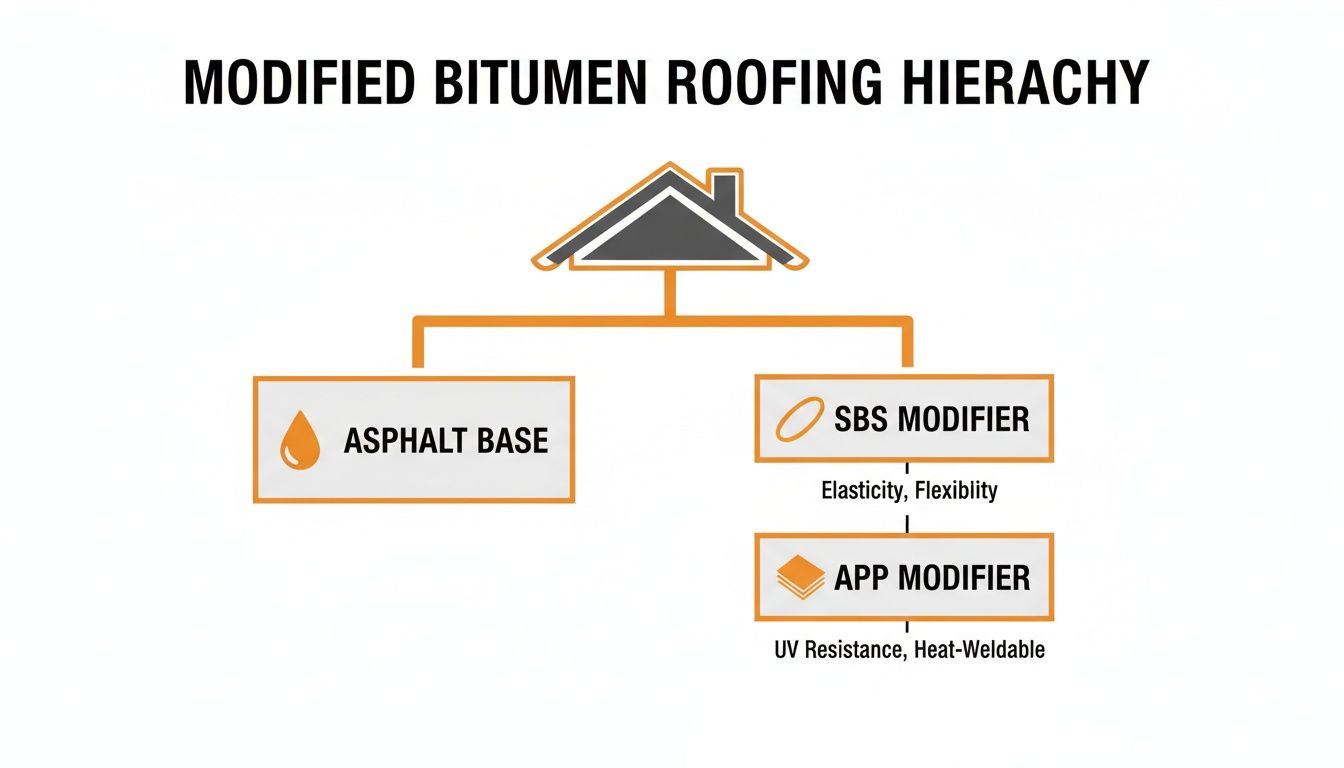
You can see it there — that asphalt base gets either the flexible SBS or the tough APP worked into it. Then every layer goes down carefully so the finished roof acts as one piece. Want to see what these look like once they're done? Take a look at our project gallery from jobs right here in Tucson. This layered build is the whole reason mod-bit is still a top pick for commercial and residential roofs alike.
Start shopping for a modified bitumen roof and you'll hit two acronyms fast: SBS and APP. Sounds technical. It isn't. The only real question is which polymer got mixed into the asphalt, and that one choice splits mod-bit into two formulas built for two different jobs.
Here's the shorthand. SBS (Styrene-Butadiene-Styrene) is the elastic rubber of the bunch. APP (Atactic Polypropylene) is the tough plastic. That single difference drives how the roof handles heat, cold, and people walking on it.
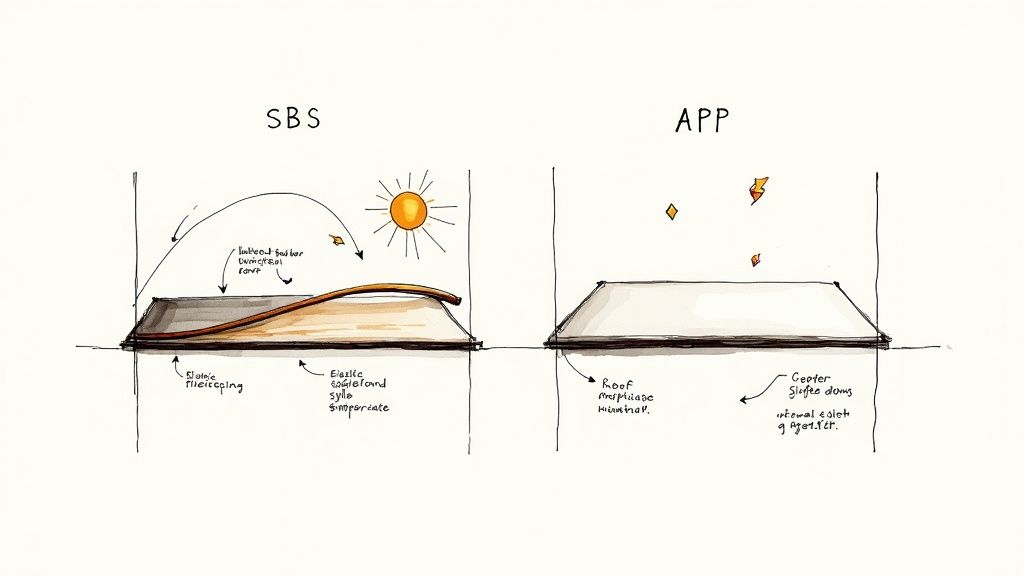
Figuring out which one fits your property starts right here.
SBS Modified Bitumen: The Flexible Champion
SBS is about give. Picture a good rubber band — pull it, let go, it bounces back to shape. That's what SBS polymers do for asphalt. The membrane can stretch and recover instead of staying stiff.
That matters most where the temperature won't sit still. Your building grows in the summer heat and shrinks on a cold desert night, and an SBS roof moves right along with it. So you get far fewer stress cracks, and the roof shrugs off that constant flexing year after year.
These polymer blends caught on in the back half of the 1900s because they ran circles around plain asphalt. No shock, then, that industry reports peg SBS at roughly 34% of modified bitumen revenue in 2025 — that's what happens when flexibility isn't optional. There's more on the modified bitumen market trends on FutureMarketInsights.com if you want the numbers.
An SBS roof is built to move. Its rubber-like composition lets it absorb the shock of building movement, hail impacts, and thermal cycling without losing its waterproof seal. It's a tough, resilient solution for the long haul.
APP Modified Bitumen: The Tough Protector
APP goes the other way. It behaves like a hard, rigid plastic. The polymer pushes the melting point way up and makes the membrane shrug off UV breakdown, which is exactly what you want when the sun never lets up — like it does here.
An SBS roof flexes. An APP roof just plants its feet. That hard, plastic-like surface fights off punctures, scuffs, and scrapes, and that's a real plus on any roof where crews are up there working on HVAC units or other equipment.
That high melting point also opens the door to one particular install method that's been around a long time.
How Chemistry Dictates Installation
The SBS-versus-APP thing isn't just trivia. It actually decides how the roof goes down, because the polymer steers which method seals things up best.
Here's how it usually shakes out:
- Torch-Down Application (Mostly for APP): The old-school way. A roofer runs a propane torch under the APP sheet as it rolls out, the bitumen melts, and it welds right to the deck — seams and all. APP's high melting point is what makes this work.
- Cold-Applied Adhesives (Common for SBS): No open flame here. Instead the layers get bonded together with roofing adhesives, which is why it's the call for buildings where fire's a worry — schools, hospitals, anything with wood framing.
- Self-Adhered Membranes (Common for SBS): Fast and safe. These are peel-and-stick — the adhesive's already on the back from the factory. Pull the liner, press the sheet down, run a heavy roller over it, done. Hardly any fumes, hardly any disruption to the building below.
So picking SBS or APP is a judgment call. Climate, how the building gets used, what the install actually involves — it all factors in. A good local roofer should sit down and walk you through all of that, then tell you straight which formula will hold up best on your building.
The Real Pros and Cons of a Modified Bitumen Roof
Every roof has trade-offs, and mod-bit is no different. It's a workhorse — we've trusted it on commercial and flat-roof jobs all over Tucson for years. But is it right for your building? That's the real question.
So let's lay out the upsides and the downsides honestly and see whether all that durability lines up with what you need and what you want to spend.
The Clear Advantages of Modified Bitumen
Why do most owners pick it? One word: tough. This isn't a flimsy single sheet. The multi-ply build gives you a thick membrane with backup baked in, and it just doesn't damage easily.
It's layered like armor. Nick the top and the base sheet and inter-ply are still down there keeping water out. For an owner, that's one less thing to lie awake about.
A few more reasons it earns its keep:
- Exceptional Puncture and Tear Resistance: Polymer-modified asphalt over a reinforced core means the membrane takes routine foot traffic — your HVAC crew up there twice a year won't hurt it.
- Proven Waterproofing Performance: This stuff has a track record going back more than 40 years. Install it right and the seams fuse into one continuous barrier that water can't find a way through.
- Weather Resilience: It's made for extremes. SBS rides out our desert temperature swings, and APP stands up to relentless UV, hail, and wind.
- Ease of Repair: A small puncture or tear is usually a quick fix for an experienced roofer. Patch it and you've bought years more life without a big bill.
A key takeaway is that modified bitumen is a workhorse system. It’s not the newest or flashiest option on the market, but its durability and reliable, long-term performance have made it a trusted standard in the roofing industry.
The Potential Drawbacks to Consider
No roof is perfect, and we're not going to pretend this one is. Mod-bit has a handful of downsides, and most of them trace back to how it's installed.
The big one is old-fashioned torch-down. You're running an open flame across a roof, and that takes a careful, skilled crew — the fire risk is real, not theoretical. It can also bump up a contractor's insurance, and that cost has a way of landing on the customer.
A few other things to know going in:
- Installation Fumes and Odors: Torch-down and hot-mop work kick up strong asphalt fumes while it's going down. They do clear out — but they're a real nuisance for tenants and the neighbors in the meantime.
- Heat Absorption: A plain black mod-bit roof drinks up solar heat. Out here, that shows up on your cooling bill. Easy fix, though — a reflective cool-roof coating knocks it right back.
- Surface Scuffing: The membrane's tough, but the granule surface can scuff if someone drags equipment across it. Mostly cosmetic. Worth knowing if your roof's in plain view.
- Weight: Being multi-ply, it's heavier than single-ply stuff like TPO or EPDM. We always check that the structure can carry the extra load before we commit to it.
Seeing it side by side helps.
Modified Bitumen Roofing: A Balanced View
| Advantages | Disadvantages |
|---|---|
| Superior Durability & Puncture Resistance | Installation Can Be Risky (Torch-Down) |
| Proven, Long-Term Waterproofing | Strong Odors During Installation |
| Excellent Performance in Extreme Weather | Dark Surfaces Absorb Heat (Unless Coated) |
| Relatively Easy and Inexpensive to Repair | Heavier Than Single-Ply Systems |
| Multi-Ply Redundancy for Peace of Mind | Granule Surface Can Scuff |
Look at both columns before you decide. That's how you make a good call.
Tough as it is, this roof isn't bulletproof. If you're seeing cracking spread out, blistering, or anything that looks like the roof's giving up, get a pro up there. A lot of the time a simple repair handles it. Here's more on knowing when you need real roof repair in Tucson over on our services page.
Modified Bitumen vs. TPO and EPDM Roofing
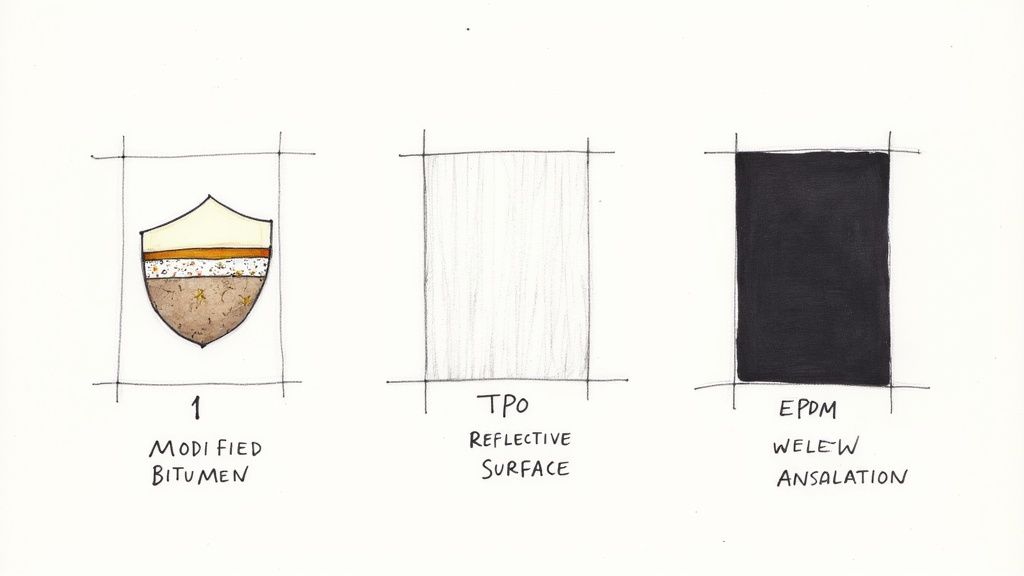
Mod-bit's a proven workhorse, sure, but it's got company on low-slope roofs. TPO and EPDM are both all over Tucson, and knowing how the three stack up is how you spend your money wisely.
Each one trades off toughness, energy savings, and cost a little differently. Let's run them head-to-head.
Durability and Puncture Resistance
This is where each system shows its true colors. Mod-bit's whole thing is those redundant plies. Gouge the top and there's still a tough base sheet under it keeping the water out — armor plating, basically.
Now TPO (Thermoplastic Polyolefin) and EPDM (Ethylene Propylene Diene Monomer) are single-ply. They're built tough, no question, but it's one layer. One dropped tool or a sharp chunk of debris can open up that spot.
- Modified Bitumen: Best puncture resistance, no contest. Those extra plies and the reinforced core make it the one to pick for roofs that take heavy foot traffic from HVAC crews.
- TPO: Plenty durable, and those heat-welded seams are seriously strong. But it's a single layer, so it's easier to puncture than its multi-ply cousin.
- EPDM: The "rubber roof." Flexible, but of the three it punctures the easiest. Its seams lean on adhesives and tapes, and those can give you trouble down the road.
If raw toughness against getting poked is what you care about, mod-bit wins this one outright.
The core difference comes down to layers. Modified bitumen is a multi-ply system built for redundancy, whereas TPO and EPDM are single-ply membranes that rely entirely on one layer for protection.
Energy Efficiency and Heat Reflection
In Tucson, how well a roof bounces the sun off is a huge piece of your cooling bill. And here the single-ply options flip the script — TPO especially.
A plain black mod-bit roof is a heat sponge, plain and simple. It waterproofs beautifully, but that dark surface gets blisteringly hot and shoves all that heat down into the building. It's a big enough deal that plenty of owners pay for a coating to fight it. We do exactly that — applying flat roof coating in Tucson can take a real bite out of what a building spends on cooling.
TPO, on the other hand, usually comes in bright white for this very reason. That reflective surface throws the UV back at the sky instead of soaking it up. EPDM's traditionally black like mod-bit, though you can get it in white too — it's just less common and tends to cost more.
Installation Process and Lifespan
Each one goes down a different way, and that changes the price, the safety on site, and how long the job takes.
- Modified Bitumen: The most options — torch-down at the old end, then safer cold-applied adhesives, then modern peel-and-stick rolls. Installed right, you'll get 15-25 years.
- TPO: The membrane gets fastened down or adhered, then the seams are heat-welded with a hot-air gun into one continuous surface. A TPO roof usually runs 20-30 years.
- EPDM: Big rubber sheets, fully adhered or mechanically attached, seams sealed with special tapes and liquid adhesives. Figure 20-30 years out of it too.
Mostly it comes down to this: proven, rugged toughness on one side, modern energy savings on the other. TPO and EPDM perform great and they last a little longer. But mod-bit stays in the conversation because nothing beats it for raw toughness and a track record you can actually count on.
Understanding Lifespan, Cost, and Maintenance
A roof is real money, so the long-term numbers matter every bit as much as the specs. What makes mod-bit pencil out is the balance — fair upfront cost, serious durability, and upkeep that won't drain you. Know what's coming and you can budget for it and keep the building covered for years.
Expected Lifespan Of Your Roof
Put down right, a mod-bit roof gives you 15 to 25 years. That range isn't a shrug — a few things decide where you land in it. Number one is the install. Sloppy seams or lazy flashing work can cut a roof's life clean in half.
Climate's the other one. Around here the sun and UV are the real enemy, no contest. A roof with a good reflective cap sheet, or a cool-roof coating on top, will outlast a plain black one that just sits there baking. And then there's upkeep — that's what gets you all the way to 25 years instead of stopping short.
Budgeting for a Modified Bitumen System
Pricing a new mod-bit roof, you're generally in the $8 to $15 per square foot range. That's not just the rolls of material, either. It's the whole system — insulation, base sheets, the cap sheet, and all the flashing work that actually keeps water out.
What moves that number around?
- Roof Complexity: A big open roof is cheap to do. Pack it with pipes, vents, HVAC units, and skylights and now you're paying for a lot of slow, careful detail work.
- Existing Roof Condition: Tearing the old roof off — especially if the deck needs repairs once it's exposed — costs more than laying new material over a clean, solid surface.
- Installation Method: Torch-down carries different labor and insurance costs than the safer cold-applied or peel-and-stick systems.
The only way to get a truly reliable budget is to get a detailed, line-item estimate from a reputable local contractor. It eliminates surprises and ensures you know exactly where every dollar is going, from materials and labor to cleanup.
Proactive Maintenance Is Key
Mod-bit is tough, but it's not set-it-and-forget-it. Staying ahead of the upkeep is the single best thing you can do to wring every year out of the roof and keep little problems from blowing up into expensive ones.
We tell folks to have it looked at twice a year — spring and fall is the usual rhythm. A trained eye catches the early wear you'd walk right past. Curious what we're actually looking for up there? Our guide on roof inspections lays the whole thing out.
A solid maintenance check covers about this much:
- Clear Debris: Get the leaves, branches, and dirt off. And clear the drains and scuppers — that's the big one, since clogged drains are what leave water sitting up there.
- Inspect Seams and Flashings: This is where roofs fail. Run every seam edge and check the seals around every vent, pipe, and curb.
- Look for Blisters and Cracks: Spot any blisters (trapped air or moisture) or alligatoring (that cracked-up surface) and get them fixed before they start letting water through.
Answering Your Final Questions About Modified Bitumen
Got the basics down and still have questions? Good — you should. Here are straight answers to the stuff owners ask us most, so you can make the call with a clear head.
Can I Make a Modified Bitumen Roof Energy Efficient?
Yep, and it's one of the smarter dollars you can spend. The move is a reflective cool-roof coating. Sunscreen for your roof, basically — a white or light coating that throws the Tucson sun back instead of drinking it in.
That one step pulls double duty. It drops the surface temperature way down, so less heat sneaks into the building and your AC gets a break. And because the coating also blocks UV off the membrane, it tacks years onto the roof while it's at it.
Is This Roofing Only for Commercial Buildings?
Nope. It's a commercial workhorse, sure, but it's great on homes too — anywhere there's a flat or low-slope section. We put it on garages, covered patios, and modern additions all the time, the spots where a pitched roof just doesn't make sense.
On houses, the priority shifts to safety and keeping the mess down. So we usually reach for peel-and-stick or cold-process adhesives instead of a torch. No open flame means fewer fumes and a lot less risk around the home.
Key Takeaway: Modified bitumen is a versatile system that works just as well for a home's flat-roofed patio as it does for a large commercial warehouse. The installation method can be easily adapted to fit the needs and safety requirements of any project.
How Are Modified Bitumen Roofs Repaired?
Here's a nice thing about mod-bit: for a pro, most repairs are simple. Small puncture or tear? We clean the spot well and bond a patch of matching material over it with a roofing cement made for the job.
Bigger trouble, like a seam that's pulled apart, and we'll cut the failed section right out. Then a fresh piece of membrane goes in, fused tight to the existing roof so it's watertight for good. One thing that's not optional — the patch has to match the roof. SBS gets an SBS patch, every time.
What Are Signs My Modified Bitumen Roof Is Failing?
Knowing the warning signs can save you from a nasty leak down the line. These are the ones that say your roof's running out of road.
The usual red flags:
- Widespread Alligatoring: Cracks webbing out across the surface, looking for all the world like alligator hide.
- Numerous Blisters: Big or frequent bubbles mean moisture's gotten trapped between the layers. Dead giveaway.
- Granule Loss: Bald spots where the mineral surface has washed off leave raw asphalt sitting exposed.
- Failing Seams: The roll edges curling up, peeling back, or coming apart.
Seeing these — and leaks that keep coming back on top of them — and it's about time to start planning a full replacement.
If you're seeing these warning signs on your Tucson property, don't wait for the next monsoon season to find out how bad the damage is. Sunrise Roofers LLC brings 20+ years of roofing experience to diagnosing and solving flat roof problems. Contact us for an honest, photo-documented inspection and a clear, no-pressure estimate. Protect your investment by scheduling your free assessment today.
Need roofing services in Tucson? Request a free inspection or call 520-753-1758. Related pages: Roof Repair · Roof Replacement · Service Areas.
Published by Sunrise Roofers LLC
Licensed & Insured Roofing Contractor · Tucson, AZ