When to Replace Roof Shingles A Homeowner's Guide
By Sunrise Roofers LLC · Nov 2, 2025 · 15-23 min read
Most asphalt shingles carry a 20-30 year rating from the manufacturer. That's the best case, though, not a promise carved in stone. The honest answer to when to replace roof shingles comes down to your climate, how well the roof went on in the first place, and the signs it's flashing at you right now.
It's less about a date on a calendar and more about what the weather's been doing to it.
How Long Do Roof Shingles Really Last?
A shingle's lifespan is like the mileage sticker on a new car. Your results depend on where and how you drive it. For a roof, the "driving conditions" are brutal sun, monsoon winds, freezing nights, and how well the thing got put together to begin with. The box might promise three decades. Real life can cut that in half.
Get your head around that gap and you'll make a smarter call about the biggest shield on your house. A roof in a mild, easy climate might sail past 30 years. Another one, baking in desert sun or getting worked over by freeze-thaw, can start failing at year 15.
The Calendar vs. Reality
Too many homeowners decide it's time based on the roof's age alone. That's a mistake, and it can be a pricey one. A 15-year-old roof that's eaten fifteen years of direct sun and violent storms can be in way worse shape than a 25-year-old roof in a kinder climate. Age is a starting point. The actual condition tells you what's really going on.
That's why you learn to read the signs. A roof talks. The little tells, curling shingles, grit in the gutters, are it letting you know it's getting tired.
The worst thing you can do is wait for a leak to show up inside. By the time water's dripping into your living room, the decking, the insulation, even the structure underneath are usually already chewed up and expensive to fix.
Climate's Critical Role
Your climate is probably the single biggest thing deciding how long your roof lasts. Under ideal conditions an asphalt roof might give you 20 to 30 years. But in a high-UV place like the Southwest, that average can crater to around 14 years as the heat and sun keep grinding the shingles down.
Knowing what your climate does to a roof helps you set honest expectations. The table below sums up how different weather wears shingles out.
Quick Guide to Shingle Lifespan by Climate
| Climate Zone | Typical Lifespan for Asphalt Shingles | Key Contributing Factors |
|---|---|---|
| Hot & Sunny (Southwest) | 12-18 years | Intense UV radiation degrades asphalt, causing brittleness and cracking. Extreme heat accelerates aging. |
| Humid & Rainy (Southeast) | 18-25 years | Persistent moisture promotes algae and moss growth, which traps water and lifts shingle edges. |
| Cold & Icy (North/Midwest) | 20-30 years | The freeze-thaw cycle is the biggest enemy. Water seeps into cracks, freezes, expands, and widens the damage. |
| Mild & Temperate (Coastal) | 25-30+ years | Fewer extreme temperature swings and less intense UV exposure lead to a much longer, more predictable lifespan. |
So yeah, where you live matters a lot. Your roof is in a fight with the weather every day, and each climate throws a different punch at how long those shingles hold up.
Here's the quick rundown of how different weather goes after your roof:
- Hot & Sunny Climates: The UV is relentless. It bakes the asphalt right out of the shingle and leaves it brittle, cracked, and too stiff to flex.
- Humid & Rainy Areas: All that moisture feeds algae and moss. The growth pins water against the roof and slowly eats away the protective granules.
- Cold & Icy Regions: Freeze-thaw is a quiet killer. Water sneaks into a tiny crack, freezes, expands like a wedge, and turns a small problem into a big one over time.
Once you know which pressures hit your roof, you know what to watch for and when to move. A real inspection shows you exactly how your roof is standing up to its local beating, and that's where experienced roofing services earn their keep.
Seven Telltale Signs Your Shingles Are Failing
Knowing when to replace your shingles is mostly about listening to your house. The roof sends signals you can see, telling you whether it's fine, just getting old, or in real trouble. Catch them early and you're looking at a clean re-roof instead of tearing into water-soaked rooms later.
Learn these seven warnings and you'll know whether your roof needs a quick repair or it's about done.
1. Curling or Clawing Shingle Edges
One of the clearest red flags is when shingle edges start curling up, or the middle buckles and lifts. It's like a sheet of paper left in the sun. The heat and UV dry the asphalt out, and it shrinks and warps.
Curled shingles are bad news. They break the watertight seal that keeps your house dry, and they give the wind an easy grip to catch, lift, and rip them clean off. Once that happens your underlayment is bare and the rain can get at it.
This infographic shows how the lifespan printed on the package doesn't always match what happens up on the roof.
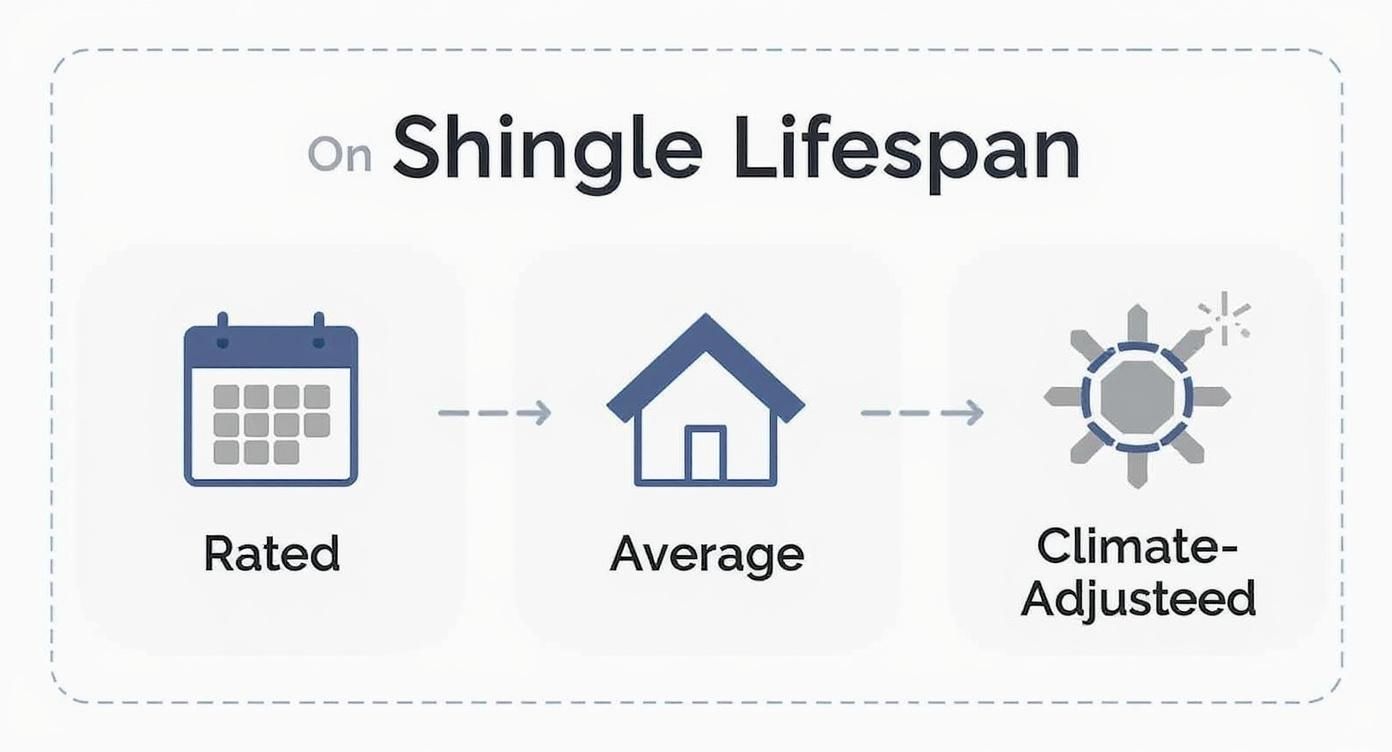
As you can see, a shingle rated for 25 years can come up well short when it's getting hammered by sun or storms season after season.
2. Cracks and Bald Spots
Asphalt shingles turn brittle as they age. That daily heat-up, cool-down cycle, what we call thermal shock, stresses them until you see cracks. Don't shrug those off. They're a straight path for water down to the decking, where it rots the wood.
You might also spot "bald spots" where the sandy granules have worn clean off. Those granules are the shingle's armor. Once they're gone, the bare asphalt is exposed and the whole thing breaks down a lot faster.
3. Granules in Your Gutters
A pile of granules in your gutters is a classic sign of an aging roof. A brand-new roof sheds some loose granules, and that's normal. But if your roof is past 10-15 years old and you're scooping out a real heap of grit, that's advanced wear talking.
Think of those granules like tire tread. Once they're worn off, the roof loses its grip and its cover, and the bare asphalt underneath is left out for the UV to make brittle and weak.
4. Missing or Damaged Shingles
This one you can usually catch from the ground. A storm with real wind will tear shingles right off and leave obvious gaps in the roof's armor. Those bare spots are open doors for water, right now.
Even one missing shingle can start a serious leak, which is why a quick roof repair in Tucson matters so much. Handle the small problem today and it never grows into the big, expensive one.
5. A Sagging Roof Deck
If you see a droop, a dip, or a wavy line in your roof, that's about as serious as it gets. A sag almost always means a structural problem in the decking under the shingles, usually from trapped moisture that's already rotted the wood.
Do not sit on this one. A sagging roof can mean a collapse risk, so call a pro right away.
6. Dark Streaks or Algae Growth
Those ugly black or dark green streaks you see, mostly in humid spots, are an airborne algae called Gloeocapsa magma. It starts out as just an eyesore. But give it time and it traps moisture against the shingles and speeds up the rot.
Moss is worse. It soaks up water like a sponge and holds a ton of it on the roof. As it spreads it pries the shingle edges up, breaks the seal, and lets water slip underneath.
7. Your Roof Is Getting Old
Sometimes the biggest sign is just time. A roof can look okay from the street and still be on borrowed time. Most asphalt roofs start showing real wear after 15-20 years.
The Insurance Institute for Business & Home Safety (IBHS) found that roofs 15 years or older are far more likely to fail in severe weather like hail or high wind. Wait for a leak and you've usually waited too long.
Visual Warning Signs and What They Mean
To tie it together, here's a quick-reference table that matches what you might see up there with what it actually means for your roof.
| Visual Sign | What It Indicates | Recommended Action |
|---|---|---|
| Curling Shingle Edges | Advanced age, sun damage, and loss of flexibility. The roof's seal is compromised. | High Priority: Schedule an inspection. Vulnerable to wind and water damage. |
| Cracks & Bald Spots | Brittleness from age and granule loss. The shingle's protective layer is gone. | High Priority: Direct path for water. Inspection needed to assess extent. |
| Granules in Gutters | The roof is losing its UV protection and is nearing the end of its lifespan. | Medium Priority: Monitor closely and budget for a replacement within 1-3 years. |
| Missing Shingles | Often caused by wind damage. An immediate and active leak risk. | Urgent: Call for immediate repair to prevent water damage to the decking and interior. |
| Sagging Roof Deck | Structural problem, likely from rotted decking due to prolonged moisture. | Urgent: Call a professional immediately. Potential risk of collapse. |
| Dark Streaks/Algae | Primarily cosmetic at first, but can lead to moisture retention and decay. | Low Priority: Can be cleaned, but consider it a sign of aging. Monitor for worsening. |
The table helps you sort out what's urgent and what can wait, but if you're not sure, get a pro up there. Your roof works as one system, and these signs are it telling you that system is losing its grip on protecting your house.
How Weather and Environment Age Your Roof
Don't count your roof's life in years. Count it in battles. Every day it's fighting the weather. Your climate is the main enemy, and it sets the pace for how fast the roof wears down. Know your local threats and you'll know when it's time for new shingles.
A roof in sunny, dry Arizona is fighting a totally different war than one in humid Florida or icy Minnesota. Each place has its own favorite way of tearing roofing apart. Once you know your region's signature threat, you can get a real read on how long your roof will actually go.
The Relentless Sun and Heat
In hot, dry country like ours here in Southern Arizona, the sun is enemy number one. That constant blast of UV radiation slow-cooks your asphalt shingles. It bakes out the oils that keep them flexible and waterproof, and you're left with something brittle that cracks at the slightest stress.
That daily routine, swelling in the afternoon heat and shrinking in the cool of night, is what we call thermal cycling, and it puts serious stress on a roof. Run it thousands of times and the shingle weakens, like an old rubber band left out in the sun. It's a big problem for certain roofs, which is exactly why reflective flat roof coating in Tucson exists, to push back against that solar beating.
Moisture, Humidity, and Biological Growth
Move to a humid or coastal region and the threat flips to moisture that never quits. A damp roof is a breeding ground for all kinds of ugly, destructive growth. You've seen those dark streaks from Gloeocapsa magma, an algae that literally feeds on the limestone filler in asphalt shingles.
At first it just looks bad. But the algae pins moisture against the surface, which speeds up granule loss and decay. Moss is worse. It holds water like a sponge and can physically lift your shingle edges, breaking the seal and letting water run down to the decking.
This is becoming a bigger deal everywhere. In tropical and subtropical climates, the combined hit from moisture, mold, and algae can shave up to 30% off the lifespan of standard asphalt shingles. Want to dig deeper? You can read more about how climate speeds up shingle wear in these global roofing insights on sinogrp.com.
The Punishing Freeze-Thaw Cycle
Up in colder country, the killer is the freeze-thaw cycle. Quiet, sneaky, and it works from the inside out.
Here's how it goes:
- Water Gets In: Rain or melting snow works its way into tiny cracks you can barely see.
- It Freezes and Expands: Temperature drops, that trapped water turns to ice, and it swells about 9%.
- The Damage Widens: That swell acts like a little wedge and pries the crack open a bit more.
- The Cycle Repeats: All winter long, over and over, until small flaws become big splits that take the whole roof down with them.
That constant push-and-pull splits your shingles apart from the inside and chops years off their life, and you usually don't notice until it's too late.
Inspecting Your Roof Safely from the Ground
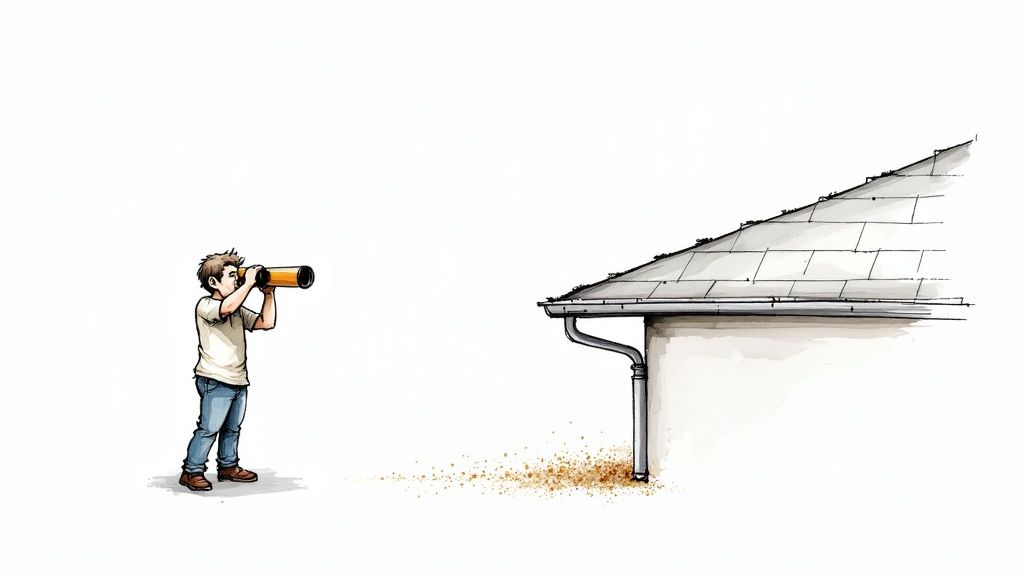
You don't need a ladder to get a good read on your roof. A lot of the biggest warning signs are easy to see from your own yard. A quick walk-around can save you from a bad fall and the even worse repair bills that come from ignoring the roof.
Grab a pair of binoculars and you're set. Walk slowly around the house and scan the whole roof from a few different angles. Look for the stuff we already covered: edges curling up, obvious cracks, or shingles that have gone missing entirely.
Pro Tip: The best time to look is a clear but overcast day. Harsh direct sun throws a glare that hides the subtle stuff, like hairline cracks or granule loss.
Checking Key Vulnerability Points
From the ground, zoom in on the spots most likely to fail first. That's wherever roof planes meet or wherever a pipe or vent pokes through.
- Vents and Chimneys: Use the binoculars to study the flashing, those metal strips sealing the joints. Rusty? Peeling up? Any gaps? That's a wide-open door for water.
- Roof Valleys: These channels do the heavy lifting, funneling buckets of rainwater off the roof. Look for dark patches where granules are gone or shingles that look buckled. A worn valley is no small thing.
- Gutters and Downspouts: Check the ground where your downspouts dump out. A pile of black, sandy grit there is a dead giveaway. Those are your shingle granules, and losing them means the roof is aging fast.
The Attic: Your Telltale Interior View
Your next safest spot, and maybe the most telling, is the attic. Go up on a bright, sunny day, kill the lights, and look up at the underside of the deck. Step only on the wooden joists, never on the drywall ceiling below, or you'll come through it.
See little pinpricks of daylight coming through? Those are holes, plain and simple. Scan the wood for dark water stains, streaks, or damp spots, and pay extra attention around the vent pipes and chimney. That's flat-out proof of a leak, whether it's active or already dried.
Even if you only catch a couple small things, it's smart to get a pro opinion. A real inspection tells you how bad the damage actually is and gives you a clear plan. If you're around Tucson, you can see what a professional roof inspection covers so nothing gets missed. That kind of look gives you what you need to make the right call on your home.
The High Cost of Delaying a Roof Replacement
When a roof starts going, you hit a fork. Patch the few spots you can see, or bite the bullet and replace the whole thing? It's only natural to lean toward the quick, cheap fix.
But patching an old, worn-out roof over and over is like taping up a broken arm. It hides the problem for a minute. It does nothing for what's really wrong.
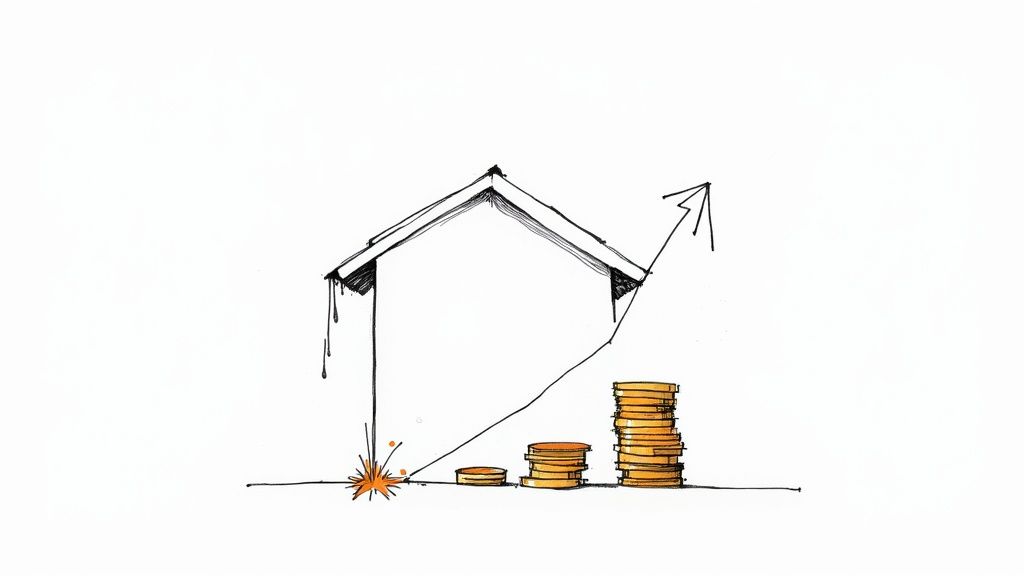
Putting off a replacement feels like saving money today. It almost always costs you more later. An aging roof loses its grip on protecting the house, and that failure sets off a chain of expensive, destructive problems that go way past a few missing shingles.
The Hidden Financial Dangers of Waiting
Betting that a small drip won't turn into a big interior leak is a bad gamble. By the time you spot a stain on the ceiling, the damage is already well along. Water's probably been working through your roof for weeks or months, quietly rotting wood where you can't see it.
This is where the bills start to snowball. What could have been a clean roofing job balloons into a full renovation.
All of a sudden you're not just paying for a roof. You're paying for:
- Structural Wood Replacement: Steady moisture rots the decking, the trusses, the support beams. Swapping out structural wood is a major job, and it's not cheap.
- Insulation Damage: Wet insulation is done. It compresses, loses its R-value, and turns into a mold and mildew nursery.
- Mold Remediation: Mold tears through an attic and into your ductwork fast. That's a real health risk and it takes a pro and real money to clear out.
- Interior Repairs: Patching stained ceilings, swapping out ruined drywall, fixing warped floors. It all piles thousands onto the final bill.
Replacing the roof before it fails is a shield over your whole home. It stops a small issue from snowballing into a financial mess, and it protects both your property's value and your family's health.
When a Repair Makes Sense
Look, a simple repair is the right move when the roof is still fairly young and the damage is in one spot. A storm tore off a few shingles but the rest looks great? Patch it. No question.
But if your roof is past 15 years and showing wear all over, curling shingles, cracking everywhere, heavy granule loss, patching one spot just buys a little time before the next one goes. You're putting a temporary fix on a permanent problem.
If you're weighing your options, knowing what a professional shingle roof replacement in Tucson actually involves clears a lot up. It's not just new shingles. It's rebuilding the whole protective system on your house. A full replacement lets a pro check the decking underneath for hidden damage and make sure every piece, underlayment to flashing, goes on right and stays right.
That's the spending that heads off the whole chain reaction procrastination kicks off, and it saves you a mountain of stress and money down the line.
Answering Your Top Roof Replacement Questions
Once you've clocked the warning signs and started thinking about money, the practical questions come rolling in. That's normal. A project this size brings a pile of "what ifs" and "how does that works."
Straight answers are the last thing standing between you and moving forward. Knowing what's coming makes the whole job smoother and helps you make the right call. So let's knock out the questions we hear most.
Can I Just Install New Shingles Over the Old Ones?
You'll hear this called a "layover" or a "re-roof." It's sometimes possible, and it's almost never a good idea. Sure, you save a little on labor up front. But it buries real problems like soft spots and rotted decking. It's like painting over a rust spot on a truck. You didn't fix anything, you just hid it for a while.
A layover also piles a ton of extra weight on a structure that was never built to carry it. And here's the kicker: most shingle makers void the warranty the second their product goes on over old shingles. A full tear-off is the standard for a reason. It's the only way a roofer can actually inspect the wood decking, the foundation of the whole roof, and put your new shingles down on a solid, secure surface that'll really protect the house.
How Does a New Roof Affect My Home Insurance?
This is one of the best parts. A new roof almost always helps your homeowner's insurance. Carriers love new roofs because they slash the odds of future leaks and pricey water-damage claims. Plenty of companies will even knock money off your premium for one.
Some insurers actually require a roof under a certain age, often 15-20 years, before they'll write full coverage at all. An old, beat-up roof reads as a liability, and hanging onto one can drive your premium up or get you a non-renewal letter.
Call your insurance agent the day the new roof is finished. You might be surprised at the better rate you qualify for. A new roof is a major upgrade that protects the whole property, and your carrier wants to hear about it.
What Is the Best Time of Year for a Roof Replacement?
The sweet spot is mild, dry weather. For most of the country that's late spring or early fall. This isn't about keeping the crew comfy. It actually matters to the shingles.
Asphalt shingles have a strip of tar-like sealant on the back. That strip needs warmth and direct sun to kick in, melt, and bond to the shingle below it, locking the whole roof into one waterproof shield.
Here's why the timing matters:
- Extreme Heat: Brutal summer heat makes shingles soft and gummy. They scuff, dent, and get marked up easy under foot traffic during the install.
- Cold Weather: Too cold and shingles go brittle, so they crack when they get nailed. Worse, the seal strips won't fire, which leaves the shingles loose and ready to blow off in the wind.
Booking it outside the rainy season helps too. The last thing you want is a surprise downpour with the old roof torn off and your decking sitting wide open. Pick the right season and the whole install goes smoother, safer, and tighter.
All of this is a lot easier with someone who's done it for years. At Sunrise Roofers LLC you get straight answers and photo-documented inspections, so you always know where you stand. No commission reps, no closers. You call, you get Eddie. Ready for a roof built to last? Reach out today. https://roofwithsunrise.com
Need roofing services in Tucson? Request a free inspection or call 520-753-1758. Related pages: Roof Repair · Roof Replacement · Service Areas.
Published by Sunrise Roofers LLC
Licensed & Insured Roofing Contractor · Tucson, AZ