How Long Does a Roof Last? A Homeowner's Guide
By Sunrise Roofers LLC · Oct 20, 2025 · 16-24 min read
Folks ask us this all the time, and the honest answer is... it depends. A roof can last anywhere from 20 years to well over 100. What decides it? Mostly the material sitting up there over your head.
A basic asphalt shingle roof might get you through two decades. A properly installed slate or tile roof, on the other hand, could easily outlast you. Once you get that, you've got a real handle on what to expect from the roof you've got now—or the one you're thinking about putting on.
Your Roof's Lifespan in a Nutshell
Here's how I explain it to people. Comparing roofing materials is a little like comparing a canvas tent to a brick house. Both keep the rain off you. But how long they hold up, and how much they cost going in, is a whole different conversation. Every material lands somewhere different on that scale.
Asphalt shingles are a good starting point, since they're on more American homes than anything else. A standard 3-tab shingle runs you 15 to 20 years. Bump up to a thicker architectural shingle and you're looking at closer to 30 years. So even inside one material family, what you buy and how it's built changes the math.
Want to see how this plays out on real homes? Take a look at the professional roofing services out there and figure out what actually suits your house.
A Quick Comparison of Materials
Numbers land better side by side. Some of these materials are cheap to put on and do the job for a while. Others are flat-out a long-term investment in keeping your building dry.
Here's how the lifespans stack up.
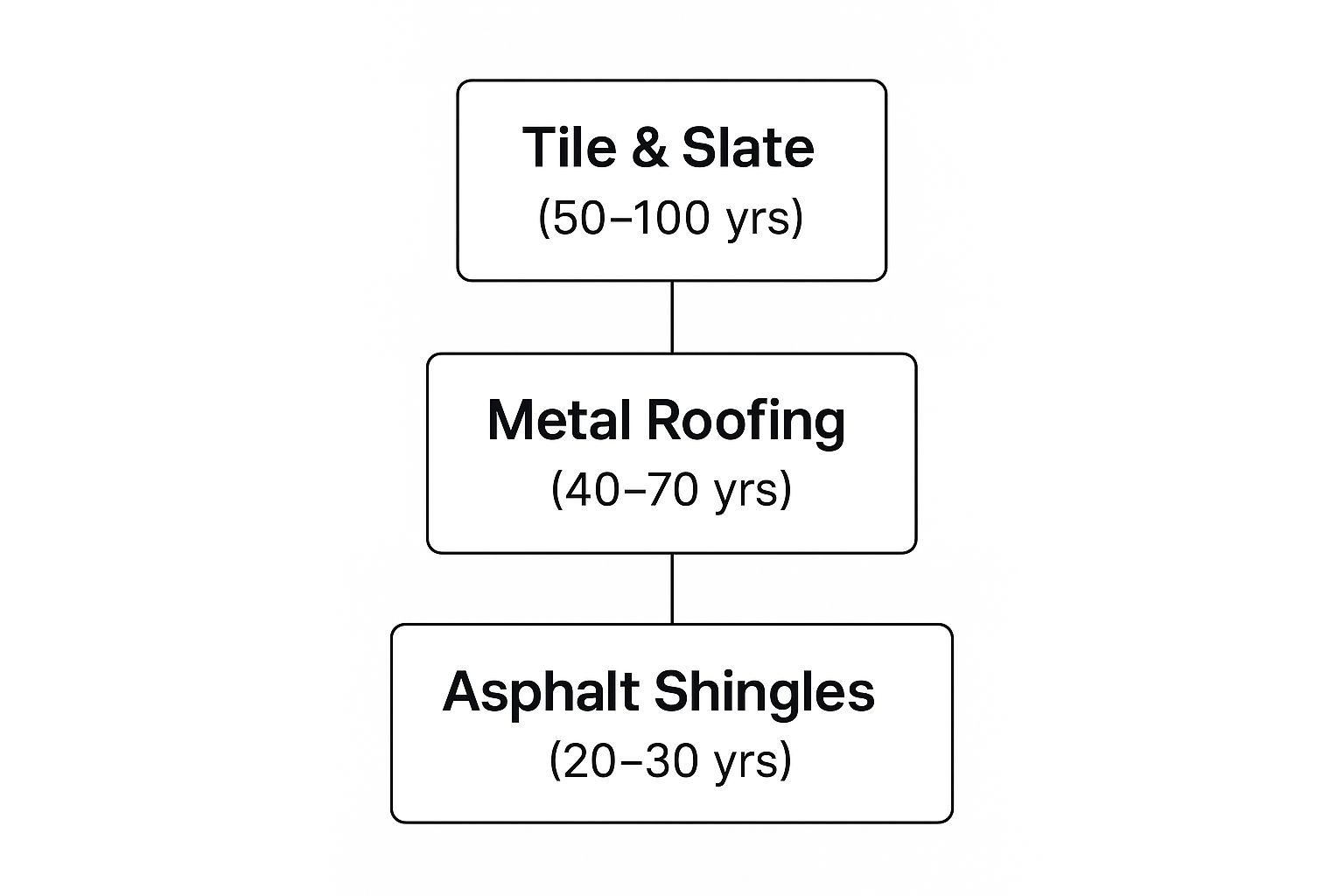
The infographic spells it out. Asphalt shingles will protect you fine for a couple of decades. Metal, slate, tile? Those are playing a different game entirely.
Here's a simple breakdown of what you can generally expect.
Average Lifespan of Common Roofing Materials
| Roofing Material | Average Lifespan (Years) |
|---|---|
| Asphalt Shingles (3-Tab) | 15 - 20 |
| Architectural Shingles | 25 - 30 |
| Wood Shingles/Shakes | 25 - 40 |
| Metal (Steel, Aluminum) | 40 - 70 |
| Clay or Concrete Tile | 50 - 100 |
| Slate | 100+ |
These numbers aren't gospel, though. They're what you get under normal conditions. Brutal sun, a bad hail year, hurricane-force wind—any of that shaves time off the back end.
So your roof's lifespan isn't really one number. It's a range, and what sets that range is whatever's standing between you and the sky. Let's get into why these numbers swing so wide, and what you can do to squeeze the most out of yours.
Exploring Different Roofing Material Lifespans
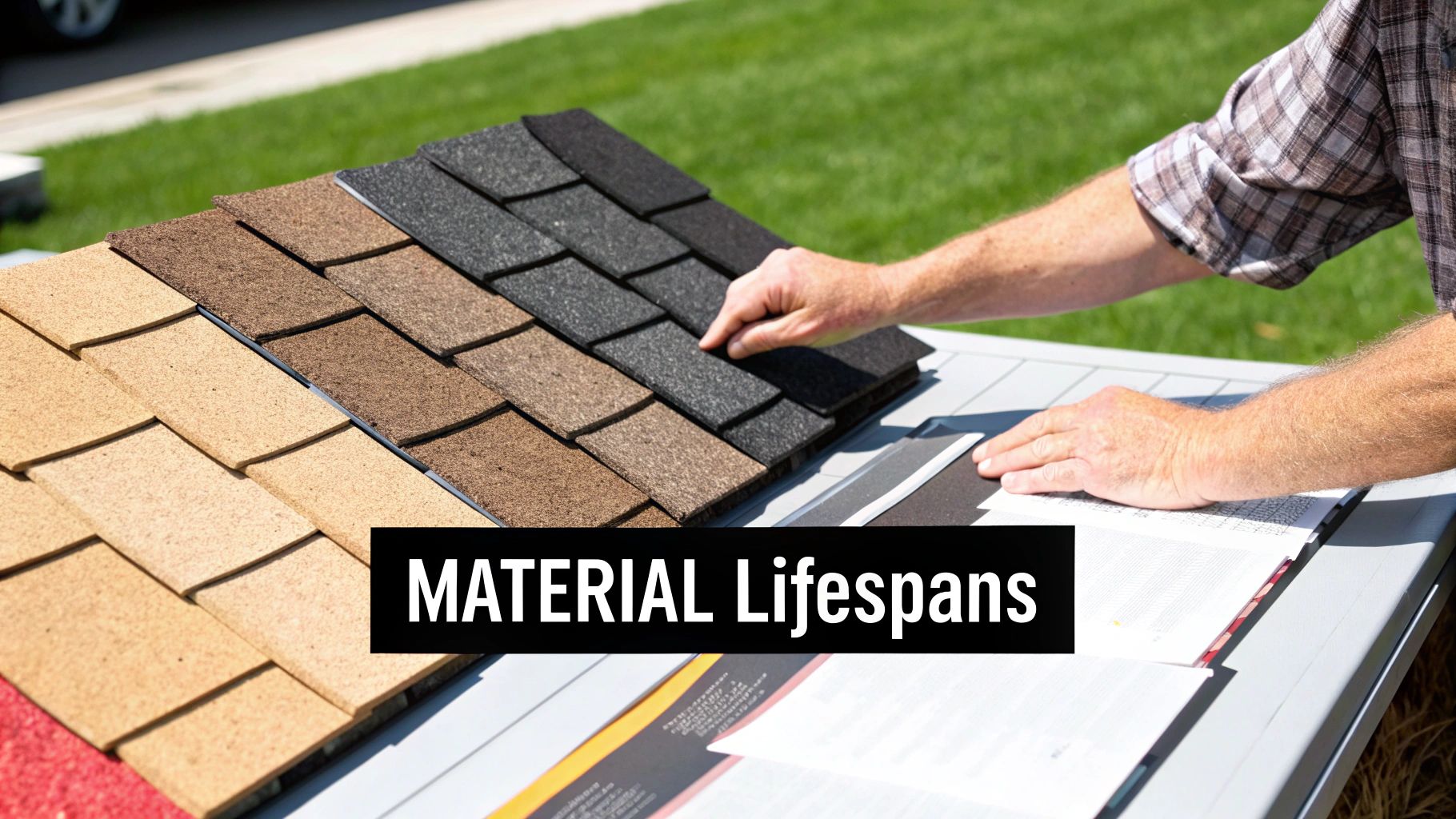
Knowing the average lifespan is one thing. Understanding why one roof gives out at 20 years while another runs for decades—that's what actually helps you spend your money right.
Every material's got its own story. What it's made of, where it's strong, where it breaks. Let's run through how the common ones actually hold up out in the real world.
Asphalt Shingles: The Popular Workhorse
There's a reason asphalt shingles cover so many American homes. They hit a nice middle ground on cost and performance. But don't let anybody tell you all asphalt shingles are the same. They're not.
- 3-Tab Shingles: The entry-level pick. One flat layer, easy on the wallet, but a shorter life—just 15 to 20 years. They're lighter, which means wind gets under them easier. Out here, monsoon season finds them fast.
- Architectural Shingles: The step up. Multiple laminated layers make them thicker and heavier, and they give the roof a deeper, more dimensional look. Think of a reinforced coat versus a thin jacket. All that extra layering buys you 25 to 30 years, sometimes more, and a lot more weather resistance.
Want to know what really kills an asphalt shingle? The sun. Those little granules on top are the shingle's sunscreen. They wear off over the years, the asphalt underneath gets exposed, and from there it goes brittle and cracks. Once that starts, the roof's done.
Metal Roofing: The Durable Defender
Metal has taken off, and I get why. It lasts. Shingles slowly cook in the sun, but metal reflects the heat right back and shrugs off rough weather instead of slowly breaking down under it.
So how long does a metal roof last? Put it on right and you're looking at 40 to 70 years, depending on what you choose.
- Steel (Galvanized or Galvalume): The common, budget-friendly option. The coatings they use now do a great job keeping rust and corrosion away, so it's a safe bet in most climates.
- Aluminum: Lighter than steel and won't rust on its own. That makes it the obvious call near the coast, where salty air eats everything else alive.
- Copper and Zinc: The lifetime stuff. They pick up a gorgeous patina over the decades and can run 100 years or more. That's not a roof, that's something you pass down.
Metal laughs off fire, rot, and bugs. Where it gets you is the install. If the crew doesn't leave room for the metal to expand and contract, you'll have trouble. Anyone weighing it should see how it actually performs in heat like ours—our page on metal roofing in Tucson lays that out.
Key Insight: What really sets a metal roof's clock is the coating on it. Scratch it deep or wear it off, and a steel roof will start to rust. A good paint finish isn't a frill—it's the whole ballgame on longevity.
Tile and Slate: The Generational Guardians
If all you care about is years, nothing beats tile and slate. These aren't really roof coverings. They're part of the building.
Clay and Concrete Tile You see tile all over the Southwest because it's built for this kind of punishment. Clay or concrete, either one can run 50 to 100 years.
Fire won't touch it and it won't rot. But here's the part most people don't realize: the tile itself isn't what keeps the water out.
The underlayment underneath does that job. And in our heat, a standard felt underlayment might only give you 15 to 25 years, even with tiles that still look brand new on top. That's why a tile "re-roof" usually means pulling the old tiles off, swapping out the shot underlayment, and laying those same tiles right back down.
Slate Slate's the champ, no argument. It's real stone, cut straight out of the ground. A slate roof can go 100 to 200 years—sometimes longer than that. Dense, fireproof, and it doesn't flinch at weather that wrecks everything else.
The catch? It's heavy. Heavy enough that your roof structure has to be reinforced to carry it. And it takes a real craftsman to install or repair. Pulling one cracked slate without busting the ones around it is a job for someone who's done it a hundred times.
The Hidden Factors That Define Your Roof's True Lifespan
Buying a good shingle or tile is only half of it. That 30, 50, or 100-year number on the wrapper is a lab result. Best case. And it's counting on one thing more than anything else—that the roof gets installed right.
It's like building a engine. You can spend top dollar on every part, but hand it to a mechanic who cuts corners and it'll blow up on you way too early. Same deal with a roof. Sloppy work can cut a premium roof's life clean in half. Your 30-year roof becomes a 15-year problem.
So in the real world, how long your roof lasts mostly comes down to who put it up there and whether they did it right.
Why Quality Installation is Non-Negotiable
A roof isn't just a layer of shingles. It's a bunch of parts working together, and they all have to go on correctly or the whole thing falls short. One small miss can snowball into early failure.
Here's where I see crews cut corners and wreck a roof's lifespan:
- Improper Nailing: Drive a nail too deep and it punches through the shingle—now you've got a hole for water. Don't drive it deep enough and the shingle sits loose, just waiting for the wind to grab it.
- Misaligned Shingles: Space them wrong and you leave gaps. Those gaps let sun and rain hit the layers underneath, and that's where the rot speeds up.
- Ignoring the Starter Strip: Skipping that dedicated first row along the eaves is a rookie move. You've basically left the door open for wind to get under the bottom row and start peeling the roof up from there.
- Cutting Corners on Flashing: Flashing is the metal that seals around chimneys, vents, and valleys, and it's where most leaks start. Cheap crews reuse old flashing or smear sealant over it. That spot will fail. Count on it.
None of this is small stuff—every one of these compromises the whole roof. A good crew knows their work lives or dies on getting each step right, from checking the wood deck on day one to setting the last ridge cap.
Your warranty is tied straight to how the roof was installed. If a manufacturer finds out the failure came from a bad install, they'll void it and you're stuck holding the bill.
Attic Ventilation: The Unseen Protector
There's a space right under your roof that matters way more than people think—your attic. Good ventilation lets your roof breathe. Without it, the roof basically smothers from the inside.
When the venting's out of balance, hot moist air gets trapped up there. Summer's the worst. That heat cooks the shingles from underneath, curling them, warping them, knocking the granules loose. An attic hitting 150°F or higher isn't unusual, and that heat ages every part of the roof faster.
Winter flips it. Now that trapped moisture condenses on the cold underside of the deck. Rot, mold, the wood sheathing starting to come apart—and that sheathing is exactly what your shingles are nailed into.
The Underlayment: Your Roof's Last Line of Defense
The shingles are the part you see. The underlayment is the waterproof layer hiding under them, and it's what keeps your house dry the day a shingle cracks or a storm rips one off.
How good that layer is matters a lot. A standard felt underlayment might only give you 15-20 years in tough climate, even with fancy tiles rated for 50 sitting on top. The day the underlayment quits, water reaches the deck and the whole system starts coming undone.
Go with a quality synthetic underlayment instead and you can stretch that protection to 25-35 years or more. It's a small upgrade that holds up a lot better against moisture and our temperature extremes, and it adds real years to the roof. The foundation ends up as tough as the surface everybody actually looks at.
How Your Local Climate Affects Roof Durability
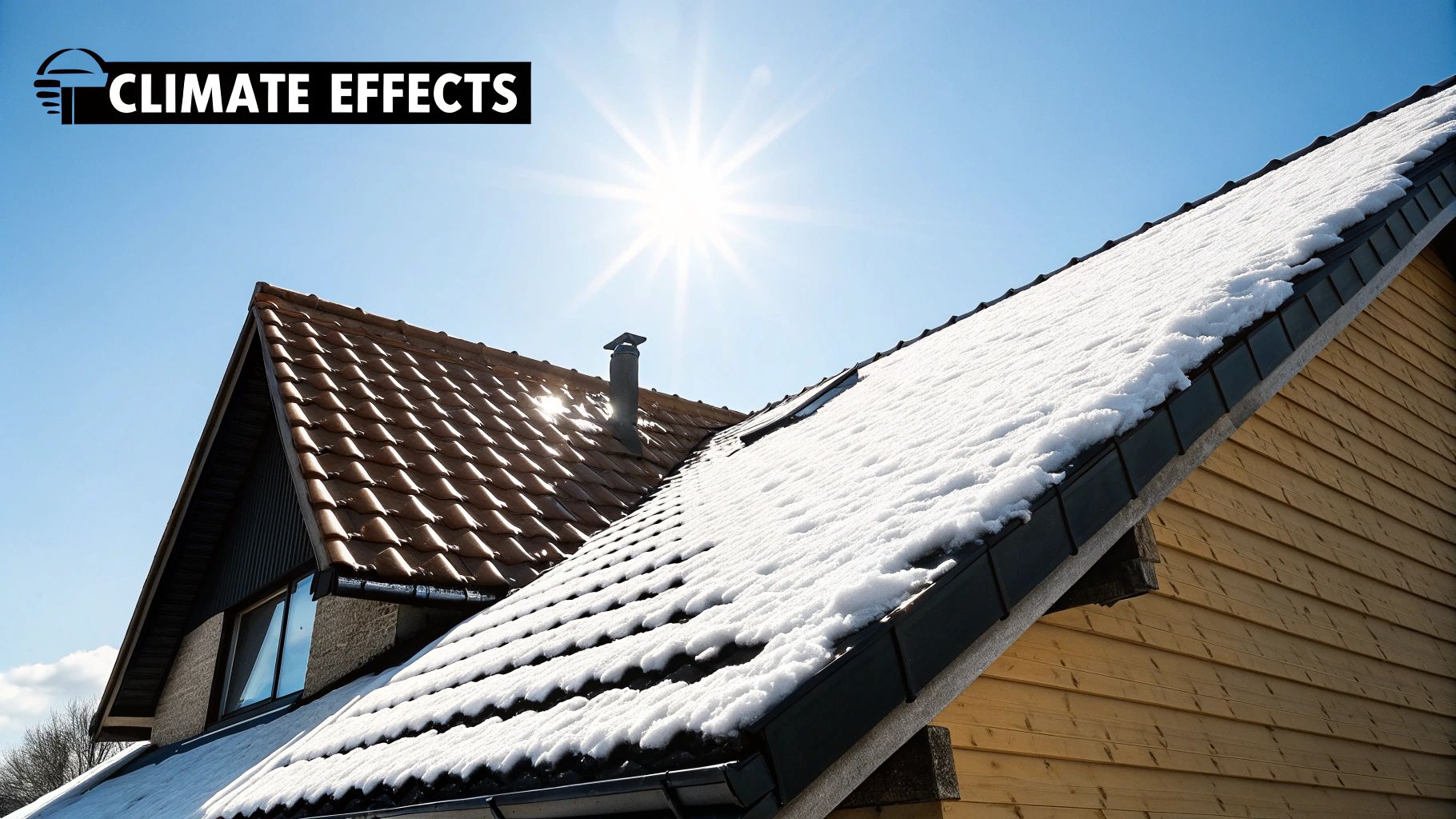
Material and install quality set what your roof could do. But your climate is what it actually fights every day. Picture the roof as a shield. A shield taking daily sun here in Tucson wears down a whole lot differently than one buried under snow up north.
Get a handle on those forces and you'll have a much better read on how long your roof will really last.
That same architectural shingle rated for 30 years? Out here under the Arizona sun, it might give you 20-25. Drop it somewhere mild and it'd sail past its warranty. Climate is the thing that turns a lab number into what you actually get.
The War Against Sun and Heat
If you live somewhere sunny like Tucson, UV radiation is your number one problem. It slow-bakes your asphalt shingles day after day, cooking out the oils that keep them flexible. What's left gets brittle and starts to crack.
All that heat also brings thermal shock. The roof can hit over 160°F in the afternoon, then cool down hard once the sun drops. Expand, contract, expand, contract—and that constant movement strains everything, from the shingles to the sealant around your vents.
Day after day, that cycle is what grinds a roof down. One of the best ways to push back is reflective material—you can see it work in this Tucson flat roof coating transformation, which bounces the heat off and buys the roof more years.
The Challenge of Cold and Moisture
Cold country has a different enemy: the freeze-thaw cycle. Water works its way into tiny cracks in the shingles or tiles you can't even see. It freezes, it expands, and over one winter those little flaws turn into real damage. It's brutal on a roof.
Heavy snow piles on weight too, straining the deck and the framing underneath. But the worst cold-weather offender is the ice dam.
Ice dams happen when heat leaking out of your attic melts the snow up top. That meltwater runs down to the colder eaves and freezes again, building a wall of ice. Water backs up behind it, sneaks under the shingles, and ends up inside your house—rotting wood and ruining insulation on the way.
Coastal Corrosion and High Winds
Live near the ocean and you've got a different problem altogether: salt air. That salty mist on the breeze is corrosive, and metal hates it. Without a special protective coating, fasteners, flashing, even the panels themselves can rust out years before they should.
Coastal and hurricane areas also fight wind, and a lot of it. Wind doesn't just rip shingles off—it pulls up on the whole roof, loosening the system bit by bit. One loose shingle is all it takes. Wind gets under it and starts peeling back whole sections.
Physical Damage from Trees and Debris
Don't sleep on what's right around your house, either. Tree limbs hanging over the roof do real damage. In a storm they scrape the granules off your shingles, and if a branch snaps off, now you've got a direct hit.
Trees drop leaves and pine needles, too. That gunk clogs gutters and traps moisture up on the roof. Stay damp like that and you've got algae, moss, and mildew setting up shop, and all three eat away at roofing materials until something rots. A roof sitting wet and shady will always die younger than one that gets good sun and airflow.
Your Proactive Roof Maintenance Checklist
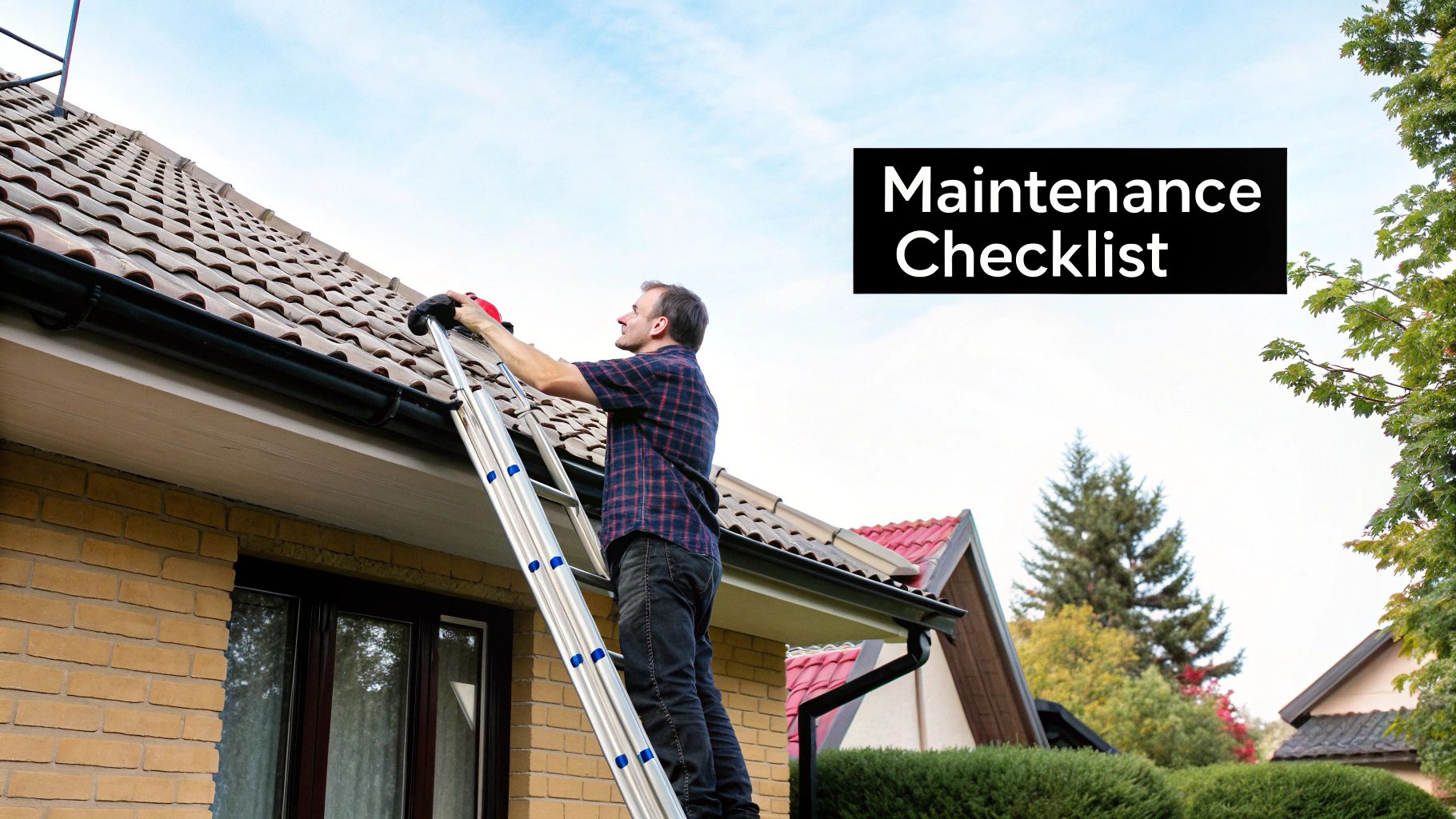 What a roof could last and what it does last are two different things. Ignoring your roof is like never changing your oil. You'll get away with it for a while. Then one day you won't, and it'll cost you.
Staying on top of it is the best way to protect what you paid for and get every year out of the roof. And no, that doesn't mean climbing up there every weekend. Most of it is knowing what to look for from the ground and knowing when it's time to call somebody. A little routine catches small stuff before it turns into leaks, rot, and the kind of structural damage that empties your wallet.
The Foundation of Roof Health: The Ground-Level Inspection
You'd be surprised how much you can tell about a roof without ever touching a ladder. Twice a year, give it a good look—once in spring, once in fall. That's your first line of defense.
Grab some binoculars and walk a lap around the house. You're hunting for the obvious trouble.
- Damaged or Missing Shingles: Look for shingles that are cracked, curling at the edges, or just gone. Watch the sides that take direct sun all day. That's where they go first.
- "Bald" Spots: On asphalt, look for spots where the granules have worn off. They show up shiny or dark, and they're a dead giveaway that shingle's about done.
- Dark Streaks or Stains: Black or green streaks, especially on the north side, usually mean algae or moss moved in. It looks like just a cosmetic thing at first, but it holds moisture and speeds up the rot.
- Damaged Flashing: Eyeball the metal around your chimney, vents, and skylights. You're checking for rust, bent pieces, or sealant that's cracked and pulling away.
That's a 15-minute job and it'll save you a world of grief. Want the full rundown? Our homebuyer roof inspection checklist walks through exactly what to look for.
Keeping Your Gutters Flowing Freely
Gutters are part of the roof system, even though nobody thinks of them that way. Their whole job is moving a ton of water away from your foundation. Pack them with leaves and twigs and gunk, and they can't.
So the water backs up, spills over, and creeps under the edge of the roof, rotting the decking and the fascia. In cold country, that same trapped water freezes into ice dams and shoves moisture right up under your shingles.
Crucial Tip: Clean your gutters at least twice a year—late spring once the trees have dropped their seeds, and late fall after the leaves come down. Got big trees over the house? You'll be doing it more than that.
A Seasonal Plan for Long-Term Protection
A schedule keeps roof care from getting away from you, and it means nothing slips through. Every season throws something different at the roof, so what you watch for shifts as the year goes.
Here's a simple plan to follow.
Seasonal Roof Maintenance Schedule
| Season | Maintenance Task | Reason |
|---|---|---|
| Spring | Thorough Inspection & Gutter Cleaning: Perform your detailed ground-level inspection and clear out any debris that built up over the winter. | This preps your roof for heavy spring rains and helps you spot any damage caused by winter storms or ice. |
| Summer | Check for Growth & Pest Activity: Look for the first signs of algae or moss. Also, check for birds or rodents nesting under eaves or tiles. | Summer humidity can kickstart moss and algae growth. Catching it early prevents it from taking over. |
| Fall | Gutter Cleaning & Debris Removal: This is the most important cleaning of the year. Clear all fallen leaves and trim back any overhanging branches. | Clogged gutters in winter are the #1 cause of ice dams. Trimming branches prevents them from scraping shingles or snapping off in a storm. |
| Winter | Visual Checks for Ice Dams: After a heavy snow, safely look at your roof eaves from the ground. Keep an eye out for large icicles or thick ridges of ice. | Ice dams are a red flag for poor attic insulation or ventilation. Catching them early can prevent major water damage inside your home. |
Run it like this and roof care stops being a mystery. Turn it into a routine you can count on, and you're the one in control of how long the roof keeps your house dry.
Warning Signs Your Roof Needs Replacing
So how do you tell a quick fix from a roof that's done? A roof rarely quits all at once. It warns you first—little signs that it's tired and can't do its job anymore. Learn to read those signs and you stay ahead of it, instead of finding out the hard way when a small thing turns into a thousand-dollar emergency.
A lot of the worst red flags are visible from your driveway. You just have to know what you're looking at. Pretending you don't see them doesn't help. It just means the replacement costs more whenever you finally can't avoid it.
Signs You Can See from the Ground
You don't need a ladder for a quick health check. Honestly, the clearest signs of a roof failing across the board are easy to see from down on the ground.
Walk around the house and look up. Are the shingle edges curling up, like the corners of an old photo? That means the shingles have dried out and lost their flex after years in the sun. Brittle. One good wind and they're gone.
Watch for bald spots, too. Those ceramic granules on asphalt shingles are the roof's sunscreen, blocking the UV. See dark patches up top, or find piles of what looks like coarse sand in your gutters, and that means your roof's main defense is washing away on you.
Key Takeaway: A couple missing shingles? Quick fix. But when the curling, cracking, and granule loss are all over the roof, the whole system's going. Patching at that point is like putting one new tire on a car running three bald ones. Doesn't fix what's actually wrong.
Clues Inside Your Home
Sometimes the loudest warnings aren't on the roof at all. They're inside. Grab a flashlight, head up into the attic, and you can catch trouble long before a stain ever shows up on your living room ceiling.
Point the light at the underside of the roof deck. Dark stains, water streaks, damp spots? That's water getting past the underlayment, plain and simple. While you're up there, check the wood between the rafters for any sag or bow. A sagging deck is a structural problem, and that one's a call-a-pro-now situation.
A few more things to keep an eye out for:
- Dark Streaks: Long dark streaks running down the roof are almost always algae. Not an emergency, but it traps moisture and speeds up how fast the shingles break down.
- Moss Growth: Moss loves damp, shady spots. It works in under the shingle edges and lifts them, and now water's got a way underneath.
- Sunlight in the Attic: If you can see daylight coming through the roof boards, rain's got the same path right into your house. No question about it.
Catch this stuff early and you can plan instead of panic. Several of these signs at once, especially on an older roof, and you're probably looking at a full replacement before long. If you're here in Tucson, our page on what goes into a shingle roof replacement lays out the process so you know what to expect.
Common Questions About Roof Lifespan
Even once you've got the materials and maintenance down, the same handful of questions keep coming up. Straight answers here are what bridge the gap between a material's "on paper" number and how long the roof will actually hold up on your house.
Think of these as the last few pieces, so you can make the call with confidence.
Can I Put a New Roof Over My Old One?
People ask about this all the time. It's called a "roof-over," and even where the code technically lets you do it, it's almost always a bad idea. The reason's simple: nobody can see the roof deck underneath.
We can't check for rot, soft spots, or old water damage that'll kill your new roof from below. All you're doing is sealing the problems in. The extra weight leans on your framing, and the new shingles won't lay flat or seal right over an uneven surface.
And here's the big one—it'll usually void the warranty on your new shingles. A full tear-off is the only way to know you're starting on a solid, healthy deck. We won't do it any other way.
Does Roof Color Affect How Long It Lasts?
Yep. Especially somewhere that bakes like Arizona. Dark shingles drink up a huge amount of solar heat, and that constant heat load is hard on the asphalt. It ages faster, goes brittle sooner, and cracks earlier.
Lighter shingles, or "cool roof" shingles, are made to throw more of that sunlight back. That's not just a lower power bill. It's less heat soaking into the material itself, which helps it fight off UV damage and last longer.
How Does a Warranty Relate to Actual Lifespan?
This one trips up a lot of homeowners. A manufacturer's warranty and how long the roof really lasts aren't the same thing—not even close. A "30-year" or "lifetime" warranty isn't a promise the roof will perform that long. It only covers factory defects.
And those warranties are usually prorated and loaded with fine print—installation by a certified contractor, proof you kept up the maintenance, all of it. A 50-year shingle with bad attic ventilation or a sloppy install can be done in 15 to 20 years flat.
So read the warranty as a sign of material quality. Not a promise of how long it'll keep your house dry.
A roof is a system, and getting it to last takes someone who knows your house and knows the Arizona sun. That's us. Sunrise Roofers LLC has been doing this for over 20 years out here, and we don't put anything up there we wouldn't put on our own homes. Got questions, or want a straight, honest look at where your roof stands? Call us—no commission reps, no closers. Learn more about our approach to roofing at roofwithsunrise.com.
Article created using Outrank
Need roofing services in Tucson? Request a free inspection or call 520-753-1758. Related pages: Roof Repair · Roof Replacement · Service Areas.
Published by Sunrise Roofers LLC
Licensed & Insured Roofing Contractor · Tucson, AZ