Metal Roofing Commercial Buildings: A Complete Guide
By Sunrise Roofers LLC · Oct 30, 2025 · 16-26 min read
Putting a metal roof on a commercial building isn't really about covering the place—it's about turning a roof that keeps costing you money into one that pays you back. You get longer life, lower lifecycle costs, and real energy savings. That's why warehouses, retail centers, and industrial buildings all over Tucson keep landing on metal.
Why Businesses Invest in Metal Roofing
Roofing a commercial property is a big money decision. It touches your day-to-day operating costs and what the building's worth down the road. More owners every year stop seeing metal as just another material and start treating it like an investment—the same way they'd think about upgrading a key piece of equipment.
On paper, TPO or built-up roofing looks cheaper. In practice they depreciate. They want constant repairs, and one day they need a full, expensive replacement. Metal's built to perform and hold up from day one. That changes the whole calculation into a business move that pays for itself over decades, while it keeps weather damage and downtime off your back.
A Smart Financial and Operational Decision
A metal roof's value runs deeper than just being tough. A modern system shows up on your bottom line in a few real ways:
- Lower Lifecycle Costs: Lasting 50 years or more, a metal roof outlives two or three rounds of conventional roofing. You skip all those replacement cycles, and every one of those is a big check.
- Reduced Maintenance Overheads: Compared to materials that crack, blister, and bake apart under the Arizona sun, metal asks for almost nothing. That's budget you get to spend somewhere else.
- Significant Energy Savings: A lot of metal systems run "cool roof" coatings that bounce solar heat back, which trims your HVAC bill—and around here, cooling is a giant chunk of that bill.
- Potential Insurance Advantages: Metal takes wind, fire, and hail so well that it can knock down the insurance premium on a commercial building.
And this isn't some fringe thing. The global metal roofing market hit $26.31 billion in 2025 and keeps climbing, a lot of it driven by commercial owners wanting buildings that hold up and run efficient. Numbers are all here in this in-depth industry report.
Buy a metal roof and what you're really buying is decades of not having to think about your roof. A line item that used to come back around every fifteen years becomes a permanent asset that makes the building worth more.
Want the quick version of how these systems stack up? Here you go.
Metal Roofing vs Traditional Materials At a Glance
The table lines metal up against the usual flat-roof materials—TPO, EPDM, and Built-Up Roofing (BUR). None of those are "bad." The point is just seeing where the long-term value actually sits.
| Feature | Metal Roofing | Traditional Roofing (TPO/EPDM/BUR) |
|---|---|---|
| Lifespan | 50+ years | 15-30 years |
| Lifecycle Cost | Lower (fewer replacements) | Higher (multiple replacements) |
| Maintenance | Minimal; periodic inspections | Regular (seam checks, patching) |
| Durability | High resistance to fire, wind, hail | Vulnerable to punctures, seam failure |
| Energy Efficiency | Excellent (highly reflective "cool roof" options) | Moderate (varies by color/material) |
| Upfront Cost | Higher | Lower |
A metal roof lets you stop worrying about the thing over your head, and traditional materials just can't say that. But none of it lands without a proper install—and this is not a job for any crew with a nail gun. Who you hire matters as much as what you buy. We get into why over here, in our guide on why selecting the right roofers in Tucson is crucial.
Choosing Your Commercial Roofing Material and Profile
Picking the right system really boils down to two calls: which metal, and which profile (the panel's shape). The metal sets your durability and lifespan. The profile decides how the roof sheds water and stands up to wind. Get both matched to your building and where it sits, and you're in good shape.
Choose well up front and you dodge a pile of headaches and bills later. A cheap steel roof might be perfect for a warehouse out in dry Arizona, and a flat-out bad idea for a building near saltwater without the right coatings on it. Nail these details and the investment holds up for the long haul.
This infographic shows how a metal roof's strengths—long life, energy savings, raw durability—pull together to protect a commercial building.
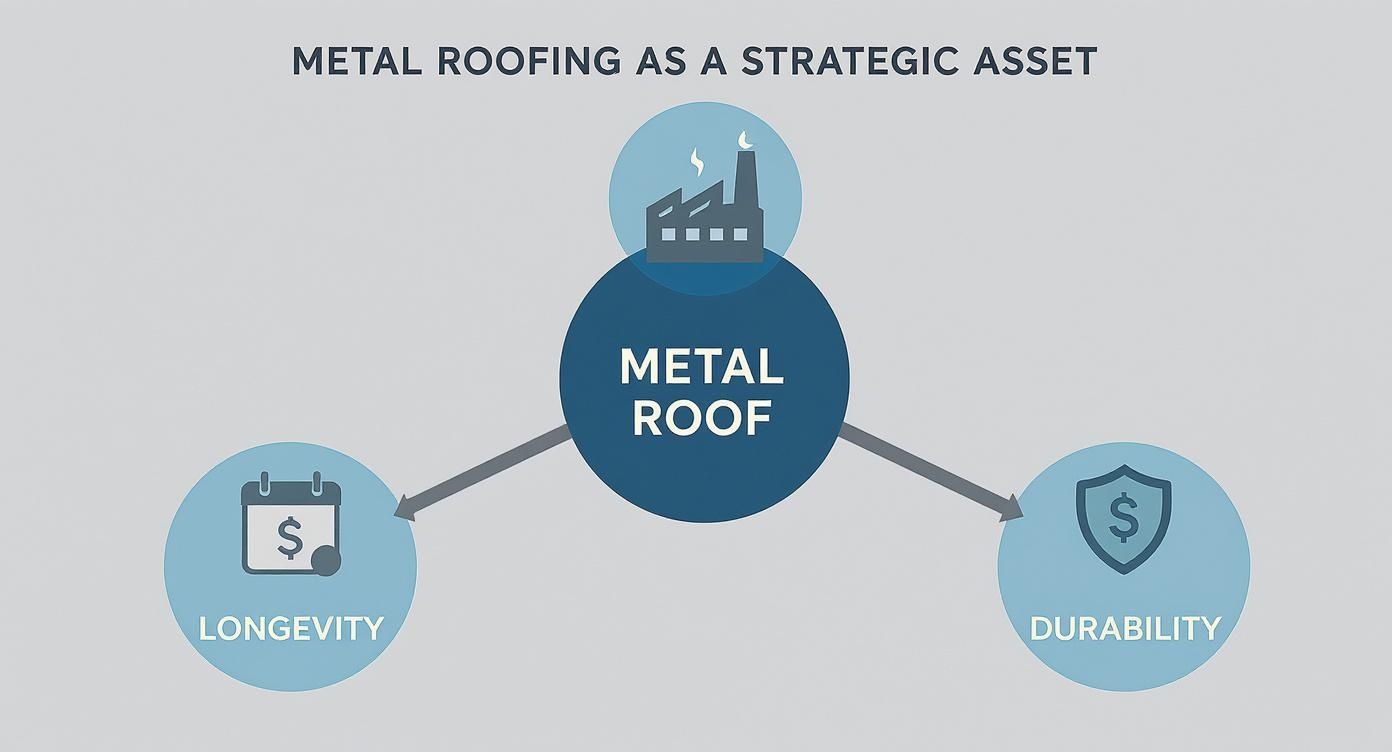
None of these benefits stand alone. They feed each other, and what you get is a building that's better protected with costs you can actually predict for its whole life.
Comparing Commercial Metal Roofing Materials
The heart of any metal roof is the metal, no surprise. Each one gives you a different blend of cost, toughness, and rust resistance. Here are the ones you'll actually see on commercial jobs.
Steel (Galvalume and Galvanized)
Steel is the workhorse of commercial roofing. Strong, fire-resistant, and a good value all at once. What separates the two main types is the coating on it.
- Galvanized Steel gets a zinc coating, which holds off corrosion pretty well.
- Galvalume® Steel uses aluminum and zinc together. That combo fights rust harder and longer, which is why it's our go-to on most commercial jobs now.
Aluminum
Light, stronger than it looks, and it won't corrode—that's just how aluminum is. Makes it the obvious pick for coastal buildings, where salt spray eats other metals alive. It runs more than steel, but in a harsh spot it earns that extra money back fast.
Copper and Zinc
These are the premium, "buy it once" metals. Gorgeous, and tough almost past belief.
- Copper is the one that turns that blue-green patina over the years, and it'll go past 100 years without breaking a sweat.
- Zinc lasts just as long. It even heals itself—small scratches close up on their own—and it's 100% recyclable.
Both copper and zinc cost real money up front. You mostly see them on high-end architectural work, where looks and permanence are the whole point.
It always comes back to matching the metal to your location and your budget. Don't blow money on copper for a plain warehouse—and don't cheap out on bare steel where the air will eat it.
This table makes it easier to see how the options line up.
Comparing Commercial Metal Roofing Materials
Here's a clear rundown of the metals we use most on commercial roofs. It helps owners pick based on budget, environment, and how long they need the thing to last.
| Material | Average Lifespan | Cost ($-$$$$) | Corrosion Resistance | Best For |
|---|---|---|---|---|
| Galvalume Steel | 40-60 Years | $$ | Excellent | General industrial, warehouses, retail |
| Galvanized Steel | 30-50 Years | $ | Good | Budget-conscious projects in dry climates |
| Aluminum | 50+ Years | $$$ | Superior | Coastal properties, humid environments |
| Copper / Zinc | 100+ Years | $$$$ | Exceptional | Architectural landmarks, institutional buildings |
Every one of these has its spot. What your building does and where it sits will point you straight at the right one.
Understanding Metal Panel Profiles
Metal picked, the next call is the panel profile. This one shapes how the roof looks, sure, but it matters more for how it works—above all, how it gets water off itself.
Standing Seam Panels
This is the gold standard for metal roofing commercial buildings. Standing seam runs raised, interlocking seams that tuck every fastener out of the weather. Clean modern look, and about as leak-proof as a roof gets, which is exactly what you want on a low-slope commercial deck.
These panels are also made to expand and pull back as the temperature swings—and in Tucson, where it can swing forty degrees in a day, that's no small thing.
Ribbed or Exposed Fastener Panels
R-panels, U-panels, same idea—the budget option. The panels just overlap, and the screws drive straight through the metal into the deck, screw heads left out in the open.
These work fine and they're plenty strong. But every exposed screw is a spot where a leak might start someday, so they want closer inspection and more upkeep over the years. You see them on barns, storage buildings, and anywhere the budget's calling the shots.
Get the metal and the profile paired right and the roof performs for decades. For what actually works out here in the desert, here's our page on metal roofing in Tucson.
The Real-World Payoff: Performance and Sustainability
A metal roof doesn't just sit there covering the building—it works for you. Going with metal roofing on commercial buildings isn't only about durability; it's a smart business call. You're putting money into something that keeps paying off in efficiency, in lower risk, even in how green your operation looks, long after our crew's truck pulls away.
Not a fad, either. The commercial metal roofing market's set to grow at a steady 6.8% CAGR from 2025 to 2032. Why? Facility managers are doing the math. A roof that can cut your energy use by up to 40% stops being a building material and starts being a financial tool. The full breakdown's in the latest commercial metal roofing market analysis.
Driving Down Costs with Smarter Energy Use
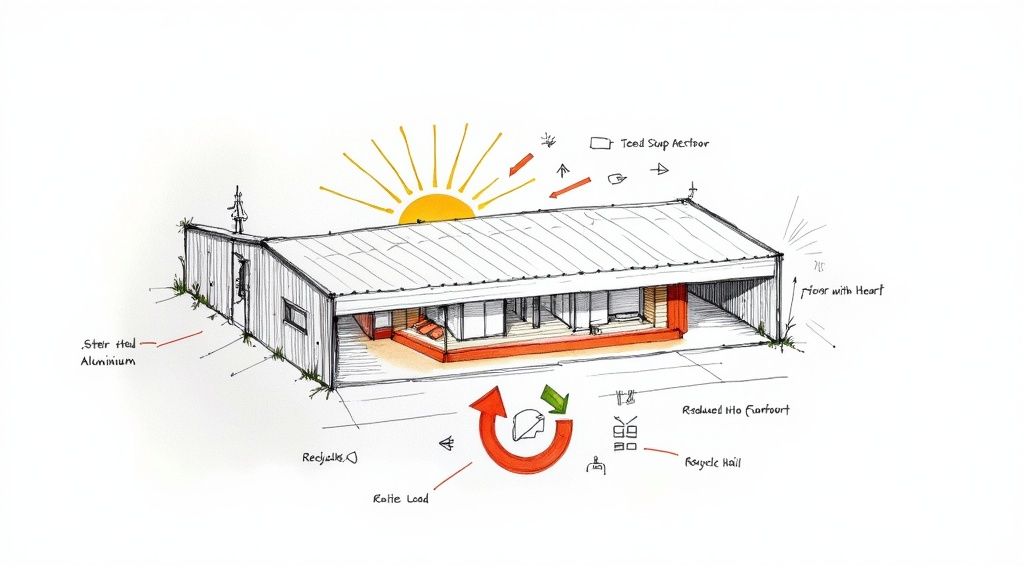
In Tucson, your HVAC is one of the biggest bills you've got. A metal roof with a reflective "cool roof" coating throws up a real shield against the sun beating down all summer.
You know how a black asphalt parking lot cooks your feet, but a light sidewalk doesn't? Dark soaks the heat up and throws it back at you. Light bounces it off. A cool-metal roof does that for the whole building, kicking a big share of the sun's heat right back at the sky.
Simple idea, and you can measure the payoff:
- Lower Surface Temps: The roof can run 50-60°F cooler than a dark one.
- Reduced HVAC Strain: Less heat works its way inside, so your AC isn't grinding away to keep the place livable.
- Real Energy Savings: Lighter load on the HVAC means smaller power bills and more years out of that expensive cooling gear.
On the big low-slope roofs you see on commercial buildings around here, that reflectivity is the whole ballgame. We dig into how the right coatings squeeze the most out of it in our guide on applying flat roof coatings in Tucson.
A Fortress Against Risk and Liability
A roof that fails isn't just a nuisance for a business. It puts your inventory, your equipment, and your ability to stay open all on the line. Metal's built from the deck up to handle that and keep the risk small.
Start with wind. Standing seam systems carry serious wind uplift ratings—the fastener patterns and clip systems are made to pin the roof down when a monsoon comes through swinging, so it doesn't peel off the way a weaker roof will.
Then there's impact. Metal roofs can hit a Class 4 impact rating, the top of the scale. That means they take a beating from hail and flying debris and barely show it. Big deal on its own, and it can bring your insurance premium down too.
A metal roof installed right answers the two weather threats that scare commercial owners most: high wind and bad hail. And it doesn't just save the building—it trims your insurance liability and keeps you from the kind of downtime that can sink a business.
A Powerful Story for Sustainability and ESG
Sustainability isn't a buzzword anymore—it's a number on the books. Companies are getting pushed harder every year to show real Environmental, Social, and Governance (ESG) progress, and a metal roof is something you can actually point to.
The environmental case is strong:
- High Recycled Content: Most roofing steel and aluminum already comes from a hefty share of recycled material, which takes pressure off new resources.
- Total Recyclability: When a metal roof finally gives out decades from now, it's 100% recyclable. It won't sit in a landfill for a couple hundred years like old shingles or membrane.
- Longevity Means Less Waste: A metal roof goes 50 years or more. So you skip the waste of ripping off and replacing a shorter-lived roof two or three times in that same stretch.
That "cradle-to-cradle" lifecycle puts metal roofing for commercial buildings near the top of the sustainable pile. It shrinks your carbon footprint, helps you hit ESG targets, and looks good to the customers who pay attention to that stuff.
Analyzing the True Cost of a Metal Roof
With metal roofing for commercial buildings, the first quote is just the opening line. To see the real story you've got to stop staring at the sticker price and start thinking about value over the life of the roof. That's what Life Cycle Costing is all about.
A cheaper traditional material looks great on paper. Then the real cost shows up over the years—repair after repair, fatter energy bills, and eventually the whole thing comes off and goes back on.
Breaking Down the Initial Investment
A handful of things set the up-front price on a new metal roof. Knowing them helps you see where the money goes, and why two quotes can land in different places.
- Material Selection: Like we said, it runs from budget-friendly Galvalume steel up to premium architectural metals like copper and zinc.
- Panel Profile: Standing seam hides its fasteners and takes more work to install, so it costs more than plain exposed-fastener panels.
- Building Complexity: A big plain rectangle is easy money. Pack the roof with vents, skylights, HVAC curbs, and odd angles and now you're into a lot more labor and custom flashing, and the price climbs.
- Labor and Expertise: The install isn't where you save. What you're paying for is a certified crew that actually gets thermal movement, fastening, and the weatherproofing details that make or break the roof.
Add those up and you've got your project cost. But that's only half the picture. It's your starting number, not what the roof costs you to own. For the full rundown on a replacement, our guide to getting a new roof in Tucson walks through the whole process.
The Other Side of the Ledger: Long-Term Value
Here's where metal leaves the rest behind. Other systems start a quiet countdown to expensive upkeep and replacement the day they go on. A metal roof starts paying you back instead.
The savings stack up from a few directions, and over the life of the building they take a serious bite out of what the roof costs to own.
The real money in a metal roof is in the costs you never pay. Wipe out whole replacement cycles, shrink the maintenance budget, knock down the monthly power bill, and the return adds up to far more than what you spent to put it on.
Here's how that value piles up over the decades:
- Dramatically Lower Maintenance: Metal asks for next to nothing past the odd inspection to check sealants and clear debris. No constant patching, no chasing seam repairs the way you do with other flat materials.
- Decades of Service Life: At 50 years or more, one metal roof outlives two or three traditional roofs. So you sidestep the giant capital hit of tearing off and replacing, over and over.
- Ongoing Energy Savings: The "cool roof" effect isn't one-and-done. It's trimming your HVAC load every sunny day, and around here that's most of them, so the savings just keep stacking.
- Potential Insurance Discounts: Metal handles wind, hail, and fire so much better that it can pull your annual premium down—another check that stays in your pocket.
Tally up all those long-term gains and the higher up-front price suddenly looks a lot smaller. It's not just an expense. It's money put into how well your building runs and how it holds its value.
Critical Installation and Maintenance Practices
Premium metal like Galvalume steel or aluminum is only half the job. You can buy the best panels made, and if they go on sloppy, the roof still fails. How your metal roofing for commercial buildings actually performs and how long it lasts comes down to the hands that put it up.
Think of a high-performance engine. Best parts money can buy, but if nothing's torqued to spec and fitted right, the engine's junk. A metal roof's the same. A small mistake at install time grows into a big, pricey problem a few years on.
That's why hiring a qualified, experienced commercial roofer isn't just smart—it's the part of the investment you don't skip. We know these systems cold and we sweat the small stuff that decides whether the roof holds.
Key Installation Details That Ensure Performance
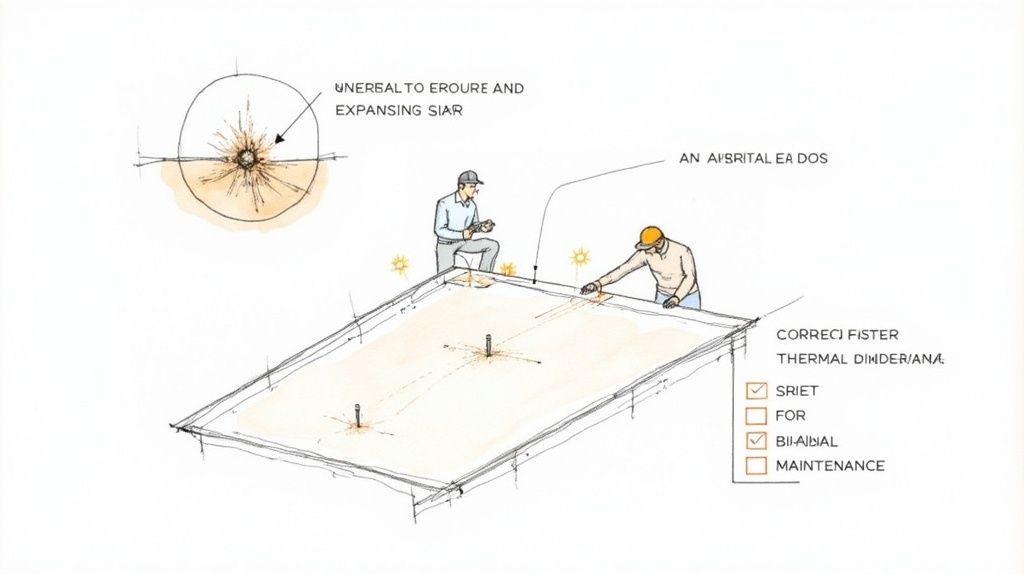
A real install is a lot more than screwing panels to a deck. It's a system that plans around Tucson's brutal heat, the way buildings move, and decades of wear.
Here's a few things a good crew won't get wrong:
- Proper Underlayment Selection: The underlayment is the roof's last line if water ever gets past the metal. In our heat you need a high-temp, self-adhering membrane—it takes the heat radiating off the panels and still seals tight.
- Accommodating Thermal Expansion: Metal moves a lot when the desert swings forty degrees in a day. A good installer uses a clip system, especially on standing seam, that lets the panels "float." Skip that and the fasteners get stressed and worn out, and that's a classic source of leaks.
- Correct Fastener Patterns: To hit a wind uplift rating—and you want that before monsoon season—the fasteners go in a precise pattern and count. Leave some out or use the wrong kind and the roof can't take a real storm anymore.
A metal roof done right is one integrated system. Every piece, from the underlayment to the last bit of trim, has to play together. The gap between a 50-year asset and a 10-year headache is exactly these install details.
A Proactive Approach to Maintenance
One of the best things about a metal roof is how little it asks of you. But low-maintenance isn't no-maintenance. A simple plan you stick to is how the roof gets to its full lifespan without surprising you.
A little prevention goes a long way—it protects what you spent and keeps the roof at its best for decades. Fixing a small thing an inspector caught is always cheaper than reacting to a blowout after it's flooded your building.
For commercial owners, the trick is just being consistent. We say a full checkup once or twice a year, which we lay out in our guide to professional roof inspection services.
Your Simple Commercial Roof Maintenance Checklist
A good maintenance plan isn't complicated. Hit a few key spots twice a year, usually spring and fall, and that's most of it.
- Clear Debris and Drainage Paths: Clear off the leaves, branches, and dirt piling up on the roof, in the gutters, and around the scuppers. Plugged drainage is the top cause of ponding water, and ponding leans hard on your seams.
- Inspect Sealants and Flashings: Get up close to the sealant around every penetration—vents, pipes, skylights, HVAC curbs. Years of sun dry sealant out and crack it. Catch it now and you stop a leak before it ever starts.
- Address Minor Surface Damage: Look for deep scratches or scuffs that went through the panel's coating. Clean the spot and touch it up with matching, manufacturer-approved paint, and you stop corrosion before it gets going.
Keep that simple routine and your metal roof stays the durable, no-worry asset you paid for on day one.
Making the Right Call for Your Commercial Property
A new roof is a big capital decision, not just an expense—it sets your building's value, your operating costs, and how well it holds up for decades. Pick metal roofing for commercial buildings and you trade a short-term cost mindset for long-term asset protection. You're keeping the doors open, cutting lifecycle costs, and bracing the place against Tucson weather and power bills that only go up.
Lean on durability, low upkeep, and real energy efficiency, and a metal roof stops being a cover and becomes part of how the building makes money. That up-front spend pays you back year after year—fewer repairs, no replacement cycles, smaller utility bills. The return is right there to measure.
Your Pre-Contract Checklist
Before you sign anything, get yourself a clear framework. Confidence comes from asking the right questions—of yourself, and of any roofer you're sizing up. It gets everybody on the same page and keeps you from expensive mistakes later.
A good roofing project runs on clarity. Spell out your goals, vet your contractor hard, and a complicated decision turns into a straightforward one.
Run through this before you lock in a plan:
- Property Goals: What's my number one goal here? Squeezing out maximum lifespan? Hitting an energy-savings target? Checking a sustainability box?
- Material and Profile Fit: Does the metal and profile they're pitching actually fit my building's structure, its look, and what Tucson's going to throw at it?
- Contractor Vetting: Has this contractor really done metal roofing on commercial buildings my size and complexity? Ask for case studies or local jobs you can go look at.
- Warranty Deep Dive: Do I get the difference between the manufacturer's material warranty and the contractor's guarantee on their own labor? Get them both in writing.
Answer those and you're the one in charge. You'll know enough to pick the right system, and just as much, the right crew to put it on so the roof actually does what it promised.
Your Top Questions About Commercial Metal Roofing
Even with all the upside spelled out, I get it. Owners have real questions about what it's actually like to live with a metal roof over their business. Let's knock down a few myths and get to the facts.
These are the ones Tucson building owners ask me most, from rain noise to whether they can go solar later.
Are Metal Roofs Noisy When It Rains?
This is probably the biggest myth going, and you can blame every old movie with a rainstorm on a tin shed. A commercial building is nothing like that. A modern commercial metal roofing system isn't a bare sheet of metal—it sits on a solid substrate with layers of insulation underneath it.
That whole sandwich kills the noise. The insulation and decking soak up the vibration, so a metal roof put on right is usually no louder in a monsoon downpour than a TPO or built-up roof would be.
How Do You Install Solar Panels on a Metal Roof?
This is one of my favorite parts. Putting solar on a metal roof, especially standing seam, is usually easier and more solid than on anything else. Standing seam is the gold standard for solar for one reason: clamps that don't poke a single hole.
Installers clamp the whole solar racking right onto the raised seams. That's zero holes, zero penetrations through the roof surface—which keeps your warranty good and leaves the roof just as watertight as the day it went on.
Other panel types can take solar too, using mounts and heavy-duty sealant, but the clamp setup on standing seam is the one I'd point any owner toward if solar's anywhere in the plan.
What Happens if a Panel Gets Damaged?
This is where a panel roof really earns it. On a single-ply membrane, one puncture can put a big area at risk. On metal, the damage usually stays put right where it happened.
- Minor Scratches: Cosmetic scuff that went through the paint? Clean it and touch it up with matching sealant. Quick fix, and it heads off any corrosion before it starts.
- Serious Damage: If falling debris really dents or punctures a panel, a roofer pulls that one panel and drops in a new one. Fast, affordable, and the rest of the roof never gets touched.
Fixing just the bad spot beats the alternative—systems that need a big messy patch over one point of failure.
Can You Install a Metal Roof Over an Existing Roof?
Yep. And a lot of the time it's the smart move. It's called a "retrofit" or "recover," and it lets us put a new metal roof straight over your old, failing flat or low-slope roof.
We build a sub-framing system that gives the new panels a dead-level, stable base to sit on. Done this way you save a ton—no cost, no mess, no business shut down for a full tear-off. It does come down to local code and how your existing deck's holding up, so we check that first.
Making the right call for your property really comes down to getting straight, honest information from somebody you trust. At Sunrise Roofers LLC, we build durable, efficient metal roofs made for what Tucson actually does to a building. Got more questions, or want a real look at your roof? We're family-owned, and no commission reps, no closers—you call, you get Eddie. Look at your options and book a no-pressure consult at https://roofwithsunrise.com.
Need roofing services in Tucson? Request a free inspection or call 520-753-1758. Related pages: Roof Repair · Roof Replacement · Service Areas.
Published by Sunrise Roofers LLC
Licensed & Insured Roofing Contractor · Tucson, AZ