10 Crucial Questions to Ask Roofing Contractor in Tucson
By Sunrise Roofers LLC · Oct 26, 2025 · 19-29 min read
Your roof takes a beating out here. The sun, the monsoon, the heat that warps everything by August. So picking the right contractor for a repair or a tear-off is a big call, and most folks walk into it blind. Pick wrong and you don't just get a rough afternoon. You get leaks, surprise charges, rotted decking nobody told you about, and a material warranty that quietly got voided the day the crew nailed it down wrong.
I'm Eddie. My wife Viky and I run Sunrise Roofers, and I got tired of watching Tucson homeowners get talked into roofs they didn't need by guys who'd be three counties over by the time the thing failed. So here's the list of questions to ask a roofing contractor before you sign anything or hand over a dime. Ask these and you'll see fast who actually knows our climate and who's just reading off a script.
We cover the boring-but-critical stuff first: license, insurance, the paperwork that saves your bacon if a guy falls off your roof. Then materials for the desert, what the job really costs, what the warranty actually covers, who pulls the permit, and who's cleaning up the nails in your driveway. None of it's complicated. You just have to ask. So ask.
1. What licenses, certifications, and insurance does your company carry?
Start here. Always. This one question tells you whether you're dealing with a real business or a guy with a ladder and a magnetic sign on his truck. A contractor without the right credentials puts the risk on you. If somebody gets hurt up there, or the work fails code, that's your problem now, not theirs. Don't let it be your problem.

In Arizona, a real roofer carries a license from the Registrar of Contractors, the ROC. Ours is #358079. That number isn't paperwork for paperwork's sake. To get it you have to prove experience, pass the trade exam, and post a bond. The bond matters to you because if a contractor takes your money and bails, or botches the job, that bond is something you can actually go after. No license, no bond, no recourse.
Why It's a Non-Negotiable Question
Here's how this goes wrong. A worker slips off your roof and breaks an arm. The contractor has no workers' comp. Guess whose homeowner's policy that lands on? Yours. Or his crew drops a bundle of shingles through your neighbor's skylight and there's no liability insurance to cover it. Now you're the one getting the lawyer's letter. This stuff is real, and it happens to nice people who just trusted the wrong guy.
Actionable Steps for Verification
Don't take anybody's word for it, mine included. A real company hands this stuff over without flinching.
- Get copies in hand: Ask for the Arizona ROC license, the general liability certificate, and proof of workers' comp. All three.
- Check it yourself: Take that ROC number and look it up on the Registrar of Contractors site. It'll show you if the license is active, in good standing, and whether anybody's filed complaints.
- Read the dates: Make sure the insurance is current and won't lapse halfway through your job.
- Look at the coverage number: General liability ought to run $1 million to $2 million for a house. That's standard. Anything less and I'd ask why.
Bottom line: Credentials aren't just a legal box to check. They tell you a guy plans to stand behind his work and be reachable when something goes sideways. Want to see what fully licensed and insured actually looks like? You can discover more about our team's credentials here.
2. How long have you been in the roofing business, and do you have references?
This one's about staying power. A brand-new company isn't automatically bad, but a roofer who's been around a while has weathered the hard jobs and has a stack of happy customers to show for it. We've been on Arizona roofs more than twenty years. When you've got that kind of history in one town, you can't afford to do shoddy work and vanish. Your name is on it.
Experience matters more here than most places. A roof in Tucson has to survive UV that'll fry a cheap shingle in a few summers, monsoon downpours that find every weak seam, and inspectors who know the local code cold. A roofer who's actually worked these conditions knows what holds up and what doesn't. Photos of finished jobs and a list of names you can call are how you prove that, not a sales brochure.
Why It's a Non-Negotiable Question
Hiring a roofer with no track record is a gamble, plain and simple. The fly-by-night guy will usually beat everyone's price. That's the bait. But a workmanship warranty from somebody who's gone in six months isn't worth the paper it's printed on. When the leak shows up, you're paying to fix it twice.
Actionable Steps for Verification
A roofer who's proud of his work loves this part. He'll point you to past customers without hesitating.
- Ask for three to five names: Recent ones, from the last year or two, on jobs like yours.
- Actually call them: Did the job finish on time and on budget? How was the cleanup? And the big one. Would you hire him again?
- Read the reviews: Pull up the company on Google, Yelp, and the BBB. Look at the rating, but read the comments too, especially how they handled the unhappy ones.
- Go look at a roof: If you can, ask to drive by a job they wrapped recently. Seeing the work beats hearing about it.
Bottom line: How a roofer treated his last hundred customers is the best read you'll get on how he'll treat you. A wall of solid work and folks who'd hire him again tells you plenty. See examples of our completed projects in our gallery and judge for yourself.
3. What roofing materials do you recommend and why?
What a roofer tells you to put up there says everything about whether he knows his trade. This question goes past the price tag. It tests whether he can match a roof to your house, your budget, and the brutal Tucson sun. If he gives you the same answer he'd give anybody, walk. Either he doesn't know enough to tailor it, or he's pushing whatever pads his margin.
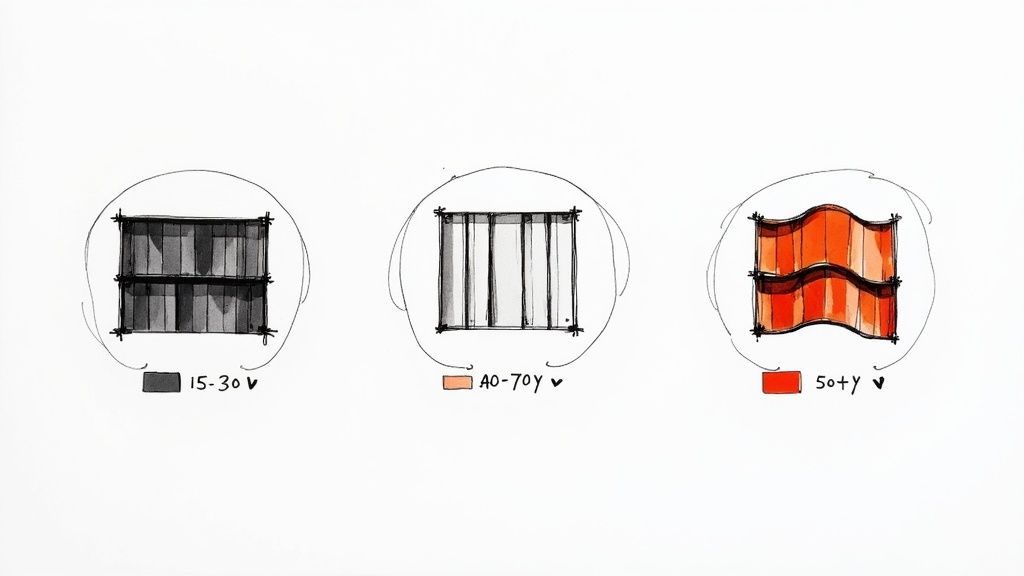
Down here the sun, the monsoon, and the swing between a 110-degree afternoon and a cool night ask a lot of a roof. A roofer who knows the desert won't just default to plain asphalt shingles. Maybe he steers you toward light-colored concrete tile that shrugs off heat, or standing-seam metal that bounces the sun right back and lasts decades. Whatever he picks, he should be able to tell you why in plain words. If it sounds like a pitch, it probably is.
Why It's a Non-Negotiable Question
The material is the single biggest thing driving how long your roof lasts and what it costs you to run the AC underneath it. Asking forces a roofer to show his hand. Is he advising you, or just selling? A guy who recommends a dark, heat-soaking shingle in Tucson and never once mentions what it'll do to your summer power bill isn't thinking about you. The right roof is a system that performs, not just something that looks sharp from the curb.
Actionable Steps for Verification
A roofer worth hiring is happy to talk materials all day and lay out a few ways to go.
- Ask for two or three options: Get an itemized quote comparing them, say good architectural shingles against metal. See the trade-offs side by side.
- Ask the desert question straight: "Why is this the best pick for the Tucson sun and monsoon season?" Listen to whether the answer holds up.
- Bring up the power bill: Are these materials ENERGY STAR rated, and how much will they knock off your cooling cost?
- Check the warranty fine print: Get the manufacturer warranty for each material, and make sure the roofer is certified to install it. A lot of those warranties are void if an uncertified crew puts it on. We're GAF-certified, which is exactly why that matters.
Bottom line: The right material isn't about curb appeal. It's about how the roof performs and what it saves you for the twenty-plus years it's up there baking. Curious why some options just plain win in the desert? You can explore the benefits of metal roofing in Tucson here.
4. What is the total project cost and what does it include?
You need to know exactly what your roof costs and what that number buys. A vague lump sum is where the surprises hide, and surprises in roofing are never the fun kind. A real pro hands you an itemized quote that spells out the whole job, materials through cleanup, line by line.
That detail tells you something. It means the guy actually climbed up, looked at your roof, and knows his pricing well enough to break it down. A scribbled "roof replacement, $8,000" with nothing behind it? That's a red flag. You have no idea where that money's going, and neither, half the time, does he.
Why It's a Non-Negotiable Question
An itemized quote keeps you from getting nickel-and-dimed, and it lets you actually compare bids. One guy looks cheaper until you notice he left out the permit and the dumpster, charges that show up later with a smile. When it's all written down, the quote becomes part of your contract, and the roofer's on the hook for exactly what he promised. Nothing more, nothing snuck in.
Actionable Steps for Verification
Never go on a handshake or a one-liner. Get it in writing and read the whole thing.
- Make him itemize: Labor, the actual materials with brand and type, permit fees, waste hauling. Each one on its own line.
- Ask about the what-ifs: What happens if he pulls the old shingles and finds rotted decking underneath? Is there a set price per sheet of plywood, or does he just bill you whatever?
- Look at the payment schedule: A fair roofer asks for a reasonable deposit, then payments tied to milestones. Never, ever pay the whole thing up front. That's how people get burned.
- Compare the same job: If you're gathering quotes, make sure everybody's bidding the same materials and the same scope. Otherwise you're comparing apples to oranges and the cheap one wins for the wrong reason.
Bottom line: How honest a roofer is about price tells you how honest he'll be about everything else. A written, itemized estimate isn't red tape. It's the thing that protects your money and keeps both of you on the same page when the work starts.
5. What is your warranty coverage and what does it include?
The warranty is your safety net if something goes wrong years down the line, whether it's a bad batch of shingles or a crew that nailed something wrong. Asking about it shows you how confident a roofer really is. A guy who'll stand behind his work for a long time is telling you he expects it to last that long. That's the kind of answer you want.
There are two warranties, and you need to know the difference. The manufacturer's warranty covers the materials themselves, the shingles, tiles, and underlayment, if they're defective. The workmanship warranty covers the roofer's labor, how the thing was actually installed. A leak from bad flashing is a workmanship problem, not a material defect, so the manufacturer won't touch it. That's why the roofer's own warranty matters just as much.
Why It's a Non-Negotiable Question
A thin workmanship warranty, or none at all, should make you nervous. Say a leak shows up a year in because the flashing was done wrong. The material maker won't cover that, so all you've got is the roofer's labor guarantee. A guy who only offers one year on his labor is basically telling you he's not sure his work survives a couple of Tucson summers. That leaves you holding the repair bill.
A certified roofer can offer a lot more. Through GAF, for instance, you can get enhanced coverage on both materials and labor, the kind of thing where a long material warranty is backed by years of workmanship coverage too. A company that can put that on paper is a company that plans to be around to honor it.
Actionable Steps for Verification
A spoken promise is worth nothing. A warranty only counts if it's written down with the terms spelled out.
- Get both in writing: The manufacturer's warranty and the workmanship warranty, both documented, both in your hands.
- Find out what voids it: Know what's covered, what isn't, and what stupid little thing might cancel it. Pressure-washing the roof or mounting a satellite dish wrong can do it.
- Ask if it transfers: Selling someday? A warranty that passes to the next owner is a real selling point. Worth knowing now.
- Know how to file a claim: If something fails, who do you call, and how fast do they get back to you? With us, you call, you get Eddie. No phone tree.
Bottom line: How long a roofer warranties his labor is a straight-up measure of how much he trusts his own crew. Don't settle for the bare minimum and leave yourself exposed. You can discover more about our team's credentials here.
6. What is your timeline for completing the project and what could delay it?
A roof replacement turns your house into a job site for a while, so you need to know how long. A roofer who's vague about the schedule, or who promises the moon, is waving a flag. A pro walks you through it phase by phase, material delivery to final sweep, and leaves a little room for the stuff that always comes up.
The answer also tells you how organized he is. A guy who swears he'll tear off and re-roof a complicated house in one day is either lying or about to rush it badly. Both end the same way, with sloppy work and a project that drags on for weeks anyway. A clear, honest timeline means he's got a plan and he respects your time.
Why It's a Non-Negotiable Question
A clear timeline kills the guesswork. Without one you're left wondering when the crew shows up, how long you'll be living next to a pile of tear-off, and when things go back to normal. A roofer who talks about delays up front, like a monsoon cell rolling in or a material that's back-ordered, is being straight with you. That's a good sign, not a bad one.
Knowing the schedule also lets you get ready. Put the dog somewhere quiet, give the neighbors a heads-up, move your cars off the driveway. And it pins the roofer to a real timeframe so the job doesn't just limp along for a month while you wait.
Actionable Steps for Clarity
Don't settle for a start date and an end date. Dig into how it actually unfolds and what could trip it up.
- Get the schedule in writing: Phase by phase, material delivery, tear-off, install, cleanup. On paper.
- Ask about weather: What happens when a storm rolls in mid-job? Does he bump to the next dry day, and how does he keep your open roof from getting soaked if the sky opens up? Out here that's not a hypothetical.
- Pin down the hours: When does the crew start, when do they knock off, and do they work weekends?
- Ask about the permit: Who pulls it, and how long does that take? It can push your start date, so you want to know going in.
Bottom line: A detailed timeline is the mark of a roofer who's actually run a lot of jobs. He knows what's coming and he tells you straight. See what a clean, no-surprises install looks like for a new roof in Tucson.
7. Will you handle permits and inspections, and who is responsible for each?
This question sounds like boring paperwork, but the answer decides whether your project is even legal. Permits and inspections aren't busywork. They're the law, and they exist so the work meets Tucson and Pima County code. A real roofer handles all of it without you lifting a finger.
Skip the permit and bad things follow. The county can slap a stop-work order on you, hand you a fine, or in the worst case make you tear the brand-new roof back off. And down the road, if you file an insurance claim, the carrier can deny it cold because the work was never permitted. Sorting out who's responsible before anybody climbs a ladder saves you all of that.
Why It's a Non-Negotiable Question
The permit is the roofer's job. Period. If a contractor asks you to pull it yourself, that's a big warning sign. Usually it means he isn't properly licensed, because the county wants a licensed contractor on that application. What he's really doing is shoving the liability onto you, so when something's not up to code, you're the one on the hook. Don't fall for it.
A roofer who knows the area knows the local rules and knows the inspectors by name. He builds the permit cost into his estimate and schedules the inspections himself, the mid-job checks and the final sign-off, so you don't have to chase any of it.
Actionable Steps for Verification
Get clear answers, in writing, before you sign anything.
- Ask point-blank: "Will your company apply for, pay for, and pull every permit this job needs?" Listen for a yes with no hedging.
- Check it yourself: You can call the City of Tucson or the Pima County building department and confirm what your job actually requires.
- Get a copy of the permit: Before work starts, have the roofer hand you the pulled permit. File it away.
- Nail down the inspection days: When do the inspectors come, and who from the crew is meeting them on the roof?
Bottom line: A roofer who handles permits and inspections smoothly is a roofer who knows this town. Curious what a real inspection actually checks? Discover what our comprehensive roof inspections cover here.
8. How do you handle unexpected issues discovered during the project?
No inspection sees through shingles. There's stuff you just can't know until the old roof comes off. That's why how a roofer handles surprises is one of the most important things to ask about. Rotted decking, a cracked rafter, even a critter that moved in years ago. Any of it can show up once the tear-off starts, and any of it can add cost and time.
How a roofer reacts to that moment separates the good ones from the rest. The good ones have a set way of telling you and getting your okay first, so you never open the final invoice and find a number you never agreed to. That keeps your budget yours and keeps you in charge of the job.
Why It's a Non-Negotiable Question
Picture opening a bill that's a couple grand over the quote because the roofer "found some bad wood" and just went ahead and replaced it. Never asked. That happens all the time when nobody nailed down a change-order rule at the start. A guy who does extra work without your say-so isn't treating you like the customer, and that's where the fights start.
Do it the right way and there's no fight. The roofer stops, snaps photos of the problem, and brings you a written price for the fix. Then you decide. You're not getting strong-armed into work you never signed off on. You're just being told the truth and given a choice.
Actionable Steps for Verification
Before you sign, know exactly how changes get handled. A straight-shooting roofer is glad to walk you through it.
- Put a change-order clause in the contract: Spell it out. No extra work happens without your written, signed okay. Full stop.
- Know who calls you: Who reaches out when something turns up, and how, phone, text, email? Quick word keeps the job moving instead of stalling.
- Make him show you: Require photos of any hidden damage before he writes up a change order. That's how you know the extra work is real.
- Ask the per-sheet price: Find out what he charges for the common stuff, like swapping a sheet of plywood decking. Now you've got a number to expect instead of a shock.
Bottom line: How a roofer deals with the unexpected tells you who he is. A clear change-order process isn't a warning that trouble's coming. It's the sign of a guy who's seen it all before and respects your wallet.
9. What safety protocols and insurance do you have for your workers?
Roofing is one of the most dangerous jobs in construction. That's not me being dramatic, it's the numbers. This question goes past liability insurance to how a roofer keeps his own people safe, which protects you too. A crew with real safety habits and real workers' comp is a crew run by somebody who takes the work, and the people doing it, seriously.
In Tucson there's a whole extra danger most people forget about. The heat. When it's 108 on the ground, it's pushing 140 on a dark roof, and heat exhaustion is as real a threat up there as a fall. Water breaks and shade aren't soft. They're survival. And here's the thing: a crew that cuts corners on keeping itself safe will cut corners on your roof too. It's the same mindset.
Why It's a Non-Negotiable Question
Hiring a sloppy crew can cost you in a way you'd never see coming. If a worker gets hurt on your roof and the contractor's short on workers' comp, those medical bills and lost wages can land on you. That's a big risk, and it's one you avoid just by asking one question up front. A crew that takes safety seriously is a crew whose job goes smooth from start to finish.
Actionable Steps for Verification
A good roofer will talk openly about how he keeps his crew safe. Here's how to check.
- Ask about training: Do they carry OSHA certification? Do they run a quick safety talk before each day to go over what's sketchy on this particular roof?
- Ask about fall protection: What kind of harness and tie-off system do they use on a steep roof? OSHA requires it past six feet, so there's a right answer here.
- Get proof of comp: Ask for a current workers' comp certificate, then call the carrier and confirm it's actually active. Takes five minutes.
- Ask about their record: How's their injury history? A crew that's proud of a clean record will tell you about it without blinking.
Bottom line: When a roofer spends money on safety and insurance, he's spending it on you too. It keeps the liability off your shoulders and tells you he runs a real operation.
10. How do you handle cleanup, and what's included in your contract?
A re-roof makes a mess. Old shingles, torn underlayment, packaging, and nails. So many nails. How a roofer cleans all that up says a lot about whether he respects your home. Blow off this step and you're left with a yard full of junk, a flat tire waiting to happen, and crushed plants where debris came down.
A good crew sweeps up as they go, every day, not as some afterthought on the last morning. And that should be written into the contract so there's no argument and no surprise charge later. "We'll clean up" isn't enough. You want the specifics, so your yard ends up the way you left it or better.
Why It's a Non-Negotiable Question
Skip this conversation and you can end up with a real headache. Roofing nails turning up in your driveway for weeks, waiting to bury themselves in a tire or a kid's bare foot. Rose bushes flattened because nobody bothered to tarp them before tearing off the roof above. A roofer who cleans up right keeps your family safe, your landscaping alive, and your whole experience a good one.
Actionable Steps for Verification
Don't assume any of this is automatic. Talk it through and get it on paper before you sign.
- Ask about daily cleanup: Does the crew tidy the site at the end of every day? It keeps debris from piling up and keeps the place safer while the job runs.
- Pin down "final cleanup": What does that actually mean? Do they run a magnetic roller over the lawn, driveway, and walkways to grab the nails you can't see?
- Ask how they protect your stuff: What's the plan for the landscaping, the AC unit, the pool, the siding? Tarps? Plywood shields? You want a real answer.
- Confirm the dumpster's in the price: Make sure hauling off the old roof is covered in the quote. You don't want a separate bill showing up for the debris.
Bottom line: How a roofer cleans up is the last thing you'll judge him on, and it sticks. The good ones leave your place as clean as they found it, sometimes cleaner.
10-Point Roofing Contractor Questions Comparison
| Question / Topic | Implementation Complexity 🔄 | Resource Requirements ⚡ | Expected Outcomes 📊 | Ideal Use Cases 💡 | Key Advantages ⭐ |
|---|---|---|---|---|---|
| What licenses, certifications, and insurance does your company carry? | Low — document verification 🔄 | Low — copies, online checks ⚡ | High — legal protection & liability reduction 📊 | Before hiring any contractor 💡 | ⭐ Protects homeowner; proves professionalism |
| How long have you been in the roofing business, and do you have references? | Medium — reference checks, site visits 🔄 | Medium — time to contact refs, travel ⚡ | High — assess reliability & track record 📊 | Selecting established contractor or large jobs 💡 | ⭐ Reduces hiring risk; verifies workmanship |
| What roofing materials do you recommend and why? | Medium — material evaluation by climate 🔄 | Medium — samples, manufacturer data ⚡ | High — optimized durability & cost-effectiveness 📊 | New roofs; climate-specific choices 💡 | ⭐ Better lifespan and value with right choice |
| What is the total project cost and what does it include? | Medium–High — itemized estimating 🔄 | Medium — labor/material/permit cost data ⚡ | Critical — prevents surprise charges, budget clarity 📊 | Comparing bids; budget planning 💡 | ⭐ Transparent pricing; dispute prevention |
| What is your warranty coverage and what does it include? | Low–Medium — review warranty docs 🔄 | Low — warranties and contract copies ⚡ | High — post-completion protection and recourse 📊 | Projects where long-term coverage matters 💡 | ⭐ Protects against defects; boosts resale value |
| What is your timeline for completing the project and what could delay it? | Medium — schedule creation & buffers 🔄 | Medium — coordination with crews/permits ⚡ | Medium — clearer expectations and planning 📊 | Time-sensitive or seasonal projects 💡 | ⭐ Sets realistic expectations; reduces disruption |
| Will you handle permits and inspections, and who is responsible for each? | Medium — permit application coordination 🔄 | Medium–High — fees, inspector coordination ⚡ | Critical — code compliance & legal protection 📊 | Any reroofing requiring permits 💡 | ⭐ Ensures compliance; avoids insurance issues |
| How do you handle unexpected issues discovered during the project? | High — inspection, change-order process 🔄 | Medium — assessment costs, contingency funds ⚡ | High — controls scope and reduces disputes 📊 | Older roofs or hidden-damage risk 💡 | ⭐ Transparent change management; cost control |
| What safety protocols and insurance do you have for your workers? | Medium — safety planning & training 🔄 | High — safety equipment, insurance premiums ⚡ | High — fewer injuries; liability protection 📊 | All roofing projects, especially steep/high roofs 💡 | ⭐ Protects workers and homeowner; indicates quality |
| How do you handle cleanup, and what's included in your contract? | Low–Medium — daily/final cleanup procedures 🔄 | Low — dumpster, labor, protection measures ⚡ | Medium — property protection and professional finish 📊 | Homes with landscaping or tight sites 💡 | ⭐ Prevents debris issues; preserves property |
Making Your Final Decision with Confidence
You're not just a homeowner with a roof problem anymore. You know what to ask, and that changes the whole conversation. This list of questions to ask roofing contractors is your guide through one of the bigger investments you'll make on your house. The goal was never to find the cheapest guy. It's to find one who'll do right by your home.
Here's a tip. How a roofer reacts to your questions tells you more than what he says. Does he welcome them, or does he get squirmy and start dodging? A confident roofer has the answers ready, ROC number to cleanup plan, no fumbling. That openness is what an honest business looks like.
From Questions to a Confident Choice
Think of it like a test you wrote yourself, and now you're grading the answers. Look past the surface and weigh the whole package. That low bid gets expensive fast if it's skipping the good underlayment your roof needs to survive the Tucson sun, or the liability insurance, or any plan for the rotted decking they'll probably find.
The takeaway: The best roofer is rarely the cheapest one. The best roofer gives you the most value over time, fair price, materials built for the Sonoran Desert, an install done right, and a warranty that actually holds.
As the bids come in, get organized. A simple spreadsheet or a side-by-side chart does the trick. Lay them out and judge each one on the stuff we've covered:
- Credentials and staying power: Is the license current? Have they built a solid name in Tucson over the years?
- The actual roof: Are they spec'ing good synthetic underlayment and reflective shingles to fight our heat, or just the cheapest thing on the shelf?
- Honest pricing: Is the estimate one mystery number, or a line-by-line breakdown that explains every charge?
- What backs it up: What does the warranty really cover? Is the manufacturer behind it? Do they carry enough insurance to keep you safe?
The Ultimate Goal: Peace of Mind Under Your New Roof
Get good at this and it pays off every time. You walk into the conversation knowing you're buying a whole roofing system built to take the monsoon and years of hard sun, not just a stack of shingles. Asking these questions to ask roofing contractors is how you take the risk out of the job and stack the odds in your favor.
And the payoff lasts. You won't lie awake wondering if somebody cut a corner or whether the roof gives out early. You'll know you hired a real one who stands behind the work. Your home is the biggest thing you own, and the roof over it. That's worth this much care. So go ask the hard questions, and pick the roofer who answers them straight.
Ready to see how a top-tier Tucson contractor answers these critical questions? The team at Sunrise Roofers LLC prides itself on transparency and education, providing detailed, photo-documented inspections and clear, comprehensive proposals. Visit Sunrise Roofers LLC to schedule a no-obligation consultation and experience the difference that a truly professional roofing partner can make.
Need roofing services in Tucson? Request a free inspection or call 520-753-1758. Related pages: Roof Repair · Roof Replacement · Service Areas.
Published by Sunrise Roofers LLC
Licensed & Insured Roofing Contractor · Tucson, AZ