Hiring a Tucson Roof Coating Specialist
By Sunrise Roofers LLC · Nov 4, 2025 · 12-18 min read
So what is a roof coating specialist, really? It's somebody who does one thing: lays down liquid membranes that seal, restore, and add years to the roof you already have. Out here in Tucson the sun chews up roofs, so we lean on these coatings hard. A bright white "cool roof" system buys you life on the membrane and shaves a real chunk off your summer cooling bill. That's the whole pitch.
Why a Specialist Matters for Your Tucson Roof
A good general roofer can handle plenty. But coatings are their own animal, and out here in the Sonoran Desert that matters more than folks think. A specialist knows the formulas cold — which one stays put through a 110-degree afternoon, which one shrugs off a monsoon, which one peels by next summer. We've watched all three happen on real Tucson roofs. You want the person who has too.
And no, the job isn't painting a roof white. It's the prep nobody sees — washing the surface down, chasing every crack, getting the whole thing clean and tight so the coating actually grabs. That's the boring part. It's also the part that gets skipped, which is exactly why so many DIY and rushed jobs are bubbling and peeling inside a year or two.
The Shield Against Sun and Storms
Your Tucson roof fights two things, mostly: UV that never lets up, and monsoon rain that shows up out of nowhere and comes down hard.
A coating laid down right — elastomeric or silicone — gives you one seamless waterproof skin that flexes with the swings. That flex is the whole game. The roof bakes and grows in 100°-plus heat, then cools and shrinks overnight, and a good coating moves right along with it instead of cracking.
Then there's the cool-roof part, and that one shows up on your bill. A solid reflective coating can knock a roof's surface temperature down 50-60°F. Cooler house. AC that isn't running itself ragged all afternoon.
A coating done right isn't a patch — it buys your roof years and your AC a break. A lot of folks earn that cost back through lower energy bills and by pushing off a full tear-off-and-replace for a good while longer.
A Growing Industry for a Reason
More people are asking about these systems every year, and it makes sense. Folks want to cut their energy use, and this is one of the easier ways to do it. The global roof coatings market already sits around $3.7 billion and keeps climbing, especially across North America where elastomeric coatings just fit the climate.
Going with a specialist is how you get your money's worth out of it. They know which products actually survive a Tucson summer and they've got the gear to put it down clean. Look at a real Tucson flat roof coating transformation sometime — a tired, heat-soaking roof turned into a bright white shield. The before-and-after says it all.
Finding the Right Roof Coating Experts in Tucson
Don't let a Google search be the whole hunt. The best coating crews in Tucson usually come up by word of mouth, because a roof that's still holding five years later is worth more than any ad.
So ask around. Knock on a neighbor's door if their white roof still looks clean. Ask your real estate agent who they'd send their own clients to. The pro desk at a local supply house hears who does good work and who doesn't. You're listening for the same name to keep coming up — the one people trust on a desert roof.
Got a short list? Good. Now do the digging.
Verify Their Credentials and Reputation
Before you call anybody for a quote, make sure they're a real, legit company. Ten minutes now saves you a world of grief later.
- Arizona Registrar of Contractors (ROC): Start here. Pull up the ROC website and type in their license number. Active? In good standing? No license, no deal — it means they aren't legally cleared to touch your roof. Ours is ROC #358079, by the way. Check it.
- Better Business Bureau (BBB): Pull their profile on the BBB. An A+ is nice, but watch how they handle a complaint. Anybody can be great until something goes sideways. A stack of unresolved gripes tells you plenty.
- Online Reviews: Read the Google, Yelp, and Angi reviews — but read them like a skeptic. A one-line "great job" is worthless. You want the long ones that walk through the whole thing, first phone call to final cleanup.
One piece of advice that'll save you: hire someone whose bread and butter is coatings. Plenty of roofers tack it on as a side gig. A specialist does it day in, day out — they bought the training and the equipment, and they know how to prep a roof so the coating survives a Tucson summer.
Focus on True Specialists
Poke around their website for proof. Do they actually talk about silicone versus elastomeric, or do they just say "we do coatings"? Is there a gallery with local jobs, real Tucson roofs they've done?
A shop with a full lineup of Tucson roofing services can be great — just make sure coatings are something they truly know, not a checkbox. Real focus usually means real prep equipment and crews who keep up their training. That's the gap between a coating that taps out at 3 years and one that's still working at 15. Don't hire a jack-of-all-trades here. Hire someone who's a master of this one.
Choosing the Right Coating for a Desert Climate
It helps to know a little about the materials before a contractor ever walks your roof. Not every coating is built for Tucson sun and monsoon rain. Get the basics of the big three — acrylic, silicone, elastomeric — and you can actually talk shop with your roofer instead of nodding along while he picks one for you.
Think of it like tires on a truck. Racing slicks are no good off-road. Same deal here — the coating has to match your roof material, the shape it's in, and whatever the desert is going to throw at it.
Decoding the Coating Options
Here's the rundown on what you'll hear about. A good specialist walks you through it on-site, but knowing the basics helps you ask sharper questions.
- Acrylic Coatings: Water-based, popular, and easy on the budget. Today's acrylics reflect heat well, bouncing UV off the house and trimming the summer cooling bill. They're tough and they breathe. Where they struggle is standing water — let it pool and acrylic doesn't love it.
- Silicone Coatings: For pure waterproofing, silicone wins. It lays down as one solid skin that laughs at ponding water, which is why it ends up on so many flat and low-slope roofs around town. UV doesn't faze it either — it won't go brittle and crack under the sun.
- Elastomeric Coatings: More of a catch-all term, and it often covers the higher-end acrylics. The name tells you the point — it stretches and snaps back. That's a big deal here. Roof swells in the heat, shrinks overnight, and elastomeric rides along with it, bridging the little cracks instead of splitting.
A real specialist gets on the roof and figures out the fit from up there. Say you've got a flat roof that turns into a pond every time a monsoon cell parks over your block — nine times out of ten they're steering you to silicone. Read up on what flat roof coating in Tucson actually does and how these materials hold up out in the real weather.
Tucson Roof Coating Comparison
Here's a quick side-by-side of the coatings we run into most around Southern Arizona. Each one has its spot, depending on the roof and what matters to you.
| Coating Type | Best For | UV Resistance | Waterproofing | Typical Cost |
|---|---|---|---|---|
| Acrylic | Pitched roofs, budget-conscious projects | Excellent | Good | $$ |
| Silicone | Flat roofs with ponding water issues | Excellent | Superior | $$$ |
| Elastomeric | Most roof types, bridging small cracks | Very Good | Excellent | $$-$$$ |
The table's just a jumping-off point. The right call always comes down to somebody actually looking at your roof.
The Rise of Cool Roof Technology
The push to use less energy has dragged coatings forward fast. "Cool roof" tech is just standard now, and around Tucson it's one of the better tools we've got against all that trapped city heat. The good coatings reflect up to 90% of sunlight right back off — roof stays cooler, and so does the house under it.
A pro's recommendation isn't a favorite color. It's building science. We look at the slope, what's already up there, and how much sun the roof eats all day, then pick the system that'll hang on the longest.
The numbers back it up. The cool roof coatings industry was worth $4.03 billion back in 2022 and keeps climbing as more homeowners hunt for ways to cut their energy use.
This decision tree is a simple way to size up a contractor before you ever get into the weeds on materials.
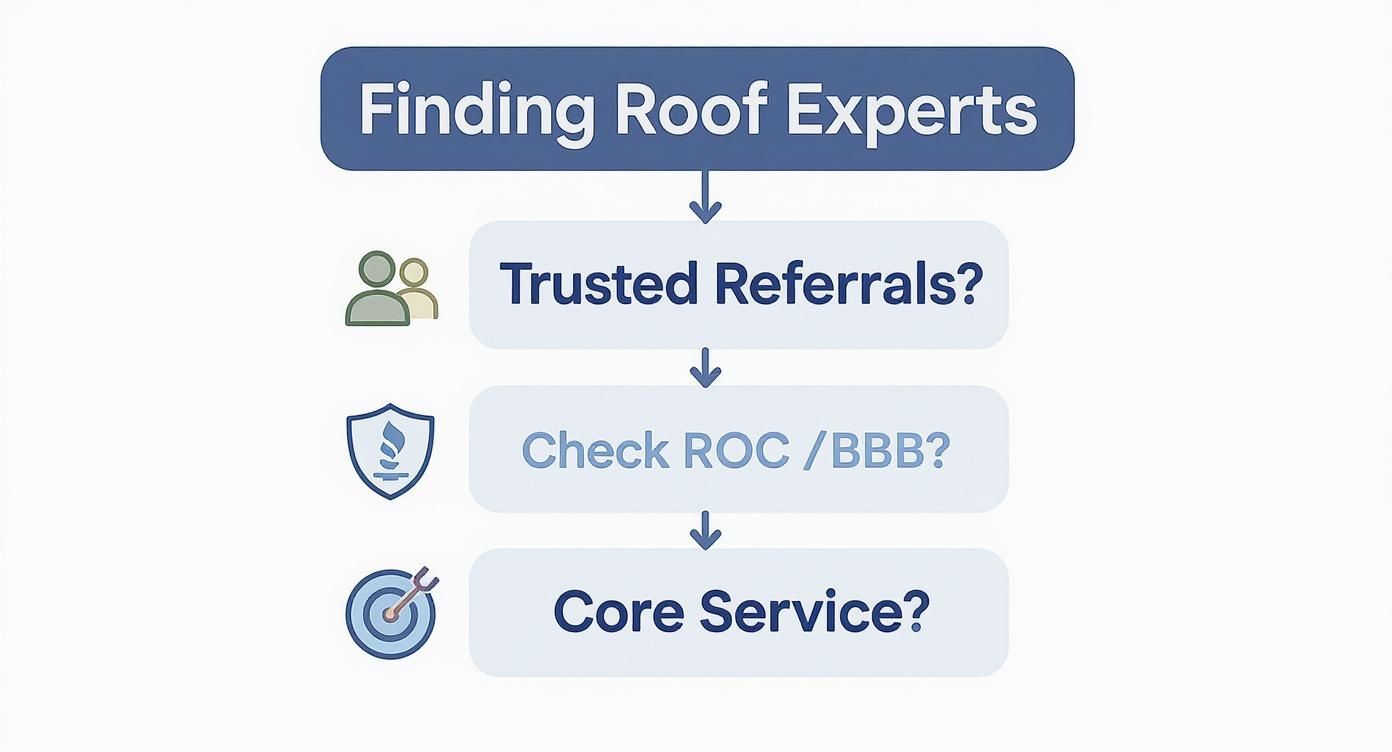
Run these checks first and you'll only be talking materials with people who are actually qualified and know what holds up out here.
How to Vet Your Shortlist of Contractors
Got a couple of names you like? Now the real homework starts. This is where you tell a true coating specialist apart from the outfit that just lists "coatings" somewhere on a menu of a dozen services. Get past the five-star reviews and ask the questions that show whether they actually know their stuff.
The first round of checks isn't optional. A legit contractor hands this over without a fuss. If pulling it out of them feels like a treasure hunt, there's your first warning.
Verifying the Essentials
Run a quick background check before you ever dial. In Arizona it's easy, and it's your best shield against the uninsured, unlicensed guys who can leave you holding the bag for an accident or a botched job with nowhere to turn.
- Arizona ROC License: Go to the Arizona Registrar of Contractors (ROC) site and punch in the license number. You want active, in good standing. CR-42 is the roofing classification. While you're there, see if any complaints are sitting open.
- Proof of Insurance: Don't take their word. Ask for the certificate of insurance, and make sure it shows both general liability and worker's comp. Liability covers your house if something gets wrecked. Worker's comp covers you if a crew member gets hurt on your property — and roofs are where people get hurt.
- Local Portfolio and References: Ask for photos, or even addresses, of coating jobs they've finished right here in Tucson. A wall of Phoenix projects doesn't tell you much about how they handle our roofs. A specialist worth hiring is glad to show off local work and can hand you names you can actually call.
A real specialist can email all of this over in one PDF without breaking stride. If a contractor gets cagey or starts making excuses when you ask for the ROC number or the insurance cert, walk. That's your answer right there.
Questions That Reveal True Expertise
Basics handled? Now find out what they actually know. How they answer these questions tells you most of what you need. You'll know fast whether they understand why a coating lives or dies out in this desert.
Get them on the phone, or better, on your roof for the estimate, and ask sharp questions about their process. Hand-wavy answers are a warning sign.
"What is your exact process for surface preparation?"
This is maybe the most important thing you'll ask. The answer should run long and cover way more than a hose-down. A pro talks about high-pressure washing (often 2,500-4,000 PSI), scraping off the old flaking coating, and patching every crack, seam, and pipe penetration with mesh and mastic. If all you get is "we clean it," keep pushing till they give you the details."Which specific product do you recommend for my roof, and why?"
There's no single coating that's right for everything, and a specialist knows it. Their answer should hinge on your roof — what it's made of, like rolled roofing or modified bitumen, how it's pitched, and whether water sits up there after a rain. They ought to lay out silicone versus acrylic for your roof, plain and simple."What does your workmanship warranty cover and for how long?"
Listen hard here. You're getting two warranties — one from the product manufacturer, one from the contractor on the labor. A roof coating specialist who trusts their own prep and application backs it with a real workmanship warranty. See how the established roofing contractors in Tucson build their crews and warranties so customers stay happy years out. A thin warranty that only covers "leaks" won't do you any good when bad prep starts peeling and bubbling a couple years down the line.
Diving Into the Quotes and Contract
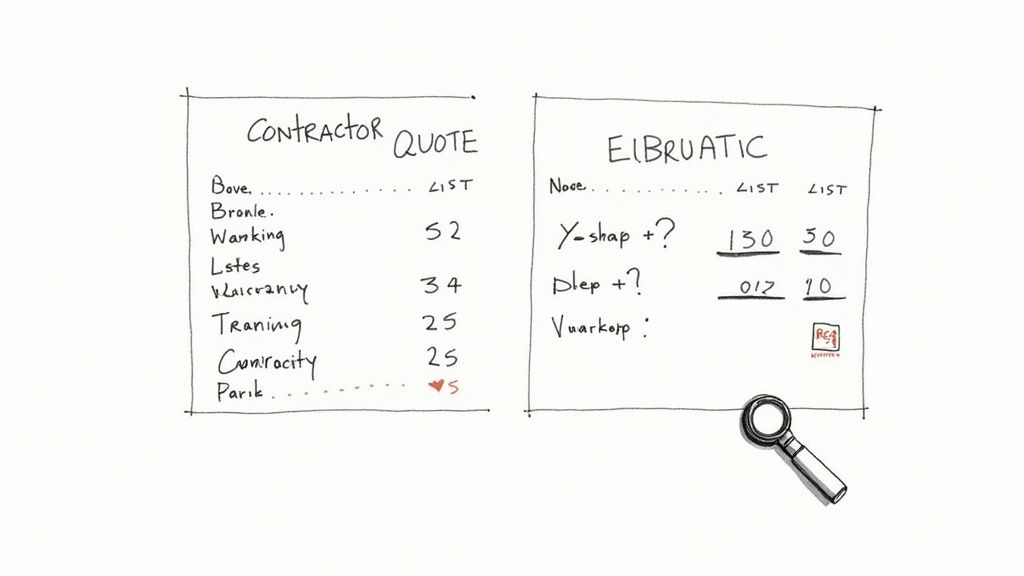
Give it a few days and the quotes start landing in your inbox. Now you decide — and no, it's not about grabbing the lowest number. You've got to compare apples to apples.
A bid that's way under everyone else? That's the biggest red flag in the whole deal. It means corners are getting cut somewhere — cheap coating, rushed prep, a green crew, take your pick. A real coating pro hands you a detailed, plain quote with nothing left to guess at.
How to Break Down the Quote
A good quote is a blueprint, not just a bill. It spells out what you're paying for, line by line. Anything vague? Ask. Make them explain it.
A solid quote always has:
- Product Specs: It needs to name the brand and type of coating — "GacoFlex S2100 Silicone," say, or "Tucson Rubberized 7000." If all it says is "white elastomeric coating," that doesn't cut it.
- Prep Work Details: This one's big. The quote has to list the whole prep — pressure washing, scraping off loose material, patching cracks with fabric and mastic, primer where it's needed. Everything else rides on this part.
- Labor & Material Costs: Broken out, not lumped together. You want to see where the money's actually going.
- Warranty Info: Both warranties, in writing — the manufacturer's on the product and the contractor's on the workmanship.
Scope of work is everything. A low price means nothing if the contractor cheaps out on the tedious prep. That prep is the difference between a coating that goes ten years and one that quits on you in two.
Reading the Fine Print in the Contract
Once you've picked your contractor, the contract makes it real. It's there to protect both sides, so read every line before you sign. All of it.
Pay close attention to the payment schedule, the timeline, and what happens if they crack open the old coating and find a surprise underneath — say, hidden rot in the deck.
A good contract also spells out cleanup and mentions lien waivers. A lot of why folks choose Sunrise Roofers in Tucson comes down to exactly this kind of detail — we button it all up so nothing's left hanging over your head. Your signature locks the whole thing in, so make sure the terms are clear, fair, and match what you talked about. And never sign a blank or half-finished contract. Ever.
Common Questions About Tucson Roof Coatings
Even after you've worked through contractors and quotes, a few real-world questions always pop up. The homeowners I talk to want to know what living with a coated roof out here actually looks like. Straight answers up front keep your expectations where they should be.
Think of your coating like sunscreen. It works hard, but the Sonoran sun wears it down over time, and eventually it needs a fresh coat to keep doing its job.
How Often Should a Roof Be Recoated in Tucson?
Probably the question I get most. Honest answer? It depends — on how good the coating is and what your roof goes through day to day.
A quality elastomeric or silicone coating, put down right here in Tucson, usually runs you 5 to 10 years. What moves that number:
- Product Quality: There's a real gap between a premium coating with high solids and good UV inhibitors and the bargain stuff. Better material lasts longer. That's just how it goes.
- Sun Exposure: A roof that takes full sun all day with no shade burns through its coating faster than one that catches a little break come afternoon.
- Drainage: If you've got low spots where water sits after a rain, that standing water leans hard on the coating right there.
Best way to stay ahead of it is having a specialist take a quick look once a year. We catch the wear early and help you line up a recoat before it turns into a leak.
Can I Just Apply a Roof Coating Myself?
Sure, the big box stores stock DIY coating buckets. For a full roof, though, I'd steer you off it. A coating job is 90% preparation and 10% application, and the prep is where a specialist's experience earns its keep.
The number one reason coatings fail — peeling, blistering, bubbling — is bad surface prep. A pro shows up with industrial power washers, grinders, and the patching materials to get the surface clean and solid so the new coating actually grabs and holds. Skip that, and you'll probably be paying somebody to redo it a year or two out.
When Is the Best Time of Year to Coat My Roof?
Timing matters here. A coating has to cure into one tough, seamless waterproof skin, and that only happens if the weather cooperates.
Tucson gives us two good windows: Spring (March to May) and Fall (October to November). Moderate temps, low humidity — the coating dries and cures the way the manufacturer drew it up.
No roofer worth a darn is going to jam a coating job into the middle of monsoon season or onto a 110-degree afternoon. Work outside that window and you're gambling with the whole job. We schedule it right so you get a roof that actually lasts.
Ready to protect your home with a professionally applied roof coating? The team at Sunrise Roofers LLC has the specialized experience to get the job done right, ensuring your roof can handle Tucson's toughest weather. Get your free, no-pressure estimate today.
Need roofing services in Tucson? Request a free inspection or call 520-753-1758. Related pages: Roof Coatings · Roof Repair · Roof Replacement · Service Areas.
Published by Sunrise Roofers LLC
Licensed & Insured Roofing Contractor · Tucson, AZ