Choosing Roofing Companies in Tucson a Guide
By Sunrise Roofers LLC · Dec 1, 2025 · 14-22 min read
Picking the right roofer in Tucson isn't something to do on a whim. The crew you hire is your real defense against the Sonoran sun and our monsoon storms. A simple, honest vetting process is how you cut through the noise and land on people you can actually trust on your roof.
How to Start Your Search for Tucson Roofers
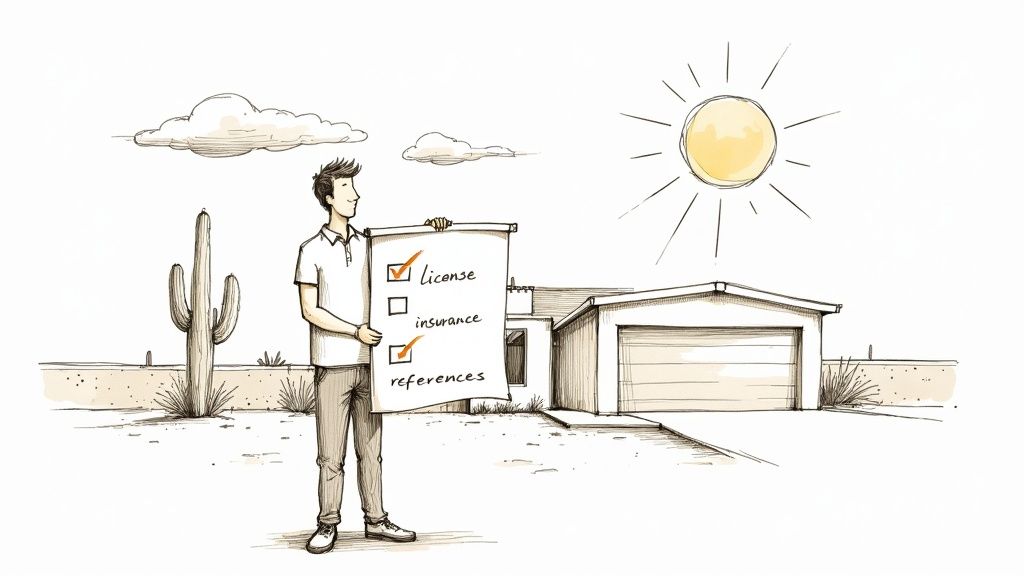
The whole search feels like a lot until you break it down. Before you call anybody for a quote, build a short list of roofers based on the basics. That one screening step saves you a pile of time by knocking out the unqualified and the shady right off the bat.
Look at it this way. You wouldn't build a house on a bad foundation. So don't hand your most important shield to a contractor who hasn't shown they're legit from the start. This isn't about the cheapest price. It's about people who get what a Tucson roof actually goes through.
Building Your Initial Shortlist
Start by pulling a few names from sources you trust. A quick online search is fine to get rolling, but don't stop there. Here's where the good leads usually hide:
- Word-of-Mouth: Ask a neighbor, friend, or coworker who's had roof work done lately. A referral from somebody you actually know is worth its weight in gold.
- Local Real Estate Agents: Realtors deal with contractors all the time. They usually know who has a solid name around town for doing the job right.
- Building Supply Houses: The folks behind the counter at the roofing supply store see who's busy, who's respected, and who keeps buying the good materials.
Once you've got three to five companies, run a quick background check on each. This part is about the non-negotiables, the stuff any contractor has to clear before you'd even let them on your property.
This step isn't about choosing your roofer yet. It's about cutting any company that can't clear the bare minimum to work on your home.
The Non-Negotiable Vetting Checklist
Before you spend an afternoon scheduling estimates, run every company on your list through this quick check so you're only talking to real, professional outfits. Any solid company offering a full range of Tucson roofing services has this stuff on hand and hands it over without blinking.
The table below helps you screen companies on the essentials before you even pick up the phone.
Tucson Roofer Vetting Checklist
| Qualification Check | Why It Matters in Tucson | How to Verify |
|---|---|---|
| Active ROC License | This is your protection. It ensures they meet state standards and gives you a path for recourse if something goes wrong. | Look them up on the Arizona Registrar of Contractors (ROC) website. |
| Proof of Insurance | This protects YOU from liability if there’s an accident or property damage. No exceptions. | Ask for a Certificate of Insurance (COI) for both general liability and workers' comp. |
| Established Local Presence | Shows they’re committed to our community, won't disappear after the job, and understand our unique climate challenges. | Check for a physical business address, look at local project photos, and read local reviews. |
| Positive Online Reviews | Gives you real insight into how they communicate, the quality of their work, and how they handle problems. | Scan Google, BBB, and Yelp. Focus on recent, detailed reviews, not just star ratings. |
Lock down these basics early and you're the one steering. The whole project goes smoother and safer from day one.
Verifying Roofer Licenses and Insurance

This is the most important check you'll ever run on a Tucson roofing company. Set the slick sales pitch aside for a second. This is where you protect your home, your bank account, and yourself from a world of headaches.
Hiring an unlicensed or uninsured roofer isn't a small gamble. It's asking for trouble. A worker gets hurt on your property and the company has no workers' comp? You could be stuck with the medical bills. Seriously. They drop a pallet of shingles on your neighbor's brand-new AC unit and carry no general liability? Now that fight is yours.
This isn't red tape. Checking credentials is what keeps you covered.
How to Check a Roofer's License
In Arizona, roofing is a licensed trade, full stop. The Arizona Registrar of Contractors (ROC) is the agency that keeps everybody honest. Any job over $1,000, counting materials and labor, legally has to be done by a licensed contractor.
Don't just take their word for it. Check it yourself. The ROC makes that part easy.
- Get their ROC license number. A legit roofer has it on the truck, the business card, and every estimate. If they drag their feet handing it over, that's a red flag right there.
- Go to the ROC website. Pull up the official Arizona Registrar of Contractors site on your phone or laptop.
- Use the "Contractor Search." Searching by license number gets you a direct hit, but the company name works too.
In about thirty seconds you'll see whether their license is active, expired, or worse, suspended. The same search pulls up any formal complaints filed against them, which tells you a lot about their track record.
What to Look For on the ROC Profile
Once you're on their profile, don't just see "Active" and call it good. Dig a little.
- License Class: Make sure it's actually a roofing license. For residential work you want the "R-42" classification.
- Bond Info: Arizona makes contractors carry a bond. It's a small safety net for you if the roofer walks off the job or stiffs their suppliers.
- Complaint History: This one's gold. It shows you how the company handles things when they go sideways. A long list of unresolved complaints? Walk away.
A clean, active ROC license is the floor, not the ceiling. Find a suspended one, an expired one, or a trail of ugly complaints, and that company comes off your list. Done. This isn't a corner you can cut.
Understanding the Two Must-Have Insurance Policies
Past the state license, proper insurance is flat-out required. Every pro roofer carries two policies, and you ask for a Certificate of Insurance (COI) to prove it. That's a standard document from their insurance agent showing the coverage is live.
Here's what you want to see on that COI:
- General Liability Insurance: This covers accidental property damage. A ladder falls and shatters a window, a truck backs into your garage door, this is the policy that pays for it. Look for at least $1,000,000 in coverage. Roofing accidents get expensive in a hurry.
- Workers' Compensation Insurance: This one's huge. It covers the medical bills and lost wages if a crew member gets hurt on your property. Without it, the homeowner can get sued to cover those costs. It happens.
Once you've got the COI, do one last thing. Call the insurance agency named on the certificate and ask if the policy is still in force. That quick call proves the document is real and the roofer hasn't let their coverage lapse.
Do all that and you know you're dealing with real pros who work safe and stand behind their crew. To see how an upfront company lays this out, read about our roofing contractors in Tucson and how seriously we take being fully licensed and insured.
Prioritizing Experience with Tucson's Climate
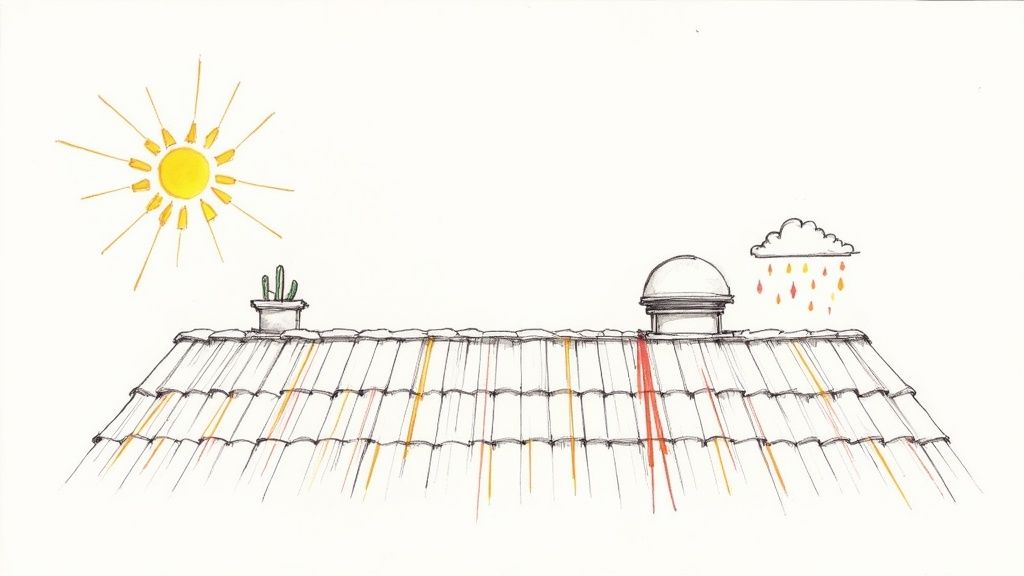 A roof that holds up fine somewhere mild can come apart out here in the Sonoran Desert. Tucson weather isn't just hot. It's a brutal mix of blistering UV, monsoon deluges that hit out of nowhere, and temperature swings that beat the daylights out of building materials.
It's not really about the heat. It's the cycle of extremes, and that takes local know-how.
Hire a roofer who doesn't get those challenges and you're signing up for early leaks, cracked tile, and pricey repairs later. Somebody from out of town puts on a standard roof. A local expert puts on a Tucson-proof one. They've seen with their own eyes which materials cook under our sun and which ones actually go the distance.
It's More Than Just Sun and Rain
The UV in Southern Arizona does more than heat up your attic. It chemically eats away at roofing materials over the years, especially asphalt shingles and some underlayments. A roof that'd go 25 years somewhere else can lose a big chunk of that life without the right products and the right install.
Then the monsoons hit. This isn't a gentle rain. It's a sudden, violent downpour that can dump an inch of water in under an hour, and it leans hard on your flashing, seals, and drainage. A roofer who's never worked through one just doesn't understand how much rides on the flashing around chimneys, vents, and skylights.
A seasoned Tucson roofer isn't just nailing down shingles. They're building a system that manages extreme heat, reflects the UV, and carries a torrential monsoon rain safely off your house. That local know-how is the line between a roof that merely covers the place and one that guards it for decades.
Asking the Right Climate-Specific Questions
When you're talking to roofing companies in Tucson, dig into their local experience. Their answers tell you fast whether you've got a real desert pro or just a generalist. Don't only ask if they've worked here. Get specific.
Here's what I'd ask:
- Underlayment Choices: "What underlayment do you put under a tile roof here, and why?" A real expert points to high-temp synthetic underlayments that won't dry out and crack the way old felt paper does in our heat.
- Ventilation Strategy: "How do you keep the attic ventilated through our summers?" You want to hear about a balanced system, intake and exhaust both, so heat doesn't pile up and cook your shingles from underneath.
- Monsoon Preparedness: "What do you do with the flashing to handle monsoon rain?" Listen for things like double-flashing, ice and water shield in the valleys, and sealants rated for high heat.
- Material Recommendations: "Which materials have you watched hold up best over 15-20 years here?" You want an answer rooted in years on local roofs, not a line from a sales brochure.
The Value of Climate-Adapted Systems
A roofer with real local time under their belt also knows the systems built for our climate, like reflective roof coatings. Those work great on the many flat and low-slope roofs we've got around Tucson.
The coatings drop roof surface temperatures way down, which trims the energy bill and stretches the roof's life. To see the difference for yourself, take a look at this Tucson flat roof coating transformation. It's night and day.
Bottom line, picking a roofer with proven Tucson experience isn't an upsell. It's a baseline requirement. It's what keeps your money working for the long haul instead of going toward a roof that fails years early.
How to Understand Roofing Warranties
A warranty is a lot more than a sheet you stuff in a drawer. It's the roofer's promise, and it tells you how much they trust their materials and, even more, their own install. As you compare quotes from Tucson roofing companies, knowing the two main kinds of warranties apart is what keeps your money protected.
The fine print is easy to get lost in, but it really comes down to two separate promises. One from the factory that made the shingles, and one from the crew that nailed them on your house. Mix those two up and you could be in for some real headaches and a surprise bill later.
Manufacturer Warranty Versus Workmanship Warranty
First is the manufacturer's warranty. That one comes straight from the company that made the shingles, tile, or coating, and it only covers defects in the material itself. Say a bad batch of shingles starts curling or shedding granules way too soon because of a factory flaw. That's when this warranty kicks in.
The workmanship warranty is the one from the contractor you actually hire. And honestly, for a homeowner, this is the one that counts. It covers the mistakes that happen during the install: flashing put on wrong, the wrong nailing pattern, bad sealing. Here's the hard truth. Most roof failures, especially in the early years, come from install errors, not bad material.
A strong, long-term workmanship warranty from a solid local company is your best protection. It proves the contractor stands behind their own work and will come back to fix an install mistake, which is the number one source of leaks.
A Real-World Scenario: What If a Leak Appears?
Picture it. Two years after your new roof goes on, a big monsoon storm blows through, and now there's a water stain creeping across your ceiling. Who do you call? This is exactly where the type of warranty makes or breaks you.
- If a faulty shingle cracked for no good reason, the manufacturer's warranty pays for the new shingle. Here's the catch, though. It often doesn't cover the labor to tear off the bad one and put the new one in.
- If the leak comes from poorly sealed flashing around a vent pipe, that's an install error. That falls 100% on the contractor's workmanship warranty. A good roofer comes out, fixes their mistake, and repairs the related damage at no cost to you.
That's exactly why a stable local company matters so much. There are roughly 2,205 roofing businesses in Arizona, and you need one that'll still pick up the phone in five years. You can dig into the state's roofing market in this IBISWorld industry report.
What to Look for in the Fine Print
When a roofer hands you a warranty, don't just check the number of years. Dig into these details, because they tell you what the promise is really worth:
- Coverage Length: How long does the workmanship warranty run? One year is the bare minimum. The best contractors back their work for 5, 10, or even 25 years.
- Transferability: If you sell the house, can the warranty go to the new owner? That's a real selling point and adds value to your property.
- Exclusions: What voids it? Watch for the usual ones: damage from somebody walking on the roof, changes you didn't get approved like a satellite dish, or storm damage tagged as an "Act of God."
- Response Time: Does it say how fast they'll get to a claim?
A clear, thorough warranty is more than a legal document. It's the mark of a company that's proud of what it builds. If you're weighing a full tear-off, getting these warranty details straight is a big part of landing a new roof in Tucson you won't have to second-guess.
Decoding Roofing Estimates and True Costs
Three roofing quotes can leave you more confused than when you started. One's shockingly high, one's suspiciously low, and one's in the middle. The skill isn't collecting the bids. It's reading between the lines so you're comparing apples to apples.
A price that's too good to be true usually means cut corners, vague wording, or missing line items that turn into surprise charges later. A real estimate from a solid roofing company in Tucson is detailed and upfront. Your job is to pick the best overall value, not just the smallest number.
Breaking Down a Professional Roofing Bid
A good estimate is a roadmap for the job, not just a price tag. A vague line like "install new roof" is a warning sign. You want a breakdown that spells out every phase, with nothing left to guess at.
Here's what should be itemized clearly:
- Tear-Off and Debris Removal: It should say all existing roofing layers come off, and spell out how the waste gets handled, dumpster fees included.
- Underlayment Type: This one's huge in Tucson's heat. The bid has to name the actual brand and type, like a high-temperature synthetic underlayment.
- Roofing Material: Be precise here. Manufacturer, product line, and color of the shingles or tile you picked.
- Flashing and Ventilation: The estimate should plainly say all flashing around chimneys, vents, and walls gets replaced, and name the ventilation parts.
- Labor Costs and Crew Details: Often it's one line, but it stands for the work of an insured, professional crew.
- Permit Fees: This tells you the contractor is pulling the city or county permits, so the job meets local code.
With the average roof replacement in Tucson running between $6,588 and $8,396 in 2025, you can't afford any gray areas. The estimate has to be crystal clear.
Comparing Bids the Smart Way
Say you get three quotes for a new tile roof: $8,500, $11,500, and $12,000. That low one's tempting, right? But look closer. It lists only "standard felt paper" for underlayment and says nothing about replacing the old metal flashing. The other two name a premium synthetic underlayment made for high heat and spell out replacing all the pipe jacks and valley flashing.
That $3,000 gap isn't extra profit. It's the cost of materials that actually survive a Tucson summer and keep the monsoon out. The low-ball bid is cutting corners right where it hurts, lining you up for a roof that quits years early.
Picking a roofer on price alone usually means you bought the cheapest materials and the greenest crew. The real cost of that choice tends to show up a few years later as leaks and repairs.
Part of judging cost is also knowing the shape of the structure under your roof. There's more on that in our guide, the Tucson homebuyer roof inspection checklist.
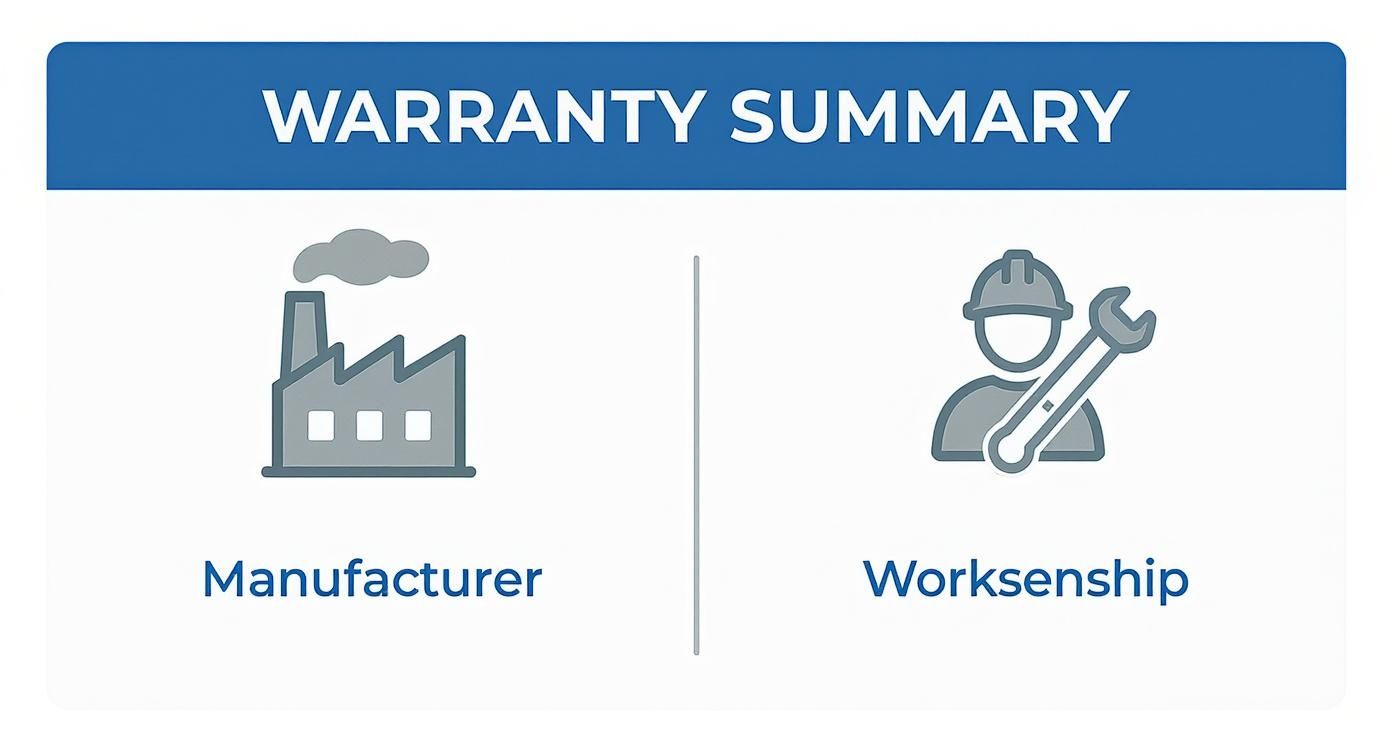
The big takeaway: a manufacturer warranty covers material defects, but the contractor's workmanship warranty is what shields you from install errors, and those are far and away the most common roofing problem.
Common Questions About Tucson Roofing Companies
Even after you've done all the homework, a few last questions always pop up right before you sign. That's normal. Getting these final details nailed down is what lets you move forward without a knot in your stomach.
Think of it as the last check-in. Any roofer worth a dang will have straight answers ready.
How Long Does a Roof Replacement Take?
This is the big one, and the honest answer is: it depends. For a standard single-family home in Tucson, a full replacement usually runs 2 to 5 days. But that's a ballpark.
A few things move that timeline around:
- Roof Size and Complexity: A long ranch-style house with a simple pitch is a whole different animal than a two-story with steep angles, a bunch of valleys, and skylights. More going on means more days.
- The Materials: Laying asphalt shingles moves a lot faster than setting clay tile one piece at a time, which takes real care.
- Monsoon Surprises: You know how fast a monsoon rolls in here. We never tear off more roof than we can make watertight before we pack up for the day, so a sudden downpour can easily tack on a day for safety's sake.
- Hidden Damage: Sometimes we don't know what's under the old roof until it's off. Find rotted decking or busted trusses and that has to get fixed before the new roof goes down. That adds time.
A good project manager gives you a real schedule up front and sends daily photo updates, so you're never left wondering where things stand.
Do I Need to Be Home During the Work?
Mostly, no. The whole job happens outside and our crews run themselves. They get set up, work safe, and manage the site without needing to bug you.
That said, there are a couple of moments where it's smart to be around:
- The Morning Kick-off: Being there day one to meet the crew leader helps a lot. You walk the property together, point out your rose bushes or the new patio furniture, and get everybody on the same page before a shingle moves.
- The Final Walk-Through: Don't skip this one. Be there when the job's done so you can walk the roofline with the contractor, look over the details, and ask any last questions before you sign off.
Just let us know your schedule and we'll work around it for those two touchpoints.
Key Takeaway: No need to burn a week of vacation. Just plan to be around for the start and the final inspection, and the whole thing runs smooth start to finish.
Will My Property Be Protected from Damage?
Absolutely. Protecting your home isn't some "add-on." It's just part of doing the job right. Tearing off a roof is messy work, but a real crew takes steps to keep your place clean and safe.
Here's what you should see before the first shingle comes off:
- Landscaping Covered: We lay tarps and plywood to shield your plants, lawn, and flower beds from falling debris.
- Siding and Windows Shielded: We lean plywood against the siding and windows in the busy spots to stop dings, dents, and the odd broken pane.
- Driveway Protection: The dumpster always sits on wooden planks so it never scratches or cracks your driveway.
- Daily Cleanup: End of every day, the crew cleans up. That means running magnetic rollers over the yard and driveway to grab stray nails. Big safety deal, especially with kids and pets around.
None of that is extra. It's the standard of care you should expect from any professional outfit.
How Much Do Roofers Make in Tucson?
Fair question, and it gives you a feel for what you're paying for. A big slice of any roofing estimate goes to skilled labor, and rightly so. You want experienced hands who know how to build a roof that takes Tucson's sun and monsoon storms.
As of late 2025, an experienced roofing contractor in Tucson averages $36.05 per hour, which works out to about $74,987 a year. That number, from local industry data, shows what it takes to keep good people in the trade. If you want to dig in, you can learn more about roofer salaries in Tucson.
Pay for quality labor and what you're really buying is an install that's safe, done right, and built to last.
When you're ready to work with a team that talks straight and builds it right, Sunrise Roofers LLC is here. We give you clear, detailed answers to every question, so you know exactly what you're getting the whole way through. No commission reps, no closers. You call, you get Eddie. https://roofwithsunrise.com
Need roofing services in Tucson? Request a free inspection or call 520-753-1758. Related pages: Roof Repair · Roof Replacement · Service Areas.
Published by Sunrise Roofers LLC
Licensed & Insured Roofing Contractor · Tucson, AZ