Find Top Rated Roofers Near Me in Tucson
By Sunrise Roofers LLC · Nov 14, 2025 · 12-18 min read

When something's wrong with your roof, you want the right help, and you want it now. That's usually what sends Tucson homeowners searching for top rated roofers near me, and a lot of the time it points them to a local outfit like us, Sunrise Roofers LLC. We're Eddie and Viky Guillen, and we built this company handling exactly what the desert does to a roof. Monsoon winds one month, sun that won't quit the next.
How to Start Your Search for a Tucson Roofer
Finding a good roofer when you're already stressed about a leak is no fun. This guide cuts the noise. I'm not going to feed you generic checklist filler. I'm going to tell you what actually makes a roofer worth hiring right here in Tucson.
It starts with knowing what to look for. A good local roofer knows how our sun and our monsoons go after a roof, and builds against both. They work with stuff that lasts out here. Tile, metal, the better shingle systems made for desert heat.
The Non-Negotiables: What Every Top Roofer Has
Before you start collecting quotes, build a shortlist on the basics. This little bit of screening saves you hours wasted on guys who shouldn't be touching your roof in the first place. Any real roofer has this stuff ready without blinking.
Check these first:
- An Arizona license: Look them up with the Arizona Registrar of Contractors (ROC). It's your first line of defense, and the most important one.
- Real insurance: They need both general liability and workers' comp. That's what keeps you off the hook if somebody gets hurt or something gets broken on your property.
- A local address: A real office here in town means they're a business that'll still be around next year, not a storm chaser who packs up and vanishes once the check clears.
- Jobs you can point to: A portfolio of finished roofs right here in Tucson, Marana, or Oro Valley.
The U.S. roofing market is no small thing. It sat around USD 23.35 billion in 2023 and it's still climbing. A lot of that comes from remodels and newer tech like cool roofing, which matters a whole lot in a place as sunny as ours.
Key Takeaway: A top-rated roofer is more than a 5-star average. They're licensed, insured, rooted right here, and they can prove they've handled Southern Arizona weather before. Nail these basics and you've set up a job that actually goes well, and a roof you don't have to think about for years. Our guide on Tucson roofing services digs into more of what to watch for.
Quick Checklist for Identifying a Top Rated Roofer
Use this table to size up a roofer fast and see whether they've got the goods.
| Essential Quality | Why It's Critical for You | How to Quickly Verify |
|---|---|---|
| AZ ROC License | Protects you from unqualified work and provides a path for recourse. | Search their company name or license number on the official AZ ROC website. |
| Full Insurance | Shields you from liability for accidents or property damage. | Ask for a Certificate of Insurance (COI) for both liability and workers' comp. |
| Local Physical Office | Shows they are a stable, long-term business, not a storm chaser. | Look them up on Google Maps; a real office, not a P.O. Box, is a good sign. |
| Tucson-Specific Portfolio | Proves they have hands-on experience with our climate and building styles. | Check their website's gallery or ask for addresses of recent local jobs. |
| Detailed Written Estimates | Ensures transparency on costs, materials, and scope of work. No surprises. | Review their proposal. It should clearly list materials, labor, and warranty terms. |
This isn't everything, but it's the part you do first. A roofer who clears all of these without any runaround is one you can comfortably have out to the house for an estimate.
Reading Between the Lines of Online Reviews

Reviews are your best tool here, but the star rating is the least useful part of them. A high average is a fine start. The real story is down in the comments, in what people actually wrote.
What you want is to get past the generic praise and find the reviews that show you who a company really is.
Look for ones that tell the whole story. "Great job" is nice but it tells you nothing. Dig for the reviews that walk through the whole thing, from the first phone call and the inspection all the way to the cleanup and whether anybody followed up after the check cleared.
The detailed ones are gold. They'll name a crew member, say what got done, like "tile roof repair after monsoon damage," and mention whether the crew showed up on time and left the place clean.
Identifying Patterns in Customer Feedback
One or two bad reviews won't sink a company. The best of us have an off day. What you're after is the stuff that shows up over and over, good or bad, across Google, Yelp, and the Better Business Bureau.
The repeats tell you the most. For instance:
- Praise for communication: If a bunch of reviews say the project manager sent updates and picked up the phone, that's a company that keeps you in the loop. Good sign.
- Cleanup gripes: Flip side. Several people griping about nails left in the yard or smashed landscaping tells you sloppiness is baked in, not a one-off.
- Scheduling messes: Missed appointments and timelines that keep sliding point to a company that can't get out of its own way.
Read enough of these and you get a real feel for how a company runs day to day. You spot what they're good at and where they slip, all before you ever dial the number.
How a roofer answers a bad review tells you as much as the review does. A calm reply that owns it and offers a fix shows you they stand behind their work. A defensive or who-cares response shows you exactly how they'll treat you when something goes sideways on your job.
How Companies Handle the Unexpected
You don't learn what a roofer's made of when everything goes perfect. You learn it when something goes wrong. And something usually does. Pull off the old shingles and find rotted decking nobody could've known about, that happens all the time.
So look for reviews where a problem came up and the contractor handled it. Did they explain it plainly, write a fair change order, and fix it the right way? One story about a roofer who admitted a mistake and made it right beats a dozen plain five-star ratings.
It helps to see the work, too. A lot of companies put up a roofer's project gallery you can flip through before you decide. Pictures of finished roofs tell you they can actually do what they say.
Verifying Licenses, Insurance, and Credentials
Hiring a roofer with no credentials is a roll of the dice you don't want to make. After the reviews, this is the step that makes or breaks it. You verify every contractor's standing. It's not box-checking for its own sake. It's how you keep a bad hire from costing you your house and your savings over something that was completely avoidable.
A real roofer makes this easy. They'll hand over proof of license and insurance before you even ask twice. If a company gets squirrely, makes excuses, or drags its feet, that's your answer. Walk away.
Decoding the Essentials: Licensed, Bonded, and Insured
You hear "licensed, bonded, and insured" everywhere, but what does it actually do for you as a Tucson homeowner? Each one covers you in a different way, so it's worth knowing what you're getting.
Licensed: In Arizona, any roofer worth hiring is licensed by the Arizona Registrar of Contractors (ROC). The license means they've put in the required years and passed the exams on running a business and on the actual trade. And if the job goes bad, it gives you somewhere to turn.
Insured: No wiggle room on this one. Your roofer needs two policies. General Liability covers it if they damage your property, say a ladder goes through a window. Workers' Comp covers their crew if somebody gets hurt up on your roof. Without it, you could end up paying the medical bills when a guy falls.
Bonded: The bond is a financial backstop for you. It's a surety bond that kicks in if the roofer walks off the job, stiffs the permit office, or doesn't hold up their end of the money.
Those three together mean you're dealing with somebody who's on the hook for their own work and their own crew. If you want a closer look at how dedicated roofing contractors in Tucson operate, that's worth a read before you put your name on anything.
How to Actively Verify a Roofer's Status
Never just take a contractor's word on this. Check it yourself. It only takes a few minutes.
For the license, go to the Arizona ROC website and search by company name or license number. Make sure it's active, in good standing, and covers the kind of work you need, residential or commercial. Expired or suspended? Done. Move on.
For insurance, ask for a Certificate of Insurance (COI). It lays out what they carry, the limits, and when it expires.
Pro Tip: Don't just eyeball the COI. Call the agency printed on it and confirm the policy is still good. A roofer can print a fresh certificate and then have the policy lapse a week later for not paying it. That one phone call is about the cheapest protection you will ever buy.
This kind of checking matters more now than ever. The global roofing market is headed for about USD 132.5 billion in 2025, fueled by houses and commercial work both. When there's that much money moving, you'd better believe there are unqualified guys trying to grab a piece of it. Verifying credentials is how you keep them off your roof.
How to Compare Roofing Quotes and Contracts
Once you've got three real estimates, the work starts. Comparing quotes isn't about hunting for the smallest number. It's about figuring out what each bid actually covers. A straight quote breaks the whole job down line by line, so nothing jumps out and surprises you later.
The cheapest bid is often the scariest one. I mean it. A price that's way under the others usually means somebody's cutting corners. Cheap underlayment, off-brand material, or skipping something that matters, like replacing the old flashing.
A good quote spells out the material brands, the labor, the permit fees, and what it costs to haul the old roof away. And watch for pressure, like a price that's "good today only." A roofer who's confident in his work gives you room to think it over.
Dissecting the Fine Print
Past the dollar figures, the contract is the thing that really protects you. It's a legal document that pins down every detail of the deal, for both sides. Before you sign, read every clause, and ask about anything that's fuzzy. A good roofer won't mind the questions.
A solid contract should spell out:
- The payment schedule: Usually a small deposit, often 10-30%, to cover materials, then payments as the work moves along. The last chunk shouldn't be due until the job's done and you're happy with it.
- The exact materials: The contract has to name the brand, color, and type of shingle, tile, or underlayment going on your house. "High-quality materials" means nothing. Make them write it down.
- The timeline: A start date and a target finish date, plus a line about how weather or surprises get handled. Rain delays happen here.
- The change-order process: How surprise work, like rotted decking we find during tear-off, gets handled, written up, and priced before anybody does it.
This sums up the credentials any real roofer carries. Licensed, insured, bonded. That's the floor, not the ceiling.
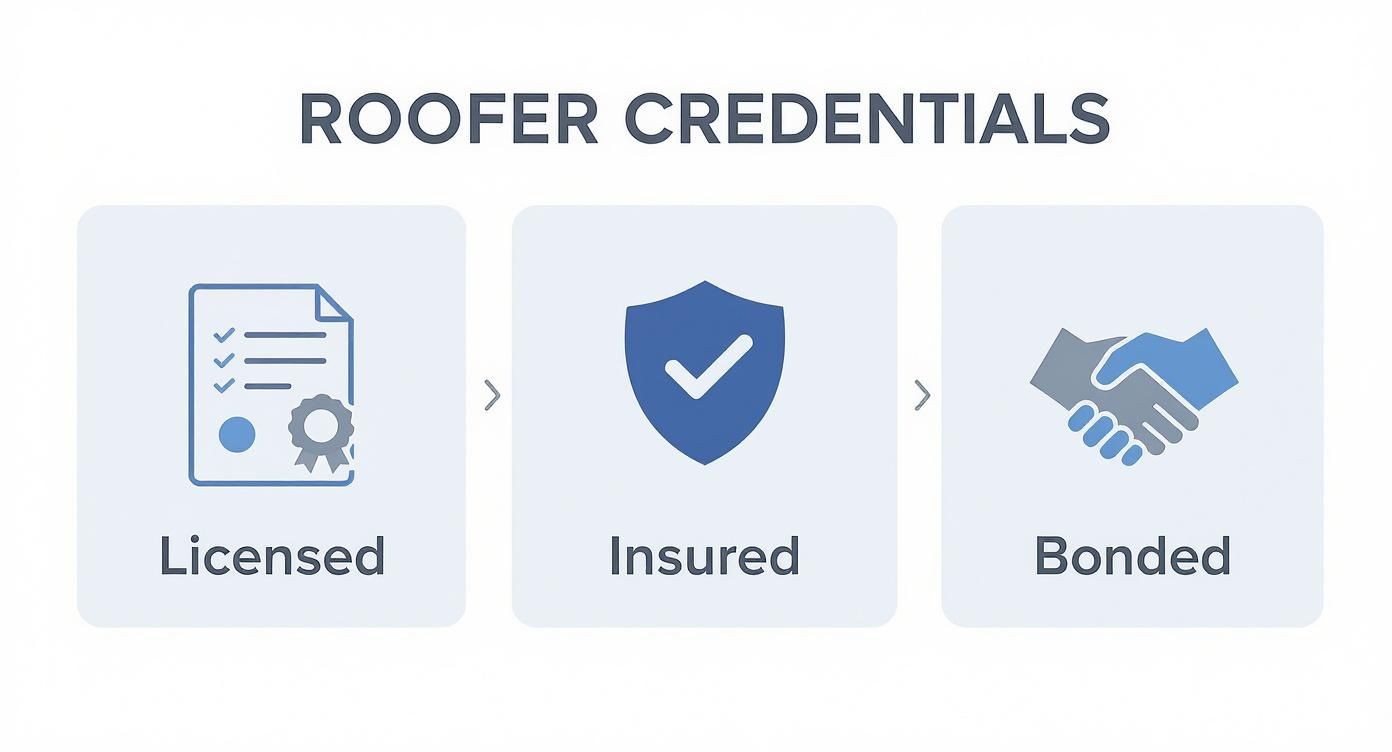
Check those three and you know the person on your roof answers for their work, their crew, and your property.
Key Clauses You Cannot Ignore
Reading the contract's fine print is where you catch the costly stuff before it bites you. Take the lien release. A lien release waiver is a paper you should get when you make the final payment, proving the roofer paid his own suppliers and subs.
Without it, a supplier the roofer stiffed could slap a lien on your house. One small piece of paper, and it saves you a world of grief.
You can only compare apples to apples when every quote covers the same work and the same materials. If one roofer included new ventilation and the other left it out, you're not looking at the same job. Tell the bidders to match up the scope so you can compare them straight.
The roofing business keeps growing, with 77% of contractors expecting more work over the next three years. A lot of that comes from newer tech like drone inspections and better materials. You can read the full research about roofing market trends if you want the details.
Comparing quotes and contracts is the last bit of homework. Slow down and read these documents, and you end up with a roofer who'll do what he said, not just whoever happened to bid. If you've got a big project coming, here's how we handle a new roof in Tucson, so you can see what a real proposal looks like.
Understanding Roofing Warranties for Long Term Value
A great roof isn't only about good materials and a clean install. It's also about what happens years later if something goes wrong. That's the warranty. And a strong one is the surest sign a roofer actually believes in his materials and his own work.Warranties sound complicated, but there are really just two kinds. Know the difference and you'll protect yourself for years.
Manufacturer vs. Workmanship Warranties
First there's the manufacturer's warranty. That covers the actual products, the shingles, tiles, or metal panels. It protects you if the product itself is bad, like shingles that shed their granules way too early. These can run 20, 30, even 50 years, but they always come with fine print.
Then there's the roofer's workmanship warranty, and honestly that's the one I'd watch closer. It's the contractor's own guarantee on how he installed it. It covers the human-error stuff. Flashing put in wrong that starts leaking, or shingles that weren't nailed right and peel off in the first big monsoon.
The best material warranty in the world is worthless if the roof goes on wrong. Bad installation is actually one of the quickest ways to void a manufacturer's warranty, and then you've got nothing.
That's the whole reason hiring one of the top-rated roofers near me matters so much. Their skill is what makes your material warranty actually mean something.
What to Look For in Your Warranty Documents
A roofer you can trust lays the warranty out plain. In writing. No jargon, no vague hand-waving.
Here's what a solid warranty package includes:
- How long it lasts: The workmanship warranty needs a stated length. For a solid roofer, 5-10 years is normal and respectable, and some go longer on premium systems.
- What's actually covered: It should say flat out what's in, like leaks from a bad install, and what's out, like a tree falling on it or you never doing any upkeep.
- Whether it transfers: If you might sell down the road, a transferable warranty is a real selling point. Check that both the manufacturer and workmanship warranties can pass to the next owner.
- How to file a claim: The contract should tell you the steps if you ever need to use it. Who do you call? What paperwork do you bring?
Heads up, though. A few things can void your warranty without you realizing it. Pressure washing the roof, a satellite dish bolted on wrong, letting little repairs slide. Before you let any other contractor up there, call your roofer first. A good company walks you through all of this on the front end, so you're not stuck with surprises long after the crew packed up.
Common Questions About Hiring a Tucson Roofer
When you get close to hiring, a few last questions always pop up. That's normal. Straight answers are what let you sign with a clear head.
Call this your gut-check before you commit. Get these sorted and you'll know you're going with one of the real top rated roofers near me, not just another name painted on a truck door.
How Many Estimates Should I Get?
Three. That's the number.
Three detailed estimates from licensed roofers you've already checked out gives you a real baseline on price, materials, and scope, without making yourself nuts over it.
Get only one or two and you've got no way to tell if a bid is way high or suspiciously low. Try to juggle more than five and you'll talk yourself in circles and never decide. Three is the sweet spot.
Key Insight: You're not just lining up the bottom-line prices. You're weighing the value. The warranty, the materials they spec, how they talk to you, and what their past customers say about them.
What Roofing Materials Are Best For Tucson?
With our sun and our monsoon downpours, you need material that's built for extremes. Two things matter most out here: how tough it is, and how well it throws back heat.
Here's what works on Tucson homes:
- Clay and concrete tile: The classic Southwest look, and there's a reason for it. It's tough, it's fire-resistant, and all that mass keeps the heat from pushing straight through into the house.
- Metal roofing: A standing-seam metal roof is a great long-haul investment. It bounces a lot of the sun's heat right back off, and you'll feel that on the cooling bill in July.
- Good asphalt shingles: Not all shingles are the same. Look for architectural shingles with "cool roof" granules built in. They reflect more sun than the standard stuff and give you solid performance without blowing the budget.
Does A Top Roofer Require A Large Down Payment?
Careful here. A contractor who wants a big pile of cash before he starts is waving a red flag at you.
A solid Arizona roofer who isn't scraping by will ask for a fair deposit, usually 10% to 30% of the total.
That deposit covers ordering your materials so the job can get rolling. If somebody wants 50% or more before a single worker sets foot on your property, that often means they're short on cash and using your money to float themselves. Your payment schedule belongs in the written contract, spelled out. Looking at how a company actually does business helps you see why to choose certain Tucson roofers over the rest.
At Sunrise Roofers LLC, we believe in total transparency from the first inspection to the final handshake. If you have more questions or you're ready for a no-pressure, detailed estimate for your home, contact us today.
Need roofing services in Tucson? Request a free inspection or call 520-753-1758. Related pages: Roof Repair · Roof Replacement · Service Areas.
Published by Sunrise Roofers LLC
Licensed & Insured Roofing Contractor · Tucson, AZ