Tucson Roof Replacement Done Right
By Sunrise Roofers LLC · Oct 25, 2025 · 16-24 min read
Figuring out when it's time for a Tucson roof replacement isn't always obvious—but the signs are usually right there once you know what you're looking at. Widespread cracking. Shingles curling up all across the field. Gutters full of granules. See those and you're past the point where a patch will save you. The Arizona sun cooks the life right out of roofing materials, and dragging your feet on a replacement usually just trades a manageable job for a disaster later on.
Knowing When to Replace Your Tucson Roof
Your roof is the one thing between your home and Tucson's one-two punch—brutal summer heat, then violent monsoon storms. A quick patch fixes a one-off problem just fine. But there's a point where a full replacement is the smarter, safer, and honestly cheaper move. Ignoring the warning signs doesn't make them go away. It just raises the stakes on the next big downpour.
Putting money into a new roof is a big decision, no question. Knowing the key failure points, though, lets you make the call at the right moment. Catch the wear while it's spreading and you head off the water damage, mold, and structural mess that turns a roofing job into a gut renovation.
Visual Clues You Can Spot from the Ground
You don't need to climb a ladder for a first look. Just walk around your place. A simple lap of the property can turn up some real red flags that tell you it's time to call somebody.
Watch for these:
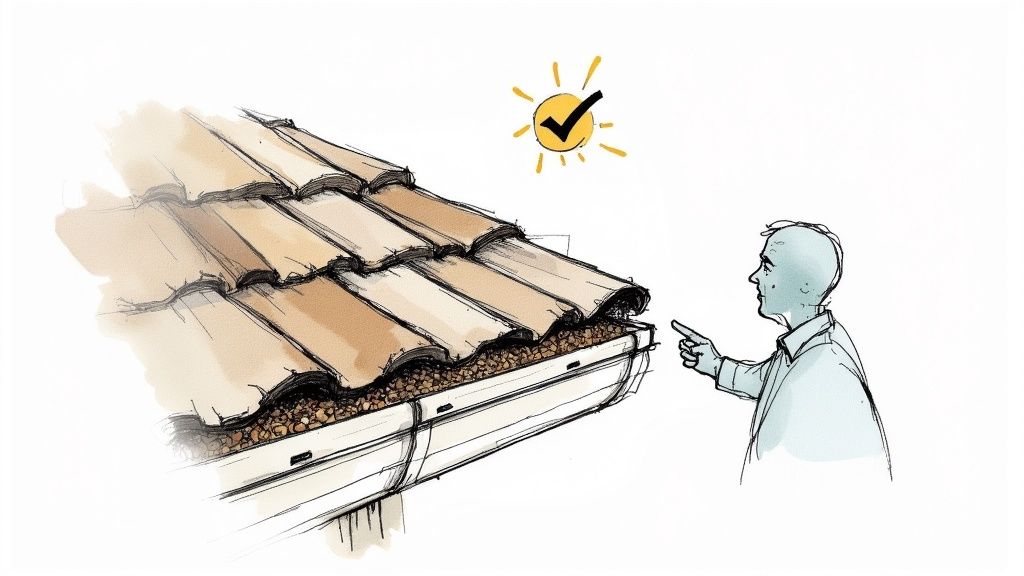
- Curling or Clawing Shingles: When the edges start curling or the corners lift, those shingles are done. Tucson's relentless UV bakes the asphalt until they shrink, go brittle, and stop shedding water the way they should.
- Widespread Cracking: One or two cracked shingles? Easy fix. But cracks running across several sections of the roof tell a different story—that's the material failing system-wide. And every crack is an open door for water once the monsoon hits.
- Bald Spots and Granule Loss: Check your gutters and the dirt by the downspouts for what looks like coarse black sand. Those are the protective granules off your shingles. Once they wash away, the asphalt underneath is bare to the sun, and from there it goes downhill fast.
Signs of an Aging Roof System
Even a roof that looks fine from the curb has a shelf life. Most standard asphalt shingle roofs in our climate are good for about 20 to 25 years. Hit that mark and you're on borrowed time, no matter how good it looks from the street.
Replacing an old roof before it fails is the calm option. You get to skip the scramble—and the jacked-up emergency pricing—that comes after a storm's already torn into it.
For a clearer picture of what to look for, run through this quick checklist. These are the signs we run into most out in the field that say a roof's time is up.
Tucson Roof Replacement Warning Signs Checklist
| Warning Sign | What It Looks Like | Why It Matters in Tucson |
|---|---|---|
| Curling Shingle Edges | The bottom edges of shingles are turning upward, creating a cupped appearance. | Extreme UV exposure has baked the shingle, causing it to shrink and lose flexibility. It can no longer seal properly against wind-driven rain. |
| Widespread Cracking | Visible cracks and fissures across many shingles, not just one or two. | A sign of advanced material aging. These cracks are direct pathways for water, especially during heavy monsoon downpours. |
| Excessive Granule Loss | "Bald" patches on shingles and heavy accumulation of granules in gutters. | The granules are the shingle's UV protection. Without them, the asphalt layer deteriorates rapidly under the intense Arizona sun. |
| Age Over 20 Years | The roof is approaching or has passed the two-decade mark. | Even without obvious damage, the underlayment and sealants have likely degraded, making the entire system vulnerable to failure. |
| Persistent Leaks | Water stains on ceilings or walls that reappear despite previous repairs. | This often indicates a systemic failure in the flashing or underlayment that spot repairs can no longer fix. |
Spot these early and you spare yourself the expense and the headache of water damage inside the house. Waiting too long always costs more than replacing on time. Always.
A ground check is a solid start. But some of the worst problems hide where you can't see them. Rotted decking, failed underlayment, flashing that was never done right around vents and chimneys—those take a trained eye to catch. If you want a real answer on where your roof stands, a thorough roof inspection is the only way to get it.
Choosing Materials That Beat the Arizona Heat
Picking the material for your Tucson roof replacement is about a lot more than how it looks from the driveway. This choice drives how long your home stays protected, what your summer cooling bills run, and whether the roof can take decades of hard sun and monsoon rain.
Think of it as your home's shield. In Southern Arizona, that shield has to be tough. Pick wrong and the UV cooks it, so you're looking at early failure and repair bills. Pick right and it's an investment—your home stays cooler and protected, and you save money and aggravation down the line.
Asphalt Shingles: An Evolving Classic
Asphalt shingles are popular for good reason—they're affordable and they come in every style under the sun. But not every shingle is cut out for our climate. The standard 3-tab kind just can't take the UV down here. They go brittle and crack way before their time.
For a Tucson home, architectural or dimensional shingles are really the only call. They're thicker, heavier, layered up, and that buys you a lot more resistance to wind, hail, and sun.
A lot of today's architectural shingles come with "cool roof" tech built in. Reflective granules that actually bounce the heat back off the roof. That's no gimmick—it can drop your attic temperature in a real way, which means your AC isn't fighting the heat as hard. Costs a little more up front. But the longer life and the energy savings make it the smart play.
Clay and Concrete Tile: Timeless Desert Defenders
Drive through any older Tucson neighborhood and you'll see tile roofs everywhere. There's a reason for that. Clay and concrete tile are both tough as nails and made for the desert.
Their best trick is how they deal with heat. That curved shape leaves a little air gap between the tile and the deck underneath. The pocket of air works like a thermal barrier, knocking down a big chunk of the heat that'd otherwise push into your home.
A tile roof is like a wide-brimmed hat on a hot day. It doesn't just block the sun—it makes a pocket of shade underneath that keeps the surface a good bit cooler. That built-in insulation is a big part of why tile has always been a Southwestern staple.
Tile shrugs off the sun, but it can be brittle. A big hailstone, or somebody walking on it the wrong way, and you've got a crack—which is exactly why proper installation and the occasional check matter so much. Cost is the other piece. The statewide average for a Clay Terra Cotta tile roof, a favorite around here, runs about $53,748. Your material picks drive that number, and you can see a full breakdown of state-wide roofing material costs on instantroofer.com.
Metal Roofing: Modern Durability and Efficiency
Metal roofing used to be a commercial thing. Not anymore. It's become a top pick for homeowners who want a roof that lasts and saves on energy. Standing seam metal, especially, is a great fit for Tucson.
- Exceptional Durability: A metal roof can easily go 50 years or more. It won't crack, peel, or warp in the sun, and it takes monsoon wind and rain in stride.
- Superior Heat Reflectivity: Most metal comes with a factory coating made to reflect a big share of the solar load. That's about as good as "cool roof" gets, and it shows up as real money saved on cooling.
- Low Maintenance: Install it right and a metal roof is just about hands-off after that.
And the look has come a long way. You can get metal in all kinds of colors to match anything from modern to traditional. The catch is the upfront price—usually higher than shingles or tile. But if you're planning to stay put for years, that mix of crazy durability and energy savings makes it a serious investment. You can read up on how metal roofing services in Tucson are set up for local homes.
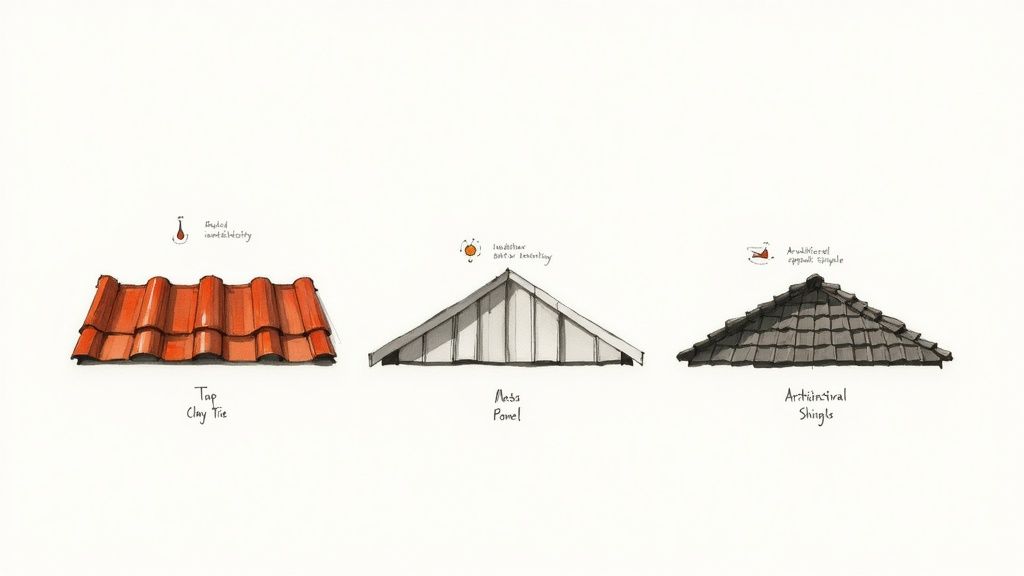
Comparing Top Roofing Materials for Tucson Homes
Picking between three good options can leave your head spinning. Each one comes with its own trade-offs on lifespan, heat resistance, and cost in a climate like ours.
| Material | Avg. Lifespan (Tucson) | Heat Resistance | Typical Cost Range | Key Benefit |
|---|---|---|---|---|
| Architectural Shingles | 20-30 Years | Good (with cool tech) | $$ | Best value & versatility |
| Clay/Concrete Tile | 50+ Years | Excellent | $$$ | Unmatched durability & aesthetic |
| Metal Roofing | 50-70+ Years | Excellent | $$$$ | Highest energy efficiency & longevity |
In the end it comes down to your budget, how long you're staying, and the look you want. All three hold up great in the desert—as long as they're installed right.
Decoding Your Roof Replacement Estimate
Open a multi-page estimate for a Tucson roof replacement and it can hit you all at once. Line items for materials, labor, permits, and a dozen things you've never heard of. Easy to get lost in it.
But that paper is your roadmap for the whole job. Learn to read it and you give yourself the best shot at a fair price and, more to the point, good work. A real quote does more than spit out a final number—it spells out the whole scope, from the exact underlayment going on to the cost of carting off your old shingles.
And if a quote feels vague or hard to follow? Big red flag.
Key Components of a Tucson Roofing Quote
Every roofer lays out a quote a little differently, but any decent one hits a few sections you shouldn't do without. You want a breakdown that splits the big costs apart so you can see exactly where your money's going.
Look for these:
- Materials Cost: Usually the biggest piece of the estimate. It should name the brand and type of shingle or tile, plus the underlayment, flashing, vents, and drip edge. A good roofer writes it all out.
- Labor Costs: This is the crew's time and know-how for both tearing the old roof off and putting the new one on. The price tracks with how cut-up and complicated your roof is.
- Tear-Off and Disposal Fees: Hauling off and legally dumping a couple tons of old roofing isn't free. This line covers the dump fees plus the labor to leave your yard clean.
- Permit Fees: A full replacement in Tucson needs a permit from the city or Pima County. Your contractor pulls it, and that fee gets passed along on the estimate.
Understanding Labor and Material Costs
Labor and material prices move with the market, but there are some solid local benchmarks to lean on. Recent Tucson numbers put asphalt shingle installation around $202.65 per 100 square feet, especially on overlay jobs. Having a figure like that lets you tell whether a quote's in the right neighborhood. You can explore local roofing installation data on instantroofer.com for more current pricing.
This is exactly why you get more than one quote. One outfit might buy GAF shingles cheaper. Another might run a leaner crew and save on labor. The only way to see those differences is to put the line-item estimates side by side.
The Hidden Costs You Need to Anticipate
The most common surprise on a re-roof is rotten decking that shows up after the old roof comes off. The plywood or OSB under your shingles can get quietly chewed up by little leaks nobody ever saw, year after year. And there's no way for a contractor to know until the tear-off's underway and the wood's exposed.
A pro will put a line in the estimate spelling out the per-sheet cost to swap any bad decking. That's not an upsell. It's the thing that makes sure your new roof goes down on solid, sound wood instead of rot.
Without that price agreed to up front, you're stuck haggling over extra work right in the middle of the job, roof half off. A clear quote gets you ready for that possibility before anybody climbs the ladder.
Another one that can sneak up on you is bringing the attic ventilation up to code. Tucson's codes for residential roofing require proper venting to deal with the wild attic heat. If what you've got isn't enough, your contractor has to add vents. That step keeps the new roof lasting and the house running efficient. You can read more about why a complete system matters so much for residential roofing in Tucson on our service page.
Once you understand each piece of the estimate, that confusing document becomes a tool. You can ask sharper questions, line offers up apples-to-apples, and spend your money knowing exactly what you're getting against the Tucson climate. A detailed estimate is the mark of a contractor who isn't hiding anything.
Finding a Tucson Roofer You Can Trust
The best materials money can buy will fail in a few years if they go on wrong. That's why who you hire matters every bit as much as which shingle or tile you pick for your Tucson roof replacement. A good roofer makes sure every piece—from the underlayment all the way to the last bit of flashing—is set to take decades of desert sun and monsoon.
Hiring the right crew isn't just about landing a good price. It's paying for craftsmanship that actually protects your home. A real pro brings a license, the know-how, and accountability—so you can stop worrying about whether it'll be done right the first time.
Where to Start Your Search
Start local. Look for established companies that are actually part of the Tucson community. A roofer who's worked here for years just gets it—they know what our climate does to a roof. They know which materials survive the UV and exactly how to seal a roof up against a monsoon downpour.
Check the reviews on Google and the Better Business Bureau, but don't stop at the star count. Read the comments. Watch for how a company handles communication, cleans up the job site, and deals with the hiccups that always come up. When you see steady, detailed praise about how professional they are, that's a great sign.
Vetting Your Shortlist of Contractors
Got a few names? Now dig into their credentials. Skip this and you're rolling the dice—it's what separates the real pros from everybody else. First stop, and the most important one, is the Arizona Registrar of Contractors (ROC).
Use the ROC's public database to confirm any contractor you're looking at has:
- An active license in good standing for roofing (Specialty Residential Contracting, R-42).
- The bond and workers' comp insurance they're required to carry.
- A clean record—no open complaints, no disciplinary actions hanging over them.
Never hire a contractor who isn't licensed with the ROC. That license is your main protection. It proves the roofer has cleared the state's bar for experience and financial footing, and it gives you a real way to fight back if the work goes bad.
Beyond the ROC, ask each one for a certificate of general liability insurance. That's what covers your property if something gets damaged during the work. Any legit roofer keeps that paperwork handy and hands it over without blinking. For more on what sets a real crew apart, here are the reasons to choose trusted roofers in Tucson who take these credentials seriously.
Critical Questions to Ask During the Consultation
When a roofer shows up to your house for an estimate, that's your chance to interview them. What they say tells you a ton about how they work, what they've seen, and whether they care about quality. Don't fixate on the bottom-line number. This is the moment to take their measure.
Come ready with a few pointed questions that go past the basics:
- Who's my main point of contact? You want one dedicated project manager. That's how communication stays clear from start to finish.
- How will you protect my landscaping and property? A pro crew has a system—tarps down, a real plan for hauling debris, so your place stays clean and undamaged.
- What's your process for rotted decking or other surprises? They should have a plan and a price ready for it, laid out in the estimate before work starts.
- Can you walk me through both warranties? A quality roofer backs up their install with a workmanship warranty that sits alongside the manufacturer's material warranty. Get both in writing.
And pay close attention to how they answer. Vague replies, hard-sell pressure, or any hemming and hawing about handing over documents—those are huge red flags. A roofer worth hiring is patient, straight with you, and glad to give you whatever you need to make the call for your home.
What to Expect During Your Roof Installation
A Tucson roof replacement is a big job, no doubt. But knowing what's coming takes a lot of the worry out of it. Once the contract's signed, a good crew moves with purpose and works through a clear order of events.
Knowing how that flow goes lets you get your home ready and stay relaxed from the day the materials land to the last nail swept off the driveway. The point is simple: get the old, failing roof off and a new watertight one on, as safe and clean as possible, usually in a few days.
Preparing Your Home and Property
The day before the real work kicks off, the crew comes by to prep your property. That right there tells you you've got a pro who respects your home. Don't be surprised to see them taking a few steps to keep things protected.
- Covering Landscaping: Shrubs, plants, and flower beds near the house get tarped over so falling debris doesn't beat them up.
- Protecting Siding and Windows: Plywood might go up against siding and windows in the spots most likely to take a hit from shingles coming down.
- Clearing the Perimeter: Patio furniture, the grill, potted plants—all of it gets moved away from the walls to open up a safe work zone.
None of this is about being tidy for its own sake. It's about an organized, safe site for everybody. A clean job site is a safe one.
The Tear-Off and Decking Inspection
First big step is the tear-off, and it's usually the loudest part of the whole job. The crew strips off every old layer—shingles, underlayment, flashing—right down to the bare wood decking.
This is the moment of truth. With the decking exposed, the project manager finally gets a real look at the bones of your roof. They're checking for water damage—soft spots underfoot, dark staining, flat-out rot.
Any bad decking has to come out before the new roof goes on. You can't build a solid house on a weak foundation, and a roof is no different. Lay new material over rotten wood and it'll fail—and it'll void most warranties while it does. A good contractor will have already talked this through with you and put a per-sheet replacement cost in the estimate.
You don't skip this. It's what puts your new roof on a solid base, ready to take whatever Tucson throws at it for decades.
This infographic gives you a quick look at the key steps for finding a contractor who'll get these details right.
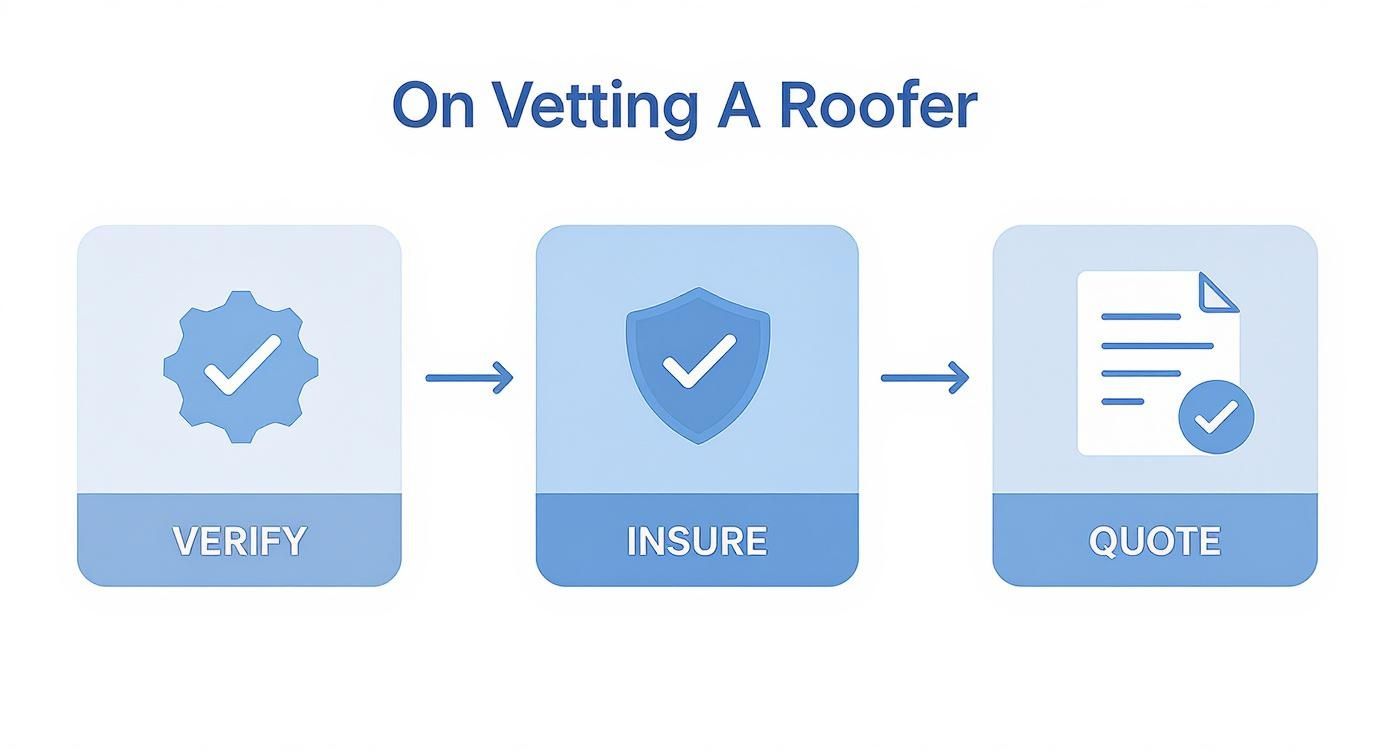 It shows how doing your homework—checking licenses, comparing quotes—is what lands you a crew that actually installs the roof the right way.
Installing the New Roofing System
Once the deck checks out solid, the build-back starts. This is where the craftsmanship shows. The crew puts down a whole new, layered system, every piece made to work with the next.
It goes in a set order:
- Drip Edge and Underlayment: First a metal drip edge along the eaves to push water into the gutters. Then a fresh layer of high-performance synthetic underlayment rolled out across the whole deck. That's your backup water barrier if anything ever gets past the top layer.
- Installing New Materials: Architectural shingles, classic tile, sleek metal—whatever you picked, the crew lays it down to the manufacturer's exact specs. Right nailing pattern, dead-on alignment.
- Flashing and Ventilation: Fresh flashing goes in careful around the chimneys, vents, and skylights—the spots where leaks love to start. They'll also set up proper attic ventilation so your home can breathe and handle that Tucson heat.
You can see some great examples of these finished roofs in our Tucson roofing project gallery.
Final Cleanup and Inspection
Last shingle goes down and the job turns to cleanup—which matters every bit as much as the install. The crew runs strong magnetic rollers across your yard to pull up stray nails, hauls off all the debris, and leaves your property the way they found it.
To close it out, the project manager walks the job with you. They answer whatever questions you've got and make sure you're 100% satisfied before they go. The whole thing should feel professional and aboveboard, and you should come out the other side with a quality roof that protects your home for years.
Common Questions We Hear About Tucson Roof Replacements
Even with a great contractor, a Tucson roof replacement is a big project, and questions come up. We get it. We've fielded hundreds of them over the years, so here are straight answers to the ones we hear most from homeowners like you.
Knowing the Southern Arizona specifics—our building codes, our wild weather—saves you time and a fair bit of grief down the road.
How Long Will My House Be a Construction Zone?
Usually the first thing people ask, and fair enough. Good news: a pro crew moves quick.
For a typical single-family home in Tucson, a standard asphalt shingle replacement runs 1 to 3 days. That's the full tear-off, any decking repairs underneath, and the complete install of the new system. Got a bigger, choppier roof with steep pitches or a pile of skylights? That pushes toward the long end.
Tile is a whole different animal. The material's heavy and the install takes a lot more hands and time. A tile replacement often runs 4 to 7 days, sometimes more depending on the size. And a surprise monsoon can always scramble the schedule—but any good roofer keeps you in the loop when it does.
Do I Really Need a Building Permit in Tucson?
Short answer: yes, absolutely. Any full roof replacement in Tucson, or anywhere in Pima County, needs a building permit. This isn't red tape for its own sake—it's one of the best protections you've got as a homeowner.
The permit gets the job documented and held to local code, and that code is written specifically for our desert heat and monsoon rain. It's your assurance the work actually meets the safety and quality bar.
One piece of advice: your contractor is the one who pulls the permit. If a roofer ever floats skipping it to "save a little money," run. An unpermitted job can blow up on you with your homeowner's insurance and again when you go to sell the house.
Will a New Roof Actually Lower My Summer Cooling Bills?
It's easy to underrate how much a new roof moves your summer TEP bill, but the difference can be real money. A modern, efficient roof improves how your home holds heat, and that drops your cooling costs.
A lot of today's best materials—architectural shingles and metal especially—are built with "cool roof" tech. Special granules or coatings that bounce a big chunk of the sun's infrared right back off the house.
So less heat soaks into your attic. A cooler attic means your AC isn't grinding away to keep the place comfortable. Stretch that over the 20 to 30-year life of the roof and the savings stack up.
What Kind of Warranty Should I Expect to Get?
Knowing your warranty matters. For any Tucson roof replacement, you should walk away with two separate warranties, both in writing. That's how you're fully covered.
- Manufacturer's Warranty: This comes from the company that made your shingles or tiles. It covers defects in the materials themselves and runs anywhere from 20 years to a "lifetime," depending on the product.
- Contractor's Workmanship Warranty: Just as important. Your roofer puts this one up to stand behind their install. If a leak shows up because of an installation mistake, this is the warranty that covers you. A reputable Tucson roofer always offers one, usually 5 to 10 years.
A roof replacement is a lot to take on, but you don't have to do it by yourself. The team at Sunrise Roofers LLC brings 20+ years of hands-on roofing, quality materials, and craftsmanship we stand behind. Schedule your free, no-pressure roof inspection today at roofwithsunrise.com.
Need roofing services in Tucson? Request a free inspection or call 520-753-1758. Related pages: Roof Repair · Roof Replacement · Service Areas.
Published by Sunrise Roofers LLC
Licensed & Insured Roofing Contractor · Tucson, AZ