Emergency Roof Repair Near Me: Fast, Trusted Help
By Sunrise Roofers LLC · Nov 1, 2025 · 12-20 min read
You see the stain bleeding across your ceiling, or you hear a branch slam down on the roof, and your stomach drops. I've watched a lot of folks freeze right there. Don't. What you do in the next few minutes actually matters. Before you start typing emergency roof repair near me into your phone, get everybody safe, snap some photos, and slow that water down however you can.
Your First Steps After Discovering Roof Damage
Those first few minutes are a blur. I get it. But if you just work down a short list instead of panicking, you can save yourself thousands in water damage and make the insurance side go a whole lot easier. Safety first. Then your camera.
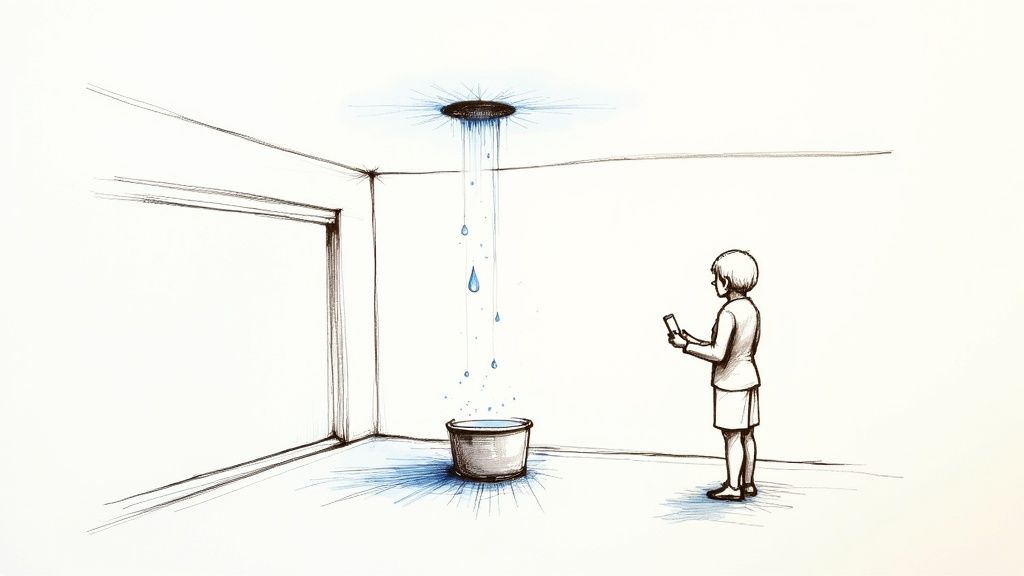
Right now, the only thing that matters is you and the people in the house. If a tree's come through the roof, or you spot anything that looks like the ceiling is giving way, clear that room. Move. And whatever you do, stay off a wet, beat-up roof, especially while it's still storming or right after. We've pulled enough folks off ladders in our 20 years out here to tell you it's not worth it.
Safely Assess the Damage From Inside
Once the room's safe to walk into, look the damage over from inside first. It's the safe way to do it, and honestly it tells you the one thing that matters most early on: where the water's actually getting in.
Here's what to watch for:
- Active Dripping: The obvious one. Water coming through the ceiling means there's a hole up top, plain and simple.
- Dark Water Stains: Discolored patches that keep growing on a ceiling or wall? That's moisture soaking into your drywall.
- Sagging Ceiling: A bulge or a droop is bad news. A lot of water has pooled up there and it's pulling on the structure. Step out from under it now.
- Visible Light: If you can see daylight through the attic or the ceiling, you've got an open hole straight to the sky.
That quick look inside tells you how worried you should be. A small stain that isn't spreading can probably wait a day. An active drip or a sagging ceiling can't. Call somebody.
Document Everything for Your Insurance Claim
Before you move anything, before you even slide a bucket under the drip, get your phone out and start shooting. Good photos are the best friend you've got when it's time to file a claim. The insurance company wants to see the damage as it happened, and they want proof you did something about it instead of letting it sit.
Clear photos and a few notes, taken the second you find the damage, are worth their weight in gold. They build a timeline. That timeline backs up your claim and shows the adjuster you didn't just let the water run.
Keep it simple. Here's what to grab:
- Wide shots of every room that got hit.
- Close-ups of the leaks, the stains, and any furniture or belongings that took water.
- A short video of the dripping if you can do it without putting yourself in a bad spot.
- A quick note with the date and time you first spotted it.
Roofing's been a busy trade lately, and a lot of that comes down to rougher weather year over year. U.S. roofing contractors pulled in somewhere around $76.4 billion, and the phones light up every time a big storm rolls through.
Once you've got the inside documented, go ahead and call a roofer. The next move is getting someone out there who can look the outside over top to bottom. A real roof inspection is how you find out how big the problem actually is, not just the part you can see from the living room.
Protecting Your Home Before Help Arrives
The clock's running the second you find a leak. The first couple hours, before any roofer pulls up, are where you either keep this a small problem or let it turn into a soggy, expensive mess inside. Your job is simple: slow the water down, and deal with what's already on the floor.
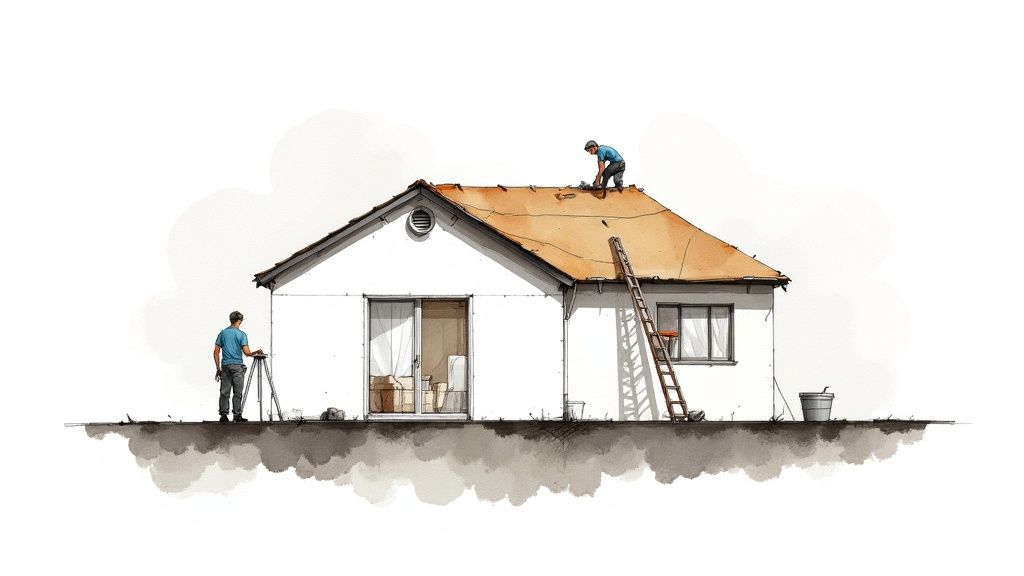
Leave the roof alone for a minute. Inside is where you've got control, and inside is where water turns into real money fast. Move the electronics, the furniture, the rugs, anything you'd hate to lose. Get it clear of the drip.
Managing Interior Water Intrusion
Water actively coming down? Grab buckets, the kitchen trash can, anything that holds water. Drop an old towel or a sponge in the bottom of each one. It kills that drip... drip... drip... and keeps water from splashing all over the floor.
Got a big ugly bulge on the ceiling that hasn't broken yet? Get ahead of it. Set a bucket under the darkest part and poke one small hole right in the center with a screwdriver. Sounds backwards, I know. But it lets the water drain out one spot instead of building up and dropping a whole sheet of drywall on your head.
A screwdriver hole is a five-minute patch with some joint compound. A collapsed, waterlogged ceiling is a whole weekend and a real bill. You're just steering the damage to one spot you can deal with.
When it's less of a single drip and more of a wide, all-over mess, reach for some heavy plastic sheeting. Tape or staple one end to the ceiling around the leak and run the other end down into a big bin. Now the water's got somewhere to go.
Safely Deploying an Emergency Roof Tarp
With the inside handled, you're probably eyeing that hole up top. An emergency roof tarp is the usual stopgap. But getting up there yourself is no small thing, and you should only think about it if you can do it without ending up in the ER.
Safety wins, every time. Never get on a roof:
- While it's still storming. Rain, wind, lightning, forget it.
- If the roof's steep or has more than one level.
- If nobody's home to spot you.
- If it's wet, slick, or littered with debris from the storm.
Say the sky's cleared, you've got a low, simple roof on a single-story place, and heights don't bother you. Fine, go slow. Run the tarp well past the hole, at least four feet on every side. Wrap the edges around 2x4s and screw the boards down to the deck. Do not just nail through the tarp and your shingles. That's how you punch a dozen new holes in a roof you're trying to protect. And I'll be straight with you: a DIY tarp tends to peel off in the next gust and leave you worse than before. A crew that does this for a living is the safer call nine times out of ten.
Out here in the desert, cracked tiles are behind a ton of these leaks. And it's never just the one tile you can see. The whole roof works as a system, so covering the hole is only half of it. We get into why fixing broken roof tiles the right way matters so much. Bottom line, these quick fixes are just buying time until a pro gets out there and makes it permanent.
How to Find a Trusted Emergency Roofer
Your roof's leaking, you type "emergency roof repair near me" into your phone, and you get a wall of names staring back at you. You're stressed and you want it over with. But grabbing the first guy who picks up the phone is exactly how people get burned.
You need somebody who's available, sure, but also somebody legit who isn't going to use a bad day to pad the bill. The trick is sizing them up quick. You don't have a week to research this. You've got about five minutes on the phone to ask the right things and tell the real roofers from the storm chasers who blew into town.
Vetting Contractors Over the Phone
Treat that first call like a quick interview. Ask straight questions and listen close. How they handle you on the phone, how honest they are, how fast they say they can get there, that tells you most of what you need to know about how the actual job will go.
These are the ones you can't skip:
- How fast can you actually get here? You want a real answer. "As soon as we can" is a dodge. "We'll have a crew there in the next 90 minutes" is what you're listening for.
- Are there emergency or after-hours fees? Ask up front about call-out charges and weekend rates. Nobody wants a surprise on the invoice on top of a flooded living room.
- Can you send proof of license and insurance? No wiggle room here. A real company emails you a certificate of insurance on the spot. Never let this one slide.
- Are you actually local? A roofer with a real address in town knows the codes and knows what Tucson's monsoon season does to a roof. Somebody passing through doesn't.
Those four questions weed out the unqualified and the predatory fast. A real company answers all of them without stumbling. If you're wondering why choosing a local Tucson roofer matters, it really comes down to two things: a track record people in town can vouch for, and a habit of doing the job right instead of slapping on a patch and disappearing.
Don't worry about coming off pushy. You're in a tough spot, and any roofer worth hiring will respect that you want straight answers and just give them to you.
Reading Between the Lines of Online Reviews
Got it down to a couple of names? Take 60 seconds and skim their reviews. Don't stop at the star rating. Look for patterns that tell you how they handle emergency work specifically.
- Hunt for the right words: Search the reviews for "emergency," "leak," "storm damage," "fast." You're trying to see how they did when the heat was on.
- Skip the fluff: "They did a great job" tells you nothing. What you want reads more like, "They showed up within an hour of my frantic call and had a tarp on my roof before the worst of it hit."
- Note the warning signs: If you see the same complaints over and over, spotty communication, mystery fees, no-shows, that's your cue. Move on.
That whole check takes a few minutes and helps you make a smart call when minutes matter. The emergency roofing business worldwide runs around USD 8.5 billion now, mostly because rough weather keeps showing up more often. More money in the trade means more roofers to pick from, which is great until you realize it also means more bad apples. Pick someone you'd call again, not just whoever can tarp it today.
The Financial Side: Emergency Costs and Insurance
When a roof goes south on you, the hole in the ceiling is only half of it. The money side weighs on people just as hard. So while you're searching "emergency roof repair near me," it helps to know what that bill actually covers. You're not just paying for a tarp. You're paying somebody to drop everything and show up, usually after hours.
And that speed costs more. It's like calling a plumber on a holiday weekend. You're paying for them to come right now, for a crew to load up outside normal hours, and for the gear it takes to work safely on a wet, broken roof.
What to Expect on an Emergency Estimate
An honest roofer tells you the emergency numbers straight. That first estimate usually isn't the full line-item quote for the permanent fix. It's just for the service call to stop the bleeding tonight.
You ought to see these spelled out:
- Call-Out Fee: A flat charge just to get a crew rolling, more so after hours or on a weekend.
- Labor: An hourly rate for the guys actually up on the roof doing the work.
- Materials: The temporary stuff, a good tarp, the lumber to hold it down, whatever sealant they use.
The total's going to run higher than a regular scheduled visit, no way around it. But a good roofer lays out every one of those charges before anybody touches the roof.
A clean, plain emergency invoice is a good sign. It should spell out exactly what they did to stop the water, not push you into signing some big long-term contract while you're rattled and soaked.
Alright, numbers. A normal scheduled roof repair in the U.S. runs about $750 on average. Call one out as an emergency and that can double, sometimes triple. Still nowhere near a full replacement, mind you, which averages around $30,680 on a typical home.
Here's a side-by-side so you can see what actually moves the needle between a standard job and an emergency call.
Emergency vs Standard Roof Repair Cost Factors
| Cost Factor | Standard Repair | Emergency Repair |
|---|---|---|
| Timing | Scheduled during business hours (M-F, 8-5) | Immediate, after-hours, weekends, or holidays |
| Labor Rate | Standard hourly rate | Premium hourly rate (often 1.5x to 2x) |
| Call-Out Fee | Typically none; cost is rolled into the estimate | Common; covers immediate crew dispatch |
| Safety | Normal safety protocols | Enhanced safety measures for adverse weather |
| Materials | Permanent materials sourced on a schedule | Immediate need for temporary materials (tarps, lumber) |
| Scope | Comprehensive, permanent fix | Damage mitigation and temporary stabilization |
The point is this: you're paying extra for speed and a roof that's protected tonight. Spend a little now and you dodge a much bigger, uglier bill down the line.
Navigating Your Insurance Claim
This is exactly what your homeowner's insurance is built for: sudden, out-of-nowhere damage like a storm tearing up your roof. The thing that makes a claim go smooth is moving quick and writing it all down.
The minute your roofer's got the temporary fix on and the house is secure, call your agent and open the claim.
Hand them everything you put together:
- Photos and video: The damage before anybody tarped it. This part really counts.
- The roofer's paperwork: That invoice and write-up prove you stepped in to stop it from getting worse.
- Your notes: A plain timeline of when you found it and what you did about it.
Your roofer's your best friend in all this. They can get on the phone with the adjuster and explain, in terms the adjuster trusts, why the tarp was needed and what the permanent repair takes. If you want to know what they're really looking at, getting familiar with a proper roof repair in Tucson gives you a feel for what adjusters check.
Move fast, lean on a roofer you trust, and the money side of this stops feeling like such a freefall.
Moving from a Temporary Patch to a Permanent Solution
An emergency tarp is first aid. It's not surgery. Its whole job is to stop the bleeding while you line up a real roofer. Keep that straight in your head: the tarp is damage control, the permanent repair is what actually gets your roof sound again for the long haul.
So the tarp's the bandage. The inspection that comes after is the doctor's visit, where somebody figures out how bad the injury really is and what it'll take to fix it right. That's when a roofer can safely climb up, peel the tarp back, and finally see everything the cover was hiding.
The Professional Follow-Up Inspection
When a roofer comes back for the follow-up, they're not just eyeballing the obvious hole. They're tracking down all the damage you'd never spot from the driveway, the stuff that quietly turns a small leak into a big problem six months later.
A real inspection always checks:
- The underlayment: That water barrier under your shingles. It can tear, soak through, or just be worn out.
- The decking: The wood sheathing your whole roof sits on. Water gets in and it goes soft, spongy, rotten.
- Sneaky shingle damage: Wind doesn't always rip shingles clean off. Sometimes it just lifts them enough to break the seal, and they're set to leak in the next storm.
- The flashing: Those metal pieces around chimneys, vents, and valleys. A storm bends them or pulls them loose, and that's a classic leak spot.
That's how the repair fixes what's actually wrong, not just the wet spot you noticed.
The graphic below walks through the money side step by step, from that first emergency call to the final repair.
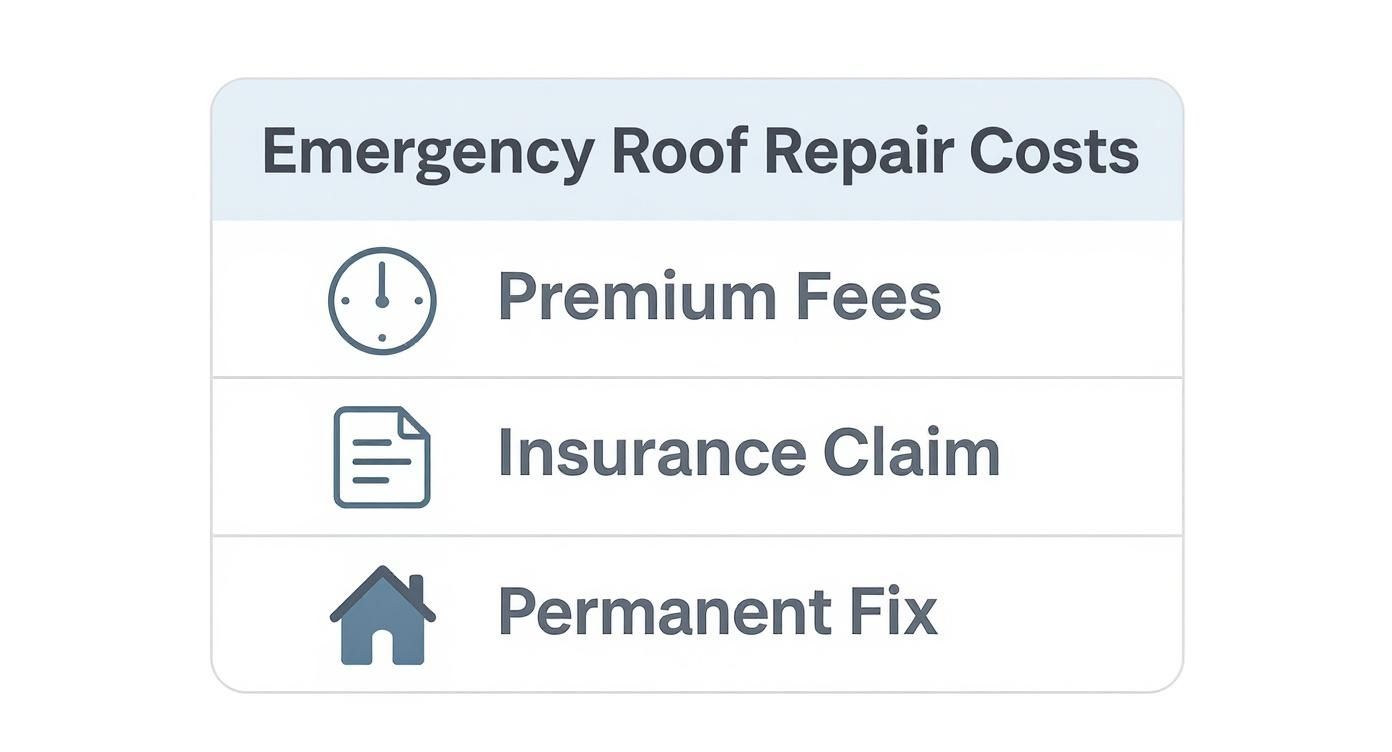
You can see how the costs shift, starting with the premium you pay to get help fast and moving to the real money for the permanent fix, which insurance often picks up.
From Proposal to Permanent Fix
After a real inspection, you'll get a proposal. It shouldn't be one lonely number on a page. It should lay out the repairs needed, the exact materials, and a line-by-line on the cost. Maybe it's a targeted fix in one spot. Or, if the damage is everywhere or the roof's just old, it might call for a full replacement. If you're staring down that decision, knowing what goes into a new roof in Tucson helps you make sense of it.
A good proposal is basically a map. By the time you finish reading it you shouldn't have a single question about what's getting done, how long it takes, or what it costs. That's how you decide with a clear head instead of a clenched jaw.
Once you give the go-ahead, the only thing left is putting it on the calendar. A good crew works with you to find a clear stretch of weather and gets the permanent fix done right, so you can finally stop staring at the ceiling every time it rains. One last thing: make sure the contract spells out warranties on both the materials and the labor.
Common Questions About Emergency Roof Repair
When a roof fails on you, the questions pile up about as fast as the water on your floor. Straight answers help you get a handle on it. So we rounded up the stuff people ask us most when they're frantically searching "emergency roof repair near me," and we'll answer it plainly, right here.
This goes past just slapping on a patch. It's about making good calls while you're stressed out of your mind. Knowing what's coming makes the whole mess a little easier to walk through.
How Can I Tell If My Roof Damage Is a True Emergency?
A real emergency is damage that's threatening your house's structure or your family's safety right now. We're not talking about a couple shingles missing after a windy afternoon. We're talking about damage that's actively getting worse and can't sit until Monday.
You've got a real one if any of this is going on:
- Serious water coming in: A steady leak that a few buckets can't keep up with. Water pouring in is an emergency, period.
- Structural trouble: A branch through the roof, or a ceiling or roofline you can actually see sagging.
- Big shingle loss: A whole section gone after a storm, leaving the underlayment bare and open.
Little drips or a small stain that isn't spreading? That can probably wait for a normal repair appointment. But if water's flooding in or the structure looks shaky, get a roofer out there now.
Will My Homeowners Insurance Cover an Emergency Repair?
Usually, yes. A standard homeowners policy is built to cover sudden, accidental damage, storms, high winds, fire, a tree coming down. That coverage almost always includes the temporary emergency work done to stop things from getting worse.
Here's something most folks don't know: your policy actually requires you to take reasonable steps to limit the damage. Getting a pro to tarp the roof isn't just smart. A lot of the time it's what keeps your claim valid.
What they won't pay for is neglect, like a slow drip you knew about for months and let go until it blew up. Once the house is secure, your next call is your insurance agent to get the claim rolling.
How Much More Does an Emergency Service Cost?
Plan on paying more for emergency work. That's not a roofer trying to fleece you. It's the real cost of getting a skilled crew to your house after hours, often in lousy weather. Figure on 1.5 to 2 times what a regular scheduled repair runs.
That extra goes toward a few real things:
- After-hours labor: Guys get paid more to work nights, weekends, and holidays. Fair's fair.
- Dropping everything: The call-out fee covers scrambling a crew and loading the truck at a moment's notice.
- The risk: Working a wet, busted roof mid-storm takes extra gear and extra care.
The bill stings more, but it's money well spent. That tarp keeps thousands of dollars of water out of your drywall, framing, insulation, even down to the foundation. Move fast and you save a fortune later.
When a storm hits, you need a local crew you can trust to show up fast. Sunrise Roofers LLC gets out fast to secure your home and stop the damage before it spreads further into your drywall and framing. Need help right now in the Tucson area? Reach us at https://roofwithsunrise.com.
Need roofing services in Tucson? Request a free inspection or call 520-753-1758. Related pages: Roof Repair · Roof Replacement · Service Areas.
Published by Sunrise Roofers LLC
Licensed & Insured Roofing Contractor · Tucson, AZ