Are Roof Leaks Covered by Homeowners Insurance?
By Sunrise Roofers LLC · Oct 24, 2025 · 14-22 min read

You hear it before you see it. That slow drip off the ceiling. And the first thing that runs through your head is a number, followed by the question every homeowner asks us: "Am I covered?"
Mostly, yeah. Roof leaks covered by homeowners insurance are common enough. But there's a catch, and it's a big one. It hangs entirely on why the thing is leaking. Your policy is there for the stuff you didn't see coming. It was never meant to bankroll an old roof you let go.
Sudden Damage vs. Gradual Decline
Your policy covers surprises. Hail punches holes in your shingles. A branch comes down in a monsoon and cracks the deck. That kind of thing is sudden and accidental, and it's exactly what you pay premiums for.
Now flip it. A slow leak that's been building for years where nobody could see it. A cracked tile or tired flashing that finally lets go after a long time fading in the sun. To an insurer, that's wear and tear. That's on you, the homeowner, and those claims get denied almost every time.
An adjuster has one question in the back of his mind the whole visit: could you have stopped this? Last week's windstorm tore your shingles off? Nope, nothing you could've done. A shingle that's been curled and cracked for five summers? Different story. You had time to fix that one.
How old your roof was and what kind of shape it was in before the damage hit? That's everything. A well-kept roof that took a storm gets approved far more often than a neglected old one that just gave out on its own.
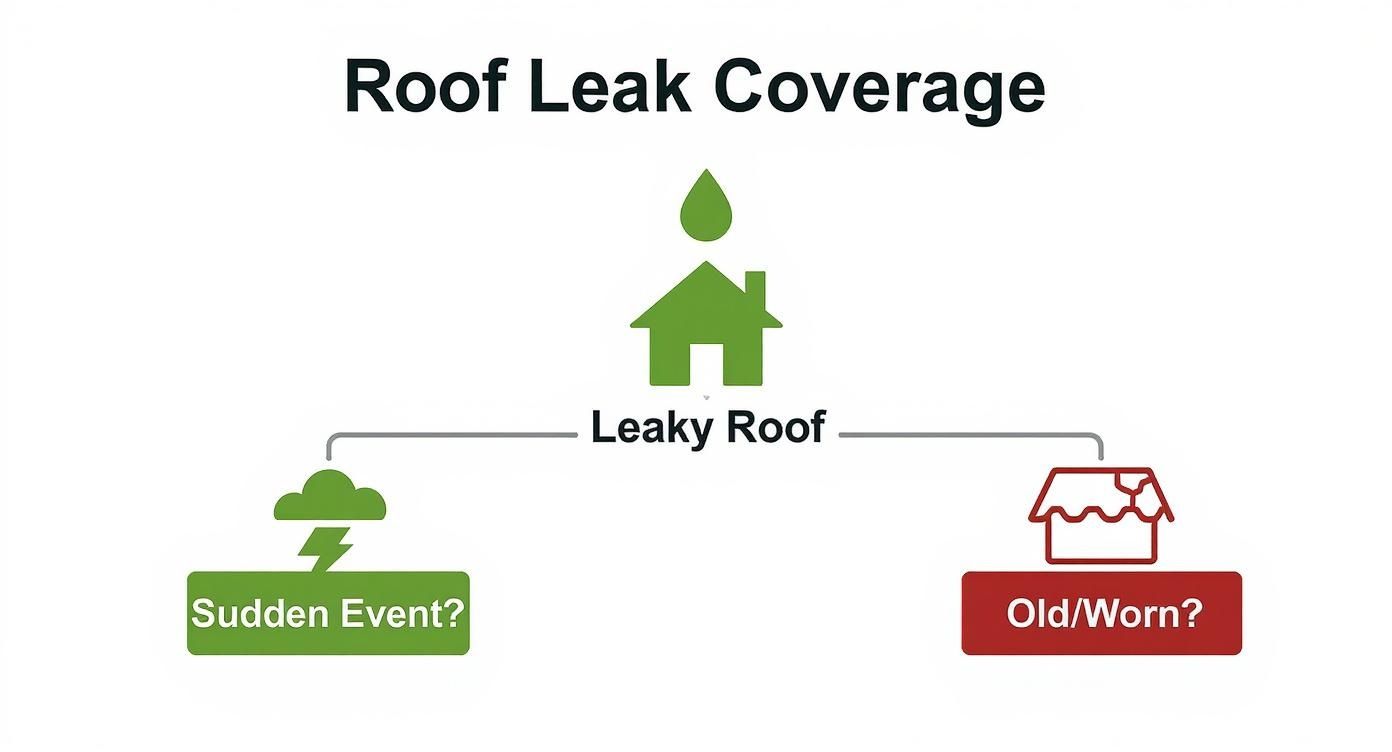
A paid claim starts with something unexpected happening. Leaks that trace back to age or a roof nobody looked after? Those come out of your own pocket, just about every time.
Proactive Care Is Your Best Policy
Here's the thing folks miss. The best move you can make for a future claim is regular upkeep. When an insurer pulls up a record of you maintaining the roof, that paper trail shows you held up your end.
Get a pro up there once a year. That gives you the documentation proving your roof was solid before anything went wrong. Want to stay ahead of trouble? Take a look at what a real roof inspection can turn up.
Roof Leak Coverage At a Glance
Here's the short version of what usually gets covered and what doesn't.
| Scenario | Typically Covered? | Reason |
|---|---|---|
| Shingles blown off by a windstorm | Yes | The damage was sudden, accidental, and caused by a covered peril (wind). |
| A tree branch falls and punctures the roof | Yes | Damage from falling objects is a standard covered peril in most policies. |
| Slow drip from old, cracked flashing | No | This is considered wear and tear, which is a homeowner maintenance issue. |
| Leak from deteriorated, sun-damaged shingles | No | Gradual decline due to age and sun exposure is excluded as it's not sudden. |
Insurance is built for disasters, not for the slow aging your house is going to do no matter what. So keeping the roof in shape does two jobs at once. It stops leaks, sure. It also keeps your policy on your side the day you actually need it.
When Your Insurance Policy Becomes Your Shield
Your policy isn't a maintenance plan. It guards your home against sudden hits you never saw coming. It does not patch up the slow falling-apart that comes with time. Every roof leak claim that ever got paid rests on four words: "sudden and accidental damage."
An insurer reading your claim wants a clean cause-and-effect story. A monsoon tears through Tucson and rips shingles right off your roof? Sudden, accidental, no argument. A drip from a tile that's been baking in the Arizona sun for five years? That's maintenance, and it's not getting paid.
Understanding Covered Perils
The specific events your policy protects you from are called covered perils. They're spelled out in your policy documents, and they're what flips the switch on your coverage. Most standard policies name the same usual suspects.
The covered perils that tend to cause roof leaks:
- Wind and Hail: Big one out here. High winds or hailstones banging into your roof is the textbook case of sudden, accidental damage.
- Falling Objects: A neighbor's limb, construction debris, whatever comes down on your roof out of nowhere. That damage usually gets covered.
- Fire: If fire gets into your roof structure, the leaks that follow are covered too, whether the water came from rain or the hoses that put it out.
- Weight of Ice or Snow: Not exactly our problem in Tucson. But heavy snow or ice load is a standard covered peril anyway.
When one of these hits, your policy steps up. The trick is proving the damage came straight from that peril and nothing else. That's where a real roofer earns his keep. We document the connection. We catch the faint signs of wind lift on shingles that somebody who doesn't do this for a living walks right past. That's a real part of the benefits of choosing a trusted Tucson roofer when a claim is on the line.
The Two-Part Coverage System
Here's a piece that trips up a lot of people: how the money actually comes out. When a covered peril causes a leak, your policy usually pays through two separate buckets.
First up is dwelling coverage (Coverage A). That handles the structure itself, the roof. It pays to fix the shingles, the underlayment, whatever roofing the storm tore up.
Say a windstorm peels off a 10x10 foot section of your roof. Your dwelling coverage pays to rebuild that patch with new, similar materials, minus your deductible.
Then there's personal property coverage (Coverage C). That one cleans up the mess the leak made inside. The water-stained ceiling, the wrecked drywall, the ruined carpet. It even pays you back for furniture or electronics the water killed.
Why does the split matter? Because you can land one without the other. An old roof that springs a leak on its own won't get repaired by your insurance. But plenty of policies will still cover the interior water damage it caused, because the water suddenly hitting your living room counts as a sudden event. Small distinction, big dollars. Read your own policy so you know which side you're on.
Understanding Common Policy Exclusions
Knowing what your policy covers is fine. Knowing what it won't touch is where you save yourself a world of grief. The exclusions are what blindside most homeowners and hand them a denied claim.
Think of the policy as a deal, not a magic shield. It covers the sudden disasters. In return, you keep the place up. The exclusions just draw a line between an accident and a problem you let simmer for years.
The Number One Reason for Denial: Lack of Maintenance
Far and away, the top reason a roof leak claim gets shot down is plain old wear and tear. People are shocked by it every time. Your roof has a shelf life, and the insurance company is counting on you to do basic upkeep along the way.
If your leak started because a 20-year-old shingle finally cracked and gave out, kiss that claim goodbye. The reason? Nothing about it was sudden or accidental. That's just how an old shingle ends. A policy isn't a home warranty. It won't pay for stuff that was always going to fail eventually.
The maintenance problems that get claims denied:
- Aged and Brittle Materials: Sun-baked, cracking shingles. Tiles that have been broken for months. Pipe flashing that's clearly been rotting for years. All of that is yours to keep up.
- Clogged Gutters: Classic one. Pack a gutter full of leaves and debris and water has nowhere to go but back up under the roof, where it rots things out. An insurer calls that 100% preventable.
- Unrepaired Minor Damage: A broken tile or two looks like nothing. Leave it alone and it becomes a much bigger leak later. Our guide gets into why fixing broken roof tiles is so important in Arizona, especially heading into monsoon season.
The insurer's logic is simple: a problem that took months or years to build means you had months or years to deal with it. A denial isn't them picking on you. It's the policy doing its one job, covering surprises and not slow rot.
Pest Damage and Slow-Growing Problems
Your policy is wired for fast threats like wind and hail. Slow ones, termites or mold, it mostly ignores. Pest damage, a squirrel chewing through decking or insects boring into wood, is almost always excluded. Keeping bugs and critters out is just part of owning a home.
Mold works the same way. If it crept in over time from humidity or a little drip you ignored, that's on you. But if a pipe bursts and mold grows as a direct result of that covered water damage, the cleanup is often covered. It always comes back to one question: sudden, or gradual?
The Critical Role of Roof Age
Roof age is huge. An older roof fails more, and insurers know it cold. It stands up worse to wind, hail, and sun, so it's a bigger risk on their books.
They're tightening up on age and condition, especially where storms hit hard. Records of regular inspections and upkeep on an older roof can help your case, but they're no guarantee. A 15-year-old roof that's been babied stands a far better chance than a 12-year-old one that got ignored.
Specific Events That Require Separate Coverage
Last thing. Every standard homeowners policy carves out the big catastrophes. Some disasters are so massive and widespread they need their own dedicated coverage.
- Flooding: Water from rising rivers, groundwater, or storm surge is never covered on a standard policy. You need a separate flood policy, which most folks pick up through the National Flood Insurance Program (NFIP).
- Earthquakes: Earth movement is out too. Quakes, sinkholes, any of it. That takes its own earthquake policy or a special add-on, what they call an endorsement, tacked onto what you've got.
Get your head around these exclusions and you've got your best shield against a denial. It steers you back to upkeep, which is the one thing you control, and the thing that keeps your insurance ready when a real disaster shows up.
Decoding Your Payout: Replacement Cost vs. Actual Cash Value
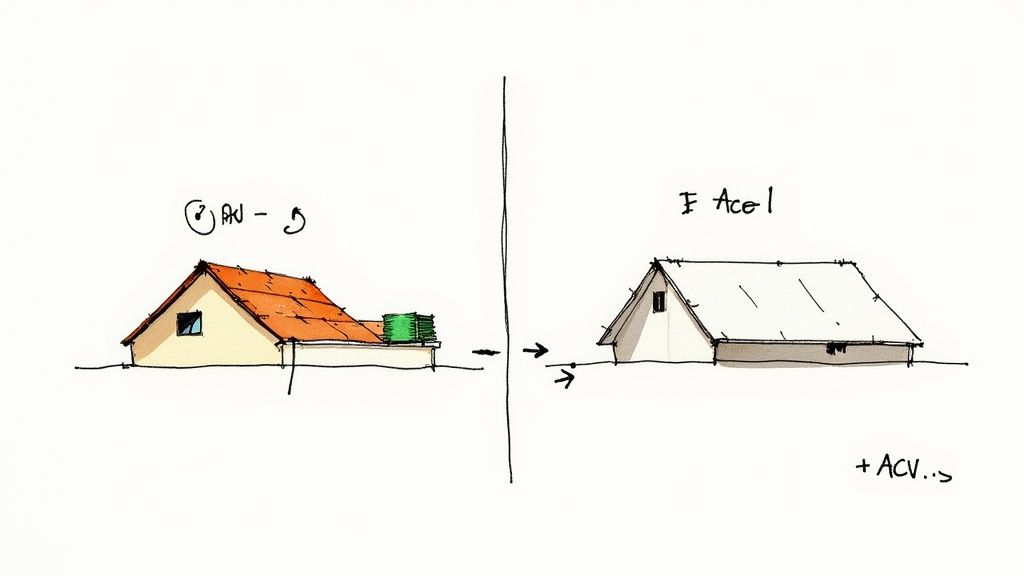
So the claim gets approved. Now the real question: how much do you actually walk away with? The answer hides behind two little acronyms in your policy. RCV (Replacement Cost Value) and ACV (Actual Cash Value).
Misread these two and you could be thousands of dollars short.
Picture a power surge frying your five-year-old laptop. An RCV policy hands you enough to buy a brand-new one at today's price. An ACV policy only pays what your beat-up five-year-old machine was worth the second before it died. That gap is enormous.
Your roof works the exact same way.
How Replacement Cost Value (RCV) Works
Replacement Cost Value is the one you want. It's meant to make you whole, paying to put your roof back with similar materials at today's labor and material prices. And here's the part that matters: it doesn't dock you for age or wear.
RCV usually pays in two checks. The first one covers the Actual Cash Value of the damaged roof. Once the work's done and you've got receipts, the insurer cuts a second check for the rest, what they call the "recoverable depreciation."
The Hard Reality of Actual Cash Value (ACV)
An Actual Cash Value policy pays to replace your roof minus depreciation. Depreciation is just a dressed-up word for the value your roof has shed over the years from age, sun, and ordinary wear. On an older roof that deduction can be brutal.
Run the numbers on a 15-year-old roof that was rated to last 25 years:
- Total Replacement Cost: Doing the repair right runs $15,000.
- Roof Lifespan Used: It's burned through 15 of its 25 years. That's 60% of its life gone.
- Depreciation Deduction: The insurer knocks off 60% of the replacement cost. $15,000 x 60% = $9,000.
- Your Payout (before deductible): $15,000 - $9,000 = $6,000.
So you're eating that $9,000 difference yourself, on top of your deductible. That right there is why you find out which policy you carry before the day you need it, not after.
The Industry is Shifting to ACV and Roof Payment Schedules
Something most homeowners never catch: your coverage may have already shifted under you. Insurers are pulling back hard from full replacement cost, especially on roofs with a few years on them.
Insurers are now commonly opting for Actual Cash Value (ACV) coverage or implementing roof payment schedules for aging roofs. For example, a new roof might be covered at 100%, but that coverage could drop to just 60% once it hits 10 years old.
It's a business call for them, a way to cap what they pay out on all these pricey roof claims. You can discover more insights about these insurance trends and see where this is all headed.
A roof payment schedule is even more blunt about it. It ties your payout percentage straight to how old your roof is. For folks out here, that makes planning a new roof in Tucson a longer-game decision. Only one way to know for sure: pull your declaration page and hunt down those three letters. RCV or ACV.
Your Action Plan for Filing a Roof Leak Claim

Finding a leak is chaos. Water dripping, your stomach dropping, no idea where to start. That's exactly when a plan saves you. It flips you out of panic and into action, which protects your home and sets up a clean claim.
Treat this as your playbook. Simple steps, in order, starting with the one that matters most: stopping the bleeding.
Step 1: Immediately Mitigate Further Damage
Before you ever pick up the phone to call your agent, stop the damage from spreading. No exceptions. Insurers expect you to take reasonable steps to protect the place, and doing it marks you as a homeowner who's on top of things.
That doesn't mean climbing up and fixing the roof yourself. It means smart, temporary moves.
- Move Your Belongings: Furniture, rugs, electronics, anything you'd hate to lose. Get it clear.
- Contain the Drip: Buckets and pans under the water. If the ceiling's bulging, a careful poke to relieve the pressure beats a full collapse.
- Tarp the Roof (If Safe): Storm's passed and you can get up there safely? A tarp over the damaged spot buys you time. Never climb up during a storm or in wind. It's not worth it.
Insurers call this your "duty to mitigate damages." Skip it and you hand them an opening to deny part of your claim, saying the extra damage was on you for not acting.
Step 2: Document Everything Meticulously
Your phone is the most valuable thing in your hand right now. Before you move a single item, start shooting photos and video. Build the case like a detective. More evidence is always better.
Go overboard with it. Shoot way more than you think you'll need, every angle you can get.
Your Documentation Checklist:
- Interior Damage: Video the water coming down. Photograph the stained ceilings and walls and anything of yours that got soaked.
- Exterior Roof Damage: From the ground, or somewhere safe, shoot the source if you can spot it. Missing shingles, hail marks, a downed limb.
- The Big Picture: Grab wide shots of the whole roof and around the house so there's context.
All that visual proof builds a timeline tying the leak to one specific event. That's the whole ballgame for showing your roof leaks covered by homeowners insurance came from something sudden and accidental.
Step 3: Contact Your Insurance Company Promptly
Leak contained, photos taken? Call your insurer. Don't sit on it. Most policies say you have to report claims in a "timely manner," and dragging your feet can sink the whole thing.
On the call, stick to facts. Clear, short, calm.
What to Say:
"Hi, I'm calling to report new damage to my home. A leak started in my living room during the storm on [Date]. I've taken steps to mitigate the damage and have photos."
What to Avoid:
Don't guess out loud. Skip the "my roof is really old" or "I think the flashing might be shot." Stay with what you actually know: an event happened, and now there's a leak.
Step 4: Prepare for the Adjuster and Get Quotes
Once you file, the insurer assigns an adjuster. His job is to look at the damage and pin down the cause and the cost. While you wait on him, don't just sit there. Call a couple of trusted local roofers and get their read.
That move does two things for you. A roofer's estimate gives you a real number for what the repair should run. And it hands you something to hold up against the adjuster's report.
Nearly 50% of all homeowners insurance claims come down to wind and hail, so a roofer who's been at it knows exactly what to look for. One who understands how the claim process actually works is worth having in your corner.
We'll give you a straight answer on your options, whether that's a patch or the whole roof. Around Tucson, getting a real opinion on your roof repair needs takes a load off during an already lousy week.
Frequently Asked Questions About Roof Leak Claims
The minute a roof starts leaking, the insurance questions come fast. Even folks who know the basics get tangled in the details. Here are straight answers to what we hear most from homeowners staring at a leak.
We'll hit the real stuff. Whether your premium jumps, what to do when they deny you, how you actually prove a storm caused it. The point is to leave you able to handle this without sweating it.
Will My Insurance Premium Go Up If I File a Claim?
The question everyone asks, and the honest answer is it depends. One claim, especially after a storm that hammered the whole neighborhood, probably won't move your rate much. Insurers see those coming.
What spooks them is a pattern. File two or three in three years and a flag goes up. Now your house looks like a risk, and that's when the premium climbs or a non-renewal letter shows up in the mail.
Run the math before you file. If a repair runs $1,800 and your deductible is $1,500, the insurer only owes you $300. Often you're better off paying it yourself, keeping your record clean and your future rate down.
What Should I Do If My Roof Leak Claim Is Denied?
A denial letter feels like the end. It isn't. It's the start of round two. First thing, read the letter slowly and find the exact reason they said no. Wear and tear? A specific exclusion? Not enough proof?
If you figure they blew the call, you can appeal, and you should.
- Get Your Evidence Together: Pull every photo and video, the inspection report from your roofer, and the local weather data from the day the storm came through.
- Write a Formal Appeal: Put together a clear, professional letter laying out why you disagree. Point right at the evidence that shows the damage came from a covered event.
- Bring in Backup: If the appeal stalls, your state's department of insurance can step in. Or hire a public adjuster. They work for you, not the insurer, and they go to bat for you.
Are Leaks From an Attic HVAC Unit Covered?
Common one, and tricky. It almost always rides on why it leaked. If something failed suddenly, a cracked drain pan or a supply line that let go, your policy will likely cover the water damage to ceiling, drywall, and floors.
What it usually won't cover is fixing or replacing the HVAC unit itself. That takes a special equipment breakdown endorsement. And if the leak traces back to neglect, like a clogged drain line you never flushed, expect them to deny the whole thing.
How Do I Prove a Storm Caused the Leak?
To get your roof leaks covered by homeowners insurance, you have to prove a storm was the direct cause. Your word won't cut it. You build a timeline backed by proof nobody can argue with.
Here's how:
- Immediate Photos and Video: Best evidence there is. The second it's safe, shoot everything, inside and out.
- Official Weather Reports: Pull a report from the National Weather Service confirming severe weather, high winds or a certain hail size, hit your address on that exact date.
- A Professional Roofer's Inspection Report: This one's big. A good roofer writes up a detailed report flagging storm-specific damage, creased shingles from wind, dents from hail. That third-party read connects the dots for the adjuster better than anything you can say yourself.
Navigating a roof leak claim can be complex, but you don't have to do it alone. For an honest assessment, expert repairs, and guidance through the insurance process in the Tucson area, trust the team at Sunrise Roofers LLC. Our experienced, owner-led professionals are committed to clear communication and quality craftsmanship to protect your home. Schedule your free, photo-documented inspection today by visiting https://roofwithsunrise.com.
Need roofing services in Tucson? Request a free inspection or call 520-753-1758. Related pages: Roof Repair · Roof Replacement · Service Areas.
Published by Sunrise Roofers LLC
Licensed & Insured Roofing Contractor · Tucson, AZ